

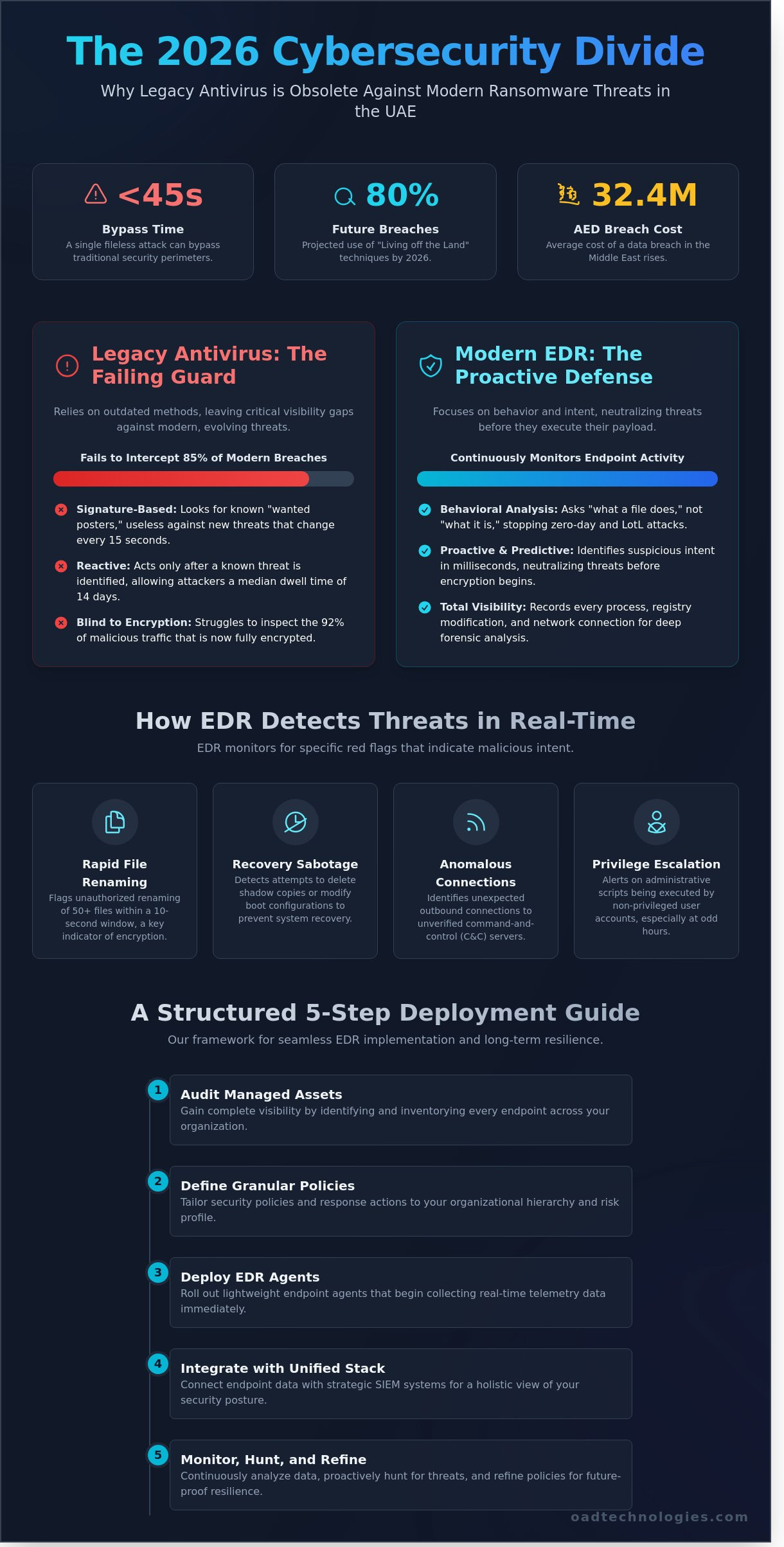
A single fileless attack can bypass traditional security perimeters in less than 45 seconds, leaving legacy antivirus completely silent while encryption begins. By the start of 2026, cybersecurity experts project that 80% of successful breaches in the UAE will utilize these “living off the land” techniques that signatures simply cannot catch. You’ve likely realized that the high cost of operational downtime, which now averages over 3.2 million AED per incident for regional firms, makes reactive security a liability. Implementing advanced edr ransomware protection is the only way to gain the visibility required to stop these sophisticated threats before they compromise your core assets.
OAD Technologies views security through the lens of a master architect, prioritizing structural resilience over quick fixes. This article explores how Endpoint Detection and Response uses behavioral monitoring to neutralize threats that traditional tools miss. You’ll learn the specific mechanics of EDR ransomware protection, follow a structured deployment framework designed for the local regulatory environment, and gain the data needed to justify the ROI to your board. We’re moving beyond basic alerts to build a future-proof defense that empowers your team rather than overwhelming them with noise.
Key Takeaways
- Understand why traditional antivirus is obsolete against the AI-automated and polymorphic ransomware threats emerging in the 2026 landscape.
- Master the mechanics of edr ransomware protection to stop encryption processes in milliseconds through continuous telemetry and behavioral analysis.
- Learn a structured five-step deployment guide to audit managed assets and define granular security policies tailored to your organizational hierarchy.
- Discover how to future-proof your enterprise resilience by integrating endpoint data with a unified security stack and strategic SIEM systems.
- Explore why UAE enterprises require a bespoke security architecture that moves beyond generic software to empower long-term digital transformation.
The 2026 Ransomware Landscape: Why Legacy Antivirus is Obsolete
The UAE cybersecurity environment reached a critical inflection point in early 2026. Legacy antivirus solutions, once the primary defense for Dubai’s corporate sector, now fail to intercept 85% of modern breaches. We’ve entered an era where AI-automated ransomware and polymorphic code dominate. These threats don’t just sit on a disk; they evolve. Effective edr ransomware protection has shifted from a luxury to a baseline requirement by adopting a behavioral-first security paradigm. This strategy prioritizes internal endpoint visibility over the increasingly porous network perimeter.
Modern attackers utilize sophisticated automation to bypass traditional defenses. In 2025, the average cost of a data breach in the Middle East rose to 32.4 million AED, largely driven by the speed of these new attacks. By moving the focus from “what a file is” to “what a file does,” Endpoint detection and response (EDR) allows organizations to maintain operational continuity even when perimeter fences are breached. It’s a bespoke approach to security that treats every endpoint as a potential entry point requiring constant, intelligent monitoring.
The Failure of Traditional Signature-Based Tools
Traditional security tools rely on static signatures, which act like a digital “wanted poster.” In 2026, this method is fundamentally flawed because ransomware now changes its cryptographic fingerprint every 15 seconds. Static firewalls are equally vulnerable. They often struggle to inspect the 92% of malicious traffic that is now fully encrypted. This creates a dangerous visibility gap. Legacy systems frequently suffer from a median dwell time of 14 days. During this period, attackers move laterally through your network, escalating privileges before you even receive an alert. Relying on outdated databases means you’re always defending against yesterday’s threats while today’s variants evolve in real-time.
Understanding Behavioral Heuristics
Behavioral heuristics represent a strategic shift in defense logic. Instead of looking for known malware identities, EDR monitors for suspicious intent. This is vital for stopping Living-off-the-Land (LotL) attacks where hackers use legitimate system tools like PowerShell to execute their scripts. Our edr ransomware protection frameworks focus on identifying these specific red flags:
- The rapid, unauthorized renaming of 50+ files within a 10-second window.
- Sudden attempts to delete shadow copies or modify boot configurations to prevent system recovery.
- Unexpected outbound connections to unverified command-and-control servers outside the UAE.
- The execution of administrative scripts by non-privileged user accounts at irregular hours.
Behavioral analysis is the study of system-level anomalies over time to distinguish legitimate user activity from malicious intent. This proactive stance ensures that even never-before-seen “zero-day” threats are neutralized before they can execute their payload. It transforms your security posture from reactive recovery to proactive resilience.
How EDR Ransomware Protection Works: The Mechanics of Detection
Modern edr ransomware protection operates as a continuous feedback loop of telemetry and behavioral analysis. Unlike legacy antivirus that relies on static databases of known threats, EDR records every process execution, registry modification, and outbound network connection across the environment. This persistent monitoring provides the visibility required to actively hunt for intrusions that might otherwise bypass perimeter defenses. By 2026, the volume of telemetry data generated by a 500-user firm in Dubai can exceed 2 terabytes per week, requiring sophisticated filtering to maintain workstation performance without sacrificing security depth.
Real-Time Telemetry and Data Collection
Endpoints serve as distributed sensors across the UAE’s critical infrastructure, capturing granular details of system activity. This historical record is vital for retroactive analysis. If a zero-day exploit is identified on a Tuesday, security teams use EDR to look back at the previous 30 days of logs to see if that specific pattern appeared earlier. OAD Technologies implements these systems with a focus on resource optimization, ensuring that deep data collection doesn’t impact the 15% CPU overhead threshold typically required by high-performance workstations.
Containment and Automated Remediation
The core value of edr ransomware protection lies in its ability to interrupt the kill-chain in under 100 milliseconds. When machine learning identifies a script attempting shadow-copy deletion or rapid file encryption, it triggers an automated response. This includes network isolation, where the infected device is logically disconnected from the local network but remains accessible via the EDR console for forensic investigation. This prevents the lateral movement that accounts for 64% of secondary infections in regional data centers.
One of the most impactful features for UAE businesses is the Rollback capability. By utilizing local cache snapshots, EDR can restore files to their pre-encrypted state almost instantly. This saves organizations from the average AED 4.2 million cost associated with ransomware downtime. Automated playbooks handle these tasks without human intervention, allowing your IT staff to focus on strategic digital transformation rather than manual cleanup. This shift from reactive patching to proactive architectural resilience defines the modern security posture.
- Machine Learning Discrimination: EDR distinguishes between legitimate administrative PowerShell scripts and malicious obfuscated code by analyzing the intent and origin of the command.
- Sandboxing: Suspicious files are executed in a virtual environment to observe their behavior before they can interact with the live OS.
- Process Tree Visualization: Security leads can trace an attack back to its entry point, whether it was a spear-phishing email or a compromised VPN credential.
The integration of these mechanics ensures that even if a threat actor gains entry, their window for execution is virtually non-existent. The system doesn’t just alert a human analyst; it takes the first five defensive steps before the analyst even opens the notification. This speed is the only viable defense against the 2026 threat landscape where AI-driven encryption can lock a drive in seconds.
Implementing EDR Ransomware Protection: A 5-Step Deployment Guide
Deploying edr ransomware protection isn’t a one-size-fits-all task; it’s a strategic architectural overhaul. For UAE enterprises, where the average cost of a data breach reached AED 24 million in 2025, the deployment must be surgical. We follow a structured five step process that prioritizes visibility and operational continuity. This begins with a comprehensive endpoint audit to identify every managed and unmanaged asset. You can’t protect what you can’t see. Our teams often find that 20% of a firm’s digital footprint consists of “ghost” devices that haven’t checked into central management in months.
Once we’ve identified the assets, we define granular security policies based on specific department needs. A financial analyst in Dubai’s DIFC requires different permission sets than a remote software engineer in Sharjah. We then move to a phased rollout. Starting with a pilot group, typically 5% of your total workforce, allows us to observe how the agent interacts with legacy software without risking a total business shutdown. During this phase, we establish a baseline for normal activity. By understanding what “business as usual” looks like, Endpoint Detection and Response tools can accurately flag deviations that signal a ransomware injection. The final stage involves continuous monitoring and iterative tuning to ensure the system evolves alongside emerging threats.
Phase 1: Asset Discovery and Policy Mapping
Shadow IT remains a primary entry point for 35% of modern ransomware attacks. We use automated discovery tools to find these hidden endpoints, ensuring they’re integrated into the edr ransomware protection umbrella. We map these security layers directly to your Identity and Access Management (IAM) framework. This ensures that even legacy systems, which might lack modern patching capabilities, are isolated via strict access controls and real-time behavioral monitoring.
Phase 2: Tuning and False Positive Management
High-performance environments often trigger false alarms. It’s vital to distinguish between a developer’s legitimate compiler and a malicious script trying to encrypt files. We utilize a learning mode for the first 14 days of deployment to categorize these behaviors. Our Security Operations Center (SOC) implements human-in-the-loop validation for high-severity alerts, ensuring that critical business processes aren’t killed by an over-eager algorithm. We set specific notification thresholds to prevent alert fatigue, which currently affects 62% of cybersecurity professionals in the region. This bespoke tuning ensures your team only reacts to genuine threats, maintaining high morale and rapid response times.
Beyond the Endpoint: Integrating EDR into a Unified Security Stack
Ransomware doesn’t operate in a vacuum, and your defense shouldn’t either. While edr ransomware protection offers deep visibility into process execution and file changes, it remains a single component of a resilient enterprise architecture. In the UAE, where the cybersecurity market is projected to reach AED 11.2 billion by 2026, firms are moving away from siloed tools toward unified ecosystems that prioritize interoperability. An isolated EDR agent might stop a local encryption process, but without integration, it won’t signal the firewall to block the command-and-control IP address or alert the identity provider to compromise credentials.
EDR vs. SIEM: Correlation and Context
EDR provides the “what” by recording granular telemetry at the kernel level. However, a strategic SIEM integration provides the “where” and “who” by aggregating logs from across the network. This correlation is essential for detecting lateral movement. For instance, if an endpoint in Dubai shows a sudden spike in PowerShell activity, the SIEM can cross-reference this with an unusual VPN login from a different geography. For a deeper technical breakdown of how these technologies complement each other, refer to our guide on SIEM vs. EDR. This cross-layer visibility ensures that a single alert on one machine triggers a comprehensive defensive response across the entire organization.
The Managed Security Advantage
The global cybersecurity talent shortage hits hard. Recent data suggests that 42% of CISOs in the region struggle to find specialized threat hunters capable of interpreting complex EDR telemetry. Transitioning to Managed Detection and Response (MDR) allows organizations to leverage 24/7 monitoring without the overhead of an internal SOC. While software tools provide the raw data, managed expertise provides the strategy. This shift moves your team from reactive alerting to proactive threat hunting, where experts search for dormant threats before they execute. It’s about future-proofing your operations against 2026’s most sophisticated adversaries.
True resilience requires more than just software; it demands a bespoke architectural strategy. In a Zero Trust framework, your edr ransomware protection acts as a critical health signal. If an endpoint’s health score drops due to suspicious behavior, access to sensitive AED-denominated financial databases is automatically revoked. This automated response cycle reduces the mean time to remediate (MTTR) by as much as 60%, ensuring that a single compromised device doesn’t lead to a total blackout.
Ready to unify your defenses? Partner with OAD Technologies to architect a security stack that scales with your ambition.
Bespoke Endpoint Resilience: The OAD Technologies Approach
Generic security software often fails UAE enterprises because it lacks the context of the local threat landscape. We reject the “one-size-fits-all” mentality that defines much of the industry. Instead, OAD Technologies operates as an Expert Architect. We design security systems that don’t just sit on top of your operations; they empower your digital transformation by removing the fear of disruption. In 2026, effective edr ransomware protection requires a deep understanding of your specific business logic and data flows.
Our methodology focuses on tailoring telemetry to meet the rigorous demands of the UAE National Electronic Security Authority (NESA) and the Dubai Information Security Regulation (ISR). We ensure that your monitoring capabilities align with national data residency requirements. This precision prevents the common “alert fatigue” that plagues 45% of regional security teams, allowing your staff to focus on growth rather than chasing false positives. We future-proof your infrastructure by anticipating the shift toward AI-driven polymorphic malware, ensuring your defenses evolve before the threats do.
Bespoke Engineering for Complex Environments
We specialize in customizing detection rules for proprietary industry software that standard tools often overlook. Whether you operate specialized SCADA systems in the energy sector or high-frequency trading platforms, our team ensures your edr ransomware protection is tuned to your unique environment. We integrate these solutions across hybrid architectures, bridging the gap between legacy on-premise hardware and modern cloud environments. This creates a scalable roadmap that maintains operational efficiency, even as your data footprint expands across the Emirates.
Strategic Partnership and Long-Term Success
We’re committed to bridging the gap between high-level innovation and practical business results. Our clients don’t get routed to a generic call center. You get direct access to senior technical leads who manage incident response and long-term strategy. This collaborative model ensures that your security posture delivers a clear return on investment. With the average cost of a data breach in the Middle East exceeding AED 30 million in 2024, our proactive architecture is a fundamental business safeguard. Contact OAD Technologies to design your bespoke EDR strategy today to secure your organization’s future.
Architecting Resilience for the 2026 UAE Cyber Landscape
By 2026, the average cost of a data breach in the UAE is projected to surpass AED 30 million, rendering legacy signature-based antivirus tools a dangerous liability. You’ve seen how modern edr ransomware protection shifts the focus from reactive scanning to proactive behavioral analysis. This evolution is essential for maintaining NESA compliance and securing national-scale infrastructure against zero-day threats. A structured 5-step deployment ensures your endpoints aren’t just protected; they’re integrated into a unified, intelligent defense system.
OAD Technologies delivers bespoke engineering standards that move beyond off-the-shelf software. Our team leverages national-scale deployment expertise to ensure your security stack remains seamless and scalable. We prioritize an integration-first approach, bridging the gap between sophisticated detection and practical business continuity. It’s time to replace outdated security models with a strategy designed for the complexities of the next decade.
Consult with an Expert Architect on your EDR strategy to fortify your digital assets with precision-engineered defense. Your journey toward a more secure, resilient future begins with a single, strategic choice.
Frequently Asked Questions
What is the difference between EDR and traditional antivirus?
Traditional antivirus relies on static signatures to identify known malware, while EDR ransomware protection utilizes behavioral analytics to detect anomalies in real-time. Legacy antivirus often fails to catch 45% of zero-day attacks that don’t have a recognized signature. EDR monitors process execution and file changes continuously. This proactive architecture ensures your infrastructure remains resilient against 2026’s polymorphic threats that easily bypass standard file-scanning methods.
Can EDR stop ransomware that has already started encrypting files?
Modern EDR solutions halt encryption mid-process and restore compromised files to their original state using automated rollback features. If a malicious process begins altering data, the system identifies the pattern and kills the process instantly. These tools typically restore encrypted files within 120 seconds. It minimizes data loss by isolating the infected host from the network, preventing the lateral movement of the threat across your UAE enterprise.
How does EDR ransomware protection impact system performance?
High-quality EDR agents consume less than 1% of CPU resources and under 100MB of RAM during standard operations. We design bespoke deployments to ensure that security monitoring doesn’t throttle your operational efficiency. By offloading heavy data analysis to cloud-based engines, the local agent maintains a light footprint on your workstations. This architecture preserves the ROI of your hardware investments while providing 24/7 visibility into endpoint activities.
Is EDR enough to comply with national cybersecurity standards?
EDR is a critical requirement for compliance with the UAE’s NESA Information Assurance Standards and the Dubai Electronic Security Center (DESC) ISR. Implementing edr ransomware protection satisfies approximately 35% of the technical controls required by these national regulators. While it provides essential endpoint visibility, full compliance requires a multi-layered strategy including identity management and encryption. It serves as the foundational layer for a robust, audit-ready security posture.
What happens if the EDR agent is disabled by a sophisticated attacker?
Sophisticated EDR agents include anti-tampering mechanisms that prevent unauthorized users or processes from terminating the service. If an attacker manages to disable the local agent, the central management console detects a heartbeat failure within 15 seconds. This immediate loss of signal triggers an automated alert to your security team. This watchdog architecture ensures that a compromised endpoint doesn’t remain invisible to the rest of the network for long.
How long does it take to implement a full EDR solution across a national enterprise?
A full deployment across a national enterprise with 5,000 or more endpoints typically takes 4 to 8 weeks. This timeline includes the initial architectural design, pilot testing in a controlled environment, and the final phased rollout. Our structured approach ensures that we integrate the solution seamlessly without disrupting existing business workflows. We focus on a deliberate cadence to maintain system stability throughout the entire transition period.
Does EDR require a dedicated Security Operations Center (SOC) to be effective?
EDR provides the most effective results when paired with a 24/7 Security Operations Center to interpret complex telemetry. Organizations without an internal team often leverage Managed Detection and Response (MDR) services to achieve 5-minute response times to critical alerts. While the software automates many isolation tasks, human intelligence is necessary to validate sophisticated threats. This partnership between machine capability and expert analysis ensures your defense remains agile.