

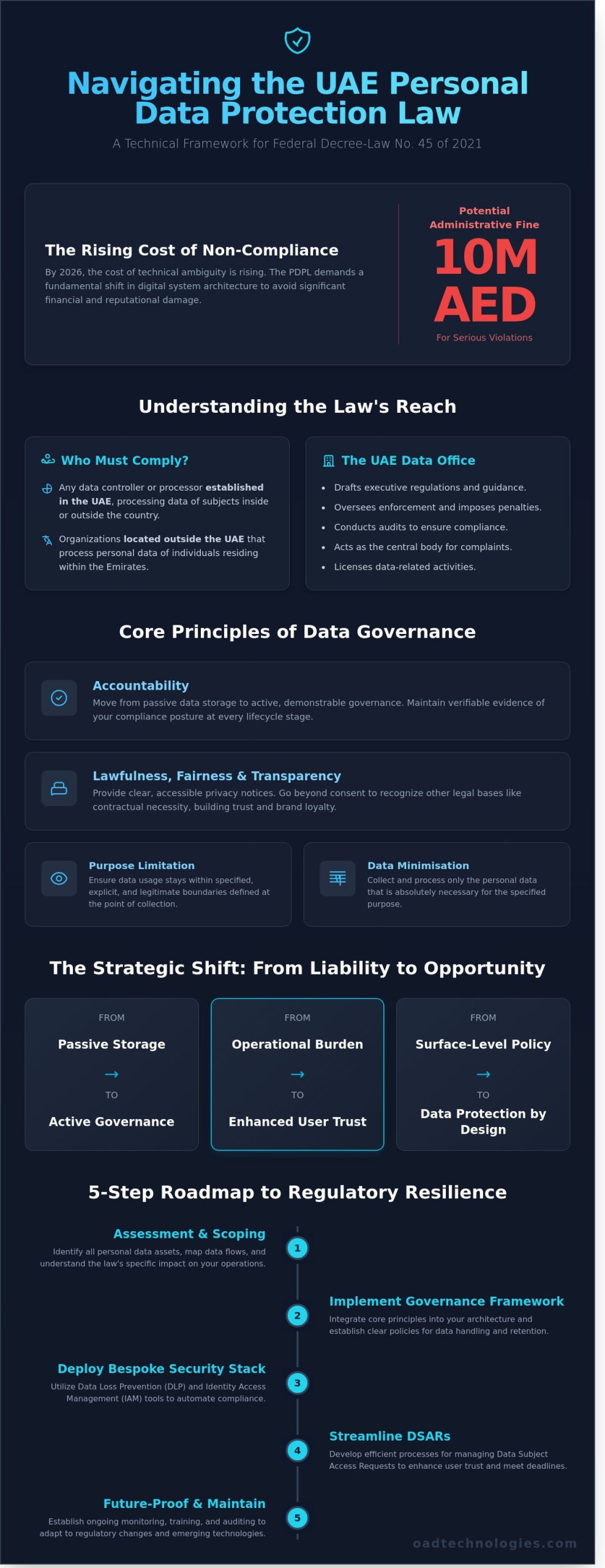
What if the very data fueling your growth is actually a hidden liability waiting for a 10 million AED administrative fine? As we approach 2026, the cost of technical ambiguity is rising, and the uae personal data protection law demands more than just a surface-level policy update. Most technology leaders recognize that Federal Decree-Law No. 45 of 2021 isn’t just a legal hurdle; it’s a fundamental shift in how we must architect digital systems. You’ve likely felt the frustration of vague implementation requirements while trying to manage complex cross-border data transfers within a global business model.
We’re here to bridge that gap by helping you master these regulatory complexities through a precise, technical framework. You’ll learn how to implement a bespoke integration strategy that aligns your infrastructure with national standards while protecting your strategic growth. This guide provides a clear roadmap for deploying Data Loss Prevention and Identity Access Management tools, ensuring your governance risk and compliance (GRC) strategy remains resilient. We’ll examine the specific scope of the PDPL and provide the engineering milestones needed to future-proof your digital ecosystem for the years ahead.
Key Takeaways
- Gain a sophisticated understanding of Federal Decree-Law No. 45 of 2021 and its strategic role in balancing digital innovation with individual privacy rights.
- Transition from passive storage to active governance by implementing a technical framework that ensures seamless alignment with the uae personal data protection law.
- Transform the operational burden of Data Subject Access Requests (DSARs) into a strategic opportunity to enhance user trust and brand loyalty.
- Deploy a bespoke security stack built on “Data Protection by Design” principles to automate compliance and safeguard your digital infrastructure.
- Follow an expert-led 5-step roadmap to mitigate the risk of administrative fines and future-proof your organization’s regulatory resilience for 2026.
Understanding the UAE Personal Data Protection Law (Federal Decree-Law No. 45 of 2021)
The uae personal data protection law, promulgated as Federal Decree-Law No. 45 of 2021, constitutes the first comprehensive federal framework designed to regulate the processing of personal data across the United Arab Emirates. It isn’t just a regulatory hurdle. It’s a strategic pillar of the UAE’s "Projects of the 50" initiative. This law establishes a unified standard for data privacy, ensuring that as the nation accelerates its digital transformation, the rights of individuals remain protected. By 2026, the maturity of this framework has transformed how organizations view data. It’s no longer just an operational byproduct but a high-value asset that requires rigorous governance.
The strategic intent behind the legislation is a sophisticated balance. The government aims to foster an environment where digital innovation thrives while maintaining world-class privacy standards. This approach mirrors global benchmarks like the GDPR but adds a bespoke layer tailored to the UAE’s unique economic ecosystem. For businesses, compliance is a prerequisite for long-term scalability and building trust within a competitive market.
Territorial and Material Scope of the Law
The law’s reach is expansive. It applies to any data controller or processor established in the UAE that processes personal data of subjects inside or outside the country. Crucially, it features extraterritorial reach. Organizations located outside the UAE that process the data of individuals residing within the Emirates must also adhere to these standards.
While certain sectors like health and credit data have specific regulations, and financial free zones such as the Dubai International Financial Centre (DIFC) and Abu Dhabi Global Market (ADGM) maintain their own independent regimes, the federal law provides the baseline. By 2026, we’ve seen a strategic alignment where free zone authorities and federal regulators work in tandem to ensure a seamless compliance landscape for multi-jurisdictional entities.
The Role of the UAE Data Office
The UAE Data Office acts as the primary regulatory architect. Established under Decree-Law No. 44 of 2021, its mandate includes drafting executive regulations, licensing data-related activities, and overseeing the law’s enforcement. It’s the central body for filing complaints and has the power to conduct audits and impose administrative penalties.
By 2026, the Office has issued detailed guidance on technical requirements for data anonymization and cross-border transfers. Their role has evolved from purely legislative to a collaborative partner for the private sector. They provide the roadmap for organizations to transition from basic compliance to advanced data stewardship. This oversight ensures that the uae personal data protection law remains a living document, capable of adapting to emerging technologies like decentralized AI and advanced cloud architectures.
Core Principles of Data Processing and Governance
Compliance with the uae personal data protection law requires a fundamental transition from passive storage to active governance. In the 2026 digital economy, data isn’t a static asset to be hoarded; it’s a dynamic liability if mismanaged. The overarching principle of Accountability demands that UAE enterprises don’t just follow the rules but maintain verifiable evidence of their compliance posture at every lifecycle stage. This structural shift directly influences the ROI of digital transformation projects. By integrating governance into the system architecture, firms reduce the risk of regulatory fines that can reach millions of AED and simultaneously streamline their operational workflows for better performance.
Lawfulness, Fairness, and Transparency
Organizations must provide clear, accessible privacy notices that explain data usage without technical obfuscation. While consent remains a vital pillar, the law recognizes other legal bases such as contractual necessity or legitimate interest. Transparency serves as a cornerstone for brand protection. A 2024 study indicated that 78% of UAE consumers are more likely to engage with brands that demonstrate clear data handling practices. It’s about building a relationship where the data subject understands the value exchange and feels secure in their digital interactions.
Purpose Limitation and Data Minimisation
Purpose limitation ensures data usage stays within specified, explicit boundaries defined at the point of collection. Data minimisation requires technical rigor to ensure only the strictly necessary data enters the system. Implementing a robust Data Loss Prevention (DLP) framework helps teams identify redundant, obsolete, or trivial (ROT) data. This prevents the “data swamp” effect and significantly lowers storage overheads while shrinking the attack surface for potential breaches.
Accuracy and Storage Limitation
The uae personal data protection law mandates that personal data stays accurate and up-to-date. This presents a technical hurdle when managing the “Right to be Forgotten” across fragmented legacy systems. Bespoke retention schedules are no longer optional. Enterprises should categorize data based on specific legal requirements, such as the 10-year retention rule for certain financial records under UAE Commercial Law, while ensuring secure destruction of marketing leads after 24 months of inactivity. OAD Technologies helps firms architect these automated lifecycles to ensure long-term resilience and regulatory alignment.
Empowering the Data Subject: Rights and Obligations
Viewing data subject rights as a mere regulatory hurdle misses the strategic potential for brand differentiation. Under the uae personal data protection law, providing individuals with control over their information serves as a powerful trust signal. Organizations that treat transparency as a feature rather than a chore build deeper user loyalty. However, the operational reality is demanding. Manually processing a single Data Subject Access Request (DSAR) can cost a UAE enterprise between AED 4,500 and AED 7,200 in administrative overhead. Scalability requires shifting away from manual spreadsheets toward automated workflows that can verify identities and aggregate data across fragmented silos in real-time.
The law provides heightened protections for “Sensitive Personal Data.” This category includes biometric data, health records, and genetic information. Processing these identifiers requires stringent security protocols and, in many cases, a mandatory Data Protection Impact Assessment (DPIA). OAD Technologies helps firms architect “privacy by design” frameworks that isolate sensitive datasets, ensuring they meet the high-threshold requirements set for the 2026 enforcement cycle.
Right to Access, Correction, and Portability
Data subjects can demand a copy of their personal data in a structured, machine-readable format. The Right to Portability is particularly disruptive for service providers because it facilitates seamless transitions between competitors. By the January 2026 deadline, firms must establish clear verification protocols to prevent data leaks during the transfer process. We recommend implementing self-service portals that allow users to download their data securely, reducing the burden on internal legal teams.
Right to Erasure and Restriction of Processing
The “Right to be Forgotten” allows individuals to request data deletion when processing is no longer necessary. While deleting a record from a primary database is straightforward, purging information from legacy backups and cold storage remains a significant technical challenge for 65% of regional firms. Restriction of processing acts as a vital middle ground. It allows companies to “freeze” data during legal disputes without fully deleting it, ensuring compliance while protecting the firm’s legal interests.
Automated Processing and Profiling Rights
The uae personal data protection law grants subjects the right to object to decisions based solely on automated processing or AI profiling. If an algorithm denies a credit application or filters a job candidate, the individual can demand human intervention. OAD Technologies advocates for a “human-in-the-loop” architecture. Our approach combines machine capability with human intelligence, ensuring that AI-driven decisions remain explainable, ethical, and compliant with the specific mandates of the PDPL.
Technical Compliance: Implementing a Bespoke Security Framework
Legal compliance is a hollow exercise without a sophisticated technical security stack to enforce it. The uae personal data protection law demands more than just policy documents; it requires a proactive architecture where privacy is a foundational element. This “Data Protection by Design and Default” mandate means your systems must automatically protect user privacy without requiring manual intervention. We see this most clearly in the intersection of privacy and Identity and Access Management (IAM). Without a strategic IAM framework, you can’t guarantee that access to UAE resident data is restricted to the absolute minimum necessary personnel. Security tools shouldn’t exist in a vacuum. They must integrate seamlessly into business workflows to prevent employees from seeking risky workarounds that compromise the entire compliance posture.
Data Loss Prevention (DLP) as a Compliance Engine
DLP provides the granular visibility required to map personal data flows across your entire enterprise. By 2026, we expect 85% of high-growth UAE firms to utilize automated classification to manage the exponential growth of unstructured data. These systems identify sensitive resident information, such as Emirates ID numbers or health records, and apply protective labels automatically. DLP prevents unauthorized cross-border transfers by blocking any data movement to jurisdictions that fail to meet the PDPL’s adequacy standards.
Managed Detection and Response (MDR) for Breach Prevention
Real-time monitoring isn’t optional; it’s a core security obligation under the federal law. MDR services provide the “Expert Architect” oversight needed to detect subtle, multi-stage threats that automated software often misses. By utilizing Endpoint Detection and Response (EDR) and SIEM technologies, organizations create an immutable audit trail. This forensic record is essential during a regulatory inquiry to prove that your organization took every reasonable step to prevent a breach.
Cloud Security and CSPM Alignment
Multi-cloud environments introduce significant risks regarding data residency and sovereign control. Cloud Security Posture Management (CSPM) ensures your cloud configurations meet specific UAE standards, closing the gaps that lead to accidental exposure. A bespoke approach is vital here. You can’t rely on “out-of-the-box” settings for SaaS and IaaS platforms when the local legal landscape is so specific. Misconfigurations currently account for over 40% of data exposures in the region, often resulting in penalties that can reach millions of AED.
Ready to harden your infrastructure against evolving regulatory risks? Partner with OAD Technologies to build a compliant, future-proof security stack.
Strategic Roadmap: Navigating Enforcement and Future-Proofing
Non-compliance with the uae personal data protection law carries risks that extend far beyond administrative fines. While the UAE Data Office hasn’t yet published a definitive list of penalties, industry benchmarks suggest that serious violations could result in fines reaching millions of dirhams (AED). Beyond the immediate financial impact, the loss of consumer trust represents a catastrophic cost that often exceeds the fine itself. OAD Technologies positions compliance as a strategic shield, protecting your brand equity and operational continuity.
To achieve alignment by 2026, your organization needs a structured, five-step roadmap:
- Data Mapping: Identify where every byte of personal data resides within your ecosystem.
- Gap Assessment: Evaluate current processing activities against Federal Decree-Law No. 45 of 2021.
- DPO Appointment: Designate a Data Protection Officer to oversee internal compliance and act as the primary liaison with the UAE Data Office.
- Control Implementation: Deploy technical measures like end-to-end encryption and multi-factor authentication.
- Continuous Auditing: Establish a cycle of regular reviews to ensure controls remain effective as your technology stack evolves.
The DPO role is the heartbeat of this roadmap. This individual doesn’t just manage logs; they serve as the bridge between technical execution and board-level reporting. They translate complex legal requirements into actionable business logic, ensuring that privacy is “baked in” to every new product or service you launch.
Breach Notification and Incident Response
The UAE Data Office mandates immediate notification for breaches that threaten the privacy or security of data subjects. However, you can’t notify the authorities if you can’t detect the incident. Organizations must prioritize “detection capability” before “notification capability.” Implementing automated incident response systems can reduce the hidden costs of a breach by up to 35%, as these tools slash the time between compromise and containment. Speed is your greatest ally in maintaining regulatory favor and minimizing damage.
Building an Effective GRC Framework
Modern compliance is too complex for manual spreadsheets. Leveraging compliance reporting automation simplifies the audit process by providing a single source of truth for all regulatory requirements. This automation should be paired with bi-annual VAPT (Vulnerability Assessment and Penetration Testing) to verify that your security controls are robust. A “living” governance risk and compliance strategy is essential; it must evolve as the UAE Data Office issues new circulars or guidelines throughout 2026.
Conclusion: Compliance as a Strategic Partnership
Standardized compliance kits often fail because they ignore the nuances of your specific data architecture. A tailored approach is the only way to ensure long-term resilience. OAD Technologies acts as your Expert Architect, crafting bespoke security frameworks that align with the uae personal data protection law while driving business growth. We don’t just help you meet the law; we help you lead with it.
Future-Proofing Your Enterprise for 2026 and Beyond
The implementation of Federal Decree-Law No. 45 of 2021 signals a new era for the Emirates’ digital economy. Organizations that prioritize technical compliance today will secure a significant competitive advantage by 2026. This journey requires a structured approach to data governance, moving beyond basic privacy policies to robust, automated enforcement. You’ll need to integrate enterprise-grade DLP and MDR solutions that are specifically tailored for national resilience and local data sovereignty requirements. Strategic security assessments and rigorous VAPT protocols aren’t just technical hurdles; they’re the building blocks of a trusted brand.
Achieving full alignment with the uae personal data protection law demands a partner who understands the intersection of high-level innovation and practical business results. OAD Technologies provides the deep technical expertise in UAE-specific GRC necessary to navigate this complex landscape. We don’t believe in one-size-fits-all solutions. Our team designs bespoke frameworks that empower your people while safeguarding your digital assets against evolving threats. We bridge the gap between regulatory mandates and operational excellence.
Architect your bespoke PDPL compliance strategy with OAD Technologies
Your path to a secure, resilient future is ready for construction.
Frequently Asked Questions
What is the UAE Personal Data Protection Law (PDPL)?
The UAE Personal Data Protection Law, officially known as Federal Decree-Law No. 45 of 2021, is the first comprehensive federal framework governing data privacy in the Emirates. It establishes a unified standard for how organizations collect, process, and store personal information. This legislation aligns the UAE with international digital standards, ensuring your digital transformation remains secure and compliant within the global economy.
Does the UAE PDPL apply to companies located outside the country?
Yes, the uae personal data protection law applies to any organization processing the personal data of UAE residents, regardless of the company’s physical location. This extraterritorial reach ensures that data subjects remain protected even when their information flows across international borders. If your business targets the UAE market or monitors behavior within the country, you must implement bespoke compliance measures to meet these legal requirements.
What are the penalties for non-compliance with the UAE Data Law in 2026?
Penalties for non-compliance include administrative fines that the UAE Data Office determines based on the violation’s severity. While specific caps are detailed in the Executive Regulations, similar regional frameworks suggest fines can reach millions of AED (د.إ) for major breaches. Beyond financial loss, companies face operational shutdowns or the suspension of data processing activities. We focus on future-proofing your infrastructure to avoid these high-risk scenarios.
Is a Data Protection Officer (DPO) mandatory for all UAE businesses?
A Data Protection Officer is only mandatory if your processing activities involve high-risk technologies or large-scale processing of sensitive personal data. Article 10 of the law requires an appointment if you’re conducting systematic monitoring or automated processing. It’s a strategic move for most mid-sized firms to appoint a DPO anyway. This role ensures your data strategy maintains its integrity and supports long-term operational efficiency.
How does the UAE PDPL differ from the GDPR?
While both share core principles like transparency and purpose limitation, the uae personal data protection law offers specific exemptions for the processing of data for public interest and lacks the GDPR’s “legitimate interests” clause. The UAE framework is designed to support the nation’s unique digital economy goals. We help you navigate these nuances by building tailored architectures that respect both local mandates and international best practices.
What are the requirements for cross-border data transfer under UAE law?
Cross-border transfers are permitted if the destination country provides an “adequate level of protection” as defined by the UAE Data Office. If the country doesn’t meet this standard, you can still transfer data using specific contracts or by obtaining express consent from the individual. This ensures your global operations maintain a seamless integration while upholding the rigorous security standards required by Federal Decree-Law No. 45.
How much time do companies have to report a data breach in the UAE?
You must report a data breach immediately to the UAE Data Office and the affected individuals if the leak poses a risk to their privacy or security. The law doesn’t specify a fixed hour count like the GDPR’s 72-hour rule, but “immediate” implies a rapid response within 24 to 48 hours. Our incident response protocols ensure your team acts with the precision needed to mitigate damage and maintain regulatory trust.
Can I process personal data without consent under the new UAE law?
You can process data without consent under specific legal grounds outlined in Article 4, such as fulfilling a contract or meeting legal obligations. Other exceptions include protecting public health or performing tasks in the public interest. However, most commercial data strategies still rely on clear, affirmative consent to maximize ROI and build consumer confidence. We design systems that balance these legal pathways with user-centric experiences.