

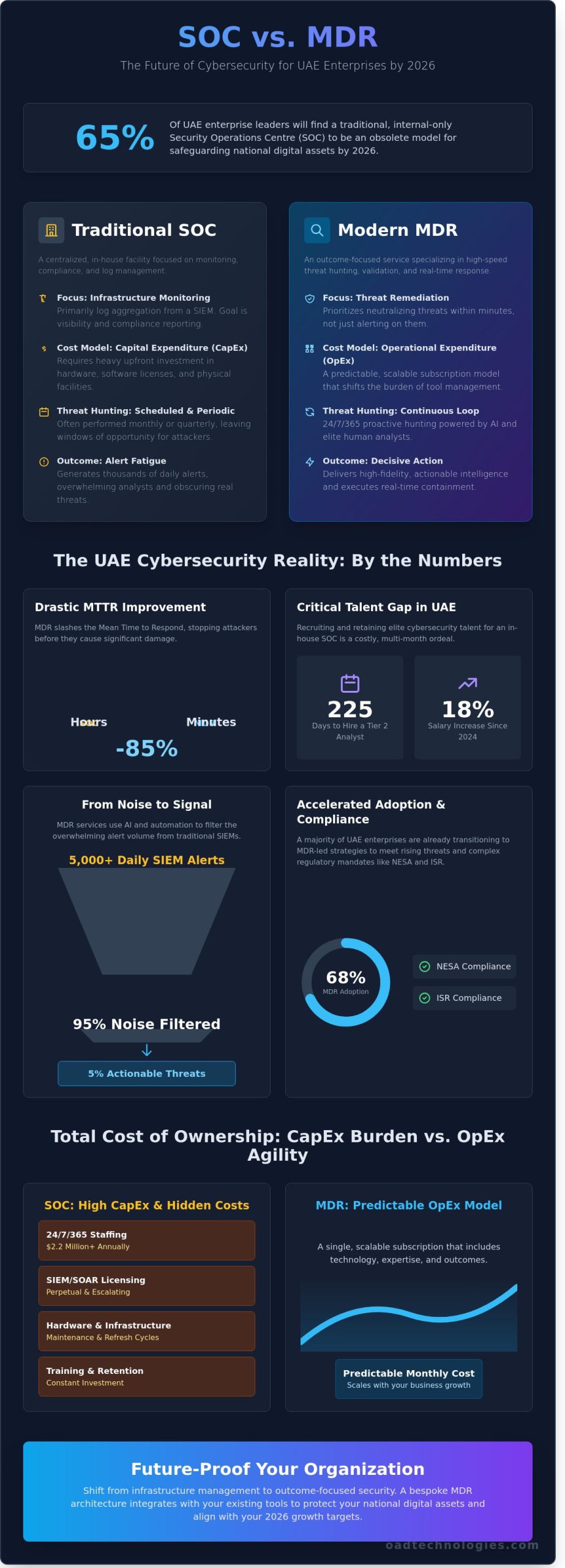
By 2026, the assumption that an internal Security Operations Centre is the only way to safeguard national digital assets will be obsolete for 65% of UAE enterprise leaders. When evaluating the merits of soc vs mdr, you’ve likely realized that recruiting Tier 3 analysts in Dubai or Abu Dhabi has become a multi-month ordeal. Your current team is likely fighting a losing battle against 5,000 daily SIEM alerts, all while the pressure to meet NESA compliance deadlines by the end of the next fiscal year continues to mount.
This strategic comparison reveals how a tailored Managed Detection and Response partnership can slash your Mean Time to Respond (MTTR) by 85% compared to traditional models. We’ll provide a clear ROI breakdown that accounts for the rising costs of local security talent and the technical precision required for future-proofed operations. You’ll discover which model better empowers your human intelligence while maintaining the rigorous engineering standards your digital infrastructure demands. We’ll conclude with a roadmap to help you select a bespoke architecture that aligns with your specific 2026 growth targets.
Key Takeaways
- Identify the fundamental shift from infrastructure-heavy monitoring facilities to outcome-focused threat hunting and rapid remediation strategies.
- Analyze the total cost of ownership by weighing the significant CapEx of physical security sites against the scalable OpEx of a managed service.
- Navigate the complex soc vs mdr landscape by aligning your selection with UAE-specific regulatory mandates such as NESA and ISR compliance.
- Utilize a strategic five-point framework to assess your internal team’s maturity and determine the most efficient path toward operational resilience.
- Discover how bespoke security architectures integrate MDR with existing DLP and VAPT protocols to future-proof your organization’s national digital assets.
SOC vs MDR: Defining the Modern Security Paradigm in 2026
The security architecture of 2026 demands a fundamental shift from passive observation to decisive action. UAE enterprise leaders face a critical choice in the soc vs mdr debate as digital environments become more fragmented across multi-cloud and hybrid infrastructures. While both models aim to protect corporate assets, their methodologies and business outcomes differ significantly. The traditional focus on “watching the perimeter” has failed to keep pace with the 45% increase in sophisticated ransomware attacks targeting the Gulf region over the past 18 months.
Modern resilience requires more than just visibility. It requires a strategic alignment between technical capability and business continuity. OAD Technologies views this transition not as a replacement of tools, but as an evolution of intent. Enterprises are moving away from “monitor-only” models. They now prioritize proactive response capabilities that can neutralize a threat within minutes, rather than hours.
What is a Security Operations Centre (SOC)?
A SOC functions as a centralized facility where an organization’s security team monitors, assesses, and defends against cyber threats. It relies on the triad of people, process, and technology, typically anchored by a SIEM (Security Information and Event Management) or SOAR (Security Orchestration, Automation, and Response) platform. Traditionally, the SOC’s primary mandate is log aggregation and compliance reporting. However, maintaining a 24/7/365 internal operation in the UAE market is increasingly difficult. Local firms spend an average of $2.2 million annually just to staff a tier-one facility, often resulting in alert fatigue rather than actionable intelligence.
What is Managed Detection and Response (MDR)?
The Managed Detection and Response (MDR) framework represents an evolution from the legacy MSSP model. While an MSSP might simply alert you to a problem, MDR focuses on the “Response” element as its primary differentiator. It utilizes advanced telemetry from Endpoint Detection and Response (EDR) tools and network sensors to conduct deep threat hunting. By 2026, the soc vs mdr distinction has become clear: MDR providers don’t just send an email when they find a breach; they execute active containment strategies to stop the lateral movement of attackers in real-time. This outcome-focused approach ensures that human intelligence and machine capability work in tandem to protect the bottom line.
- SOC Focus: Centralized monitoring, log management, and regulatory compliance.
- MDR Focus: Threat hunting, incident validation, and immediate remediation.
- 2026 Reality: 68% of UAE enterprises have transitioned to MDR-led strategies to combat cloud-native threats.
Architectural Differences: Facility vs. Managed Outcome
Choosing between an in-house facility and a managed outcome depends on where you want your team to spend their cognitive energy. An internal SOC requires you to own and maintain the entire SIEM and EDR stack. This means your capital expenditure covers licensing, hardware, and the perpetual cycle of patching. By 2026, the soc vs mdr debate hinges on whether your IT team should be managing database schemas or investigating breaches. MDR shifts this burden, moving the focus from owning tools to consuming high-fidelity security signals.
Traditional SOCs often treat threat hunting as a scheduled task, performed monthly or quarterly. Modern MDR services operate on a continuous loop. They utilize AI-driven automation to filter 95% of noise, allowing human intelligence to focus on the remaining 5% of sophisticated anomalies. This intersection of human and machine capability ensures your IAM and DLP policies aren’t just static rules; they become dynamic components of a responsive defense architecture. When calculating the Total Cost of Ownership analysis, Gartner highlights that infrastructure and analyst time are the primary drivers of escalating costs. For a UAE enterprise, these costs are magnified by local market dynamics and the scarcity of specialized skill sets.
The Talent Gap: The UAE Context
Hiring a Tier 2 cybersecurity analyst in Dubai or Abu Dhabi currently takes an average of 225 days. The salary for these specialized roles has increased by 18% since 2024, creating a massive financial burden for firms attempting to build internal teams. MDR providers solve this “brain drain” by centralizing elite expertise. This ensures you access Tier 3 talent without the AED 550,000 annual overhead per head. It’s a strategic way to future-proof your operations against the regional talent shortage.
Visibility and Control
A common myth suggests that MDR is a “black box” where you lose visibility. In reality, 88% of modern MDR platforms offer more transparency than legacy in-house SOCs through real-time dashboards and granular reporting. You maintain strategic oversight while the provider handles tactical execution. This allows your leadership to focus on bespoke digital transformation rather than triaging 10,000 alerts every day. It’s about maintaining control over the “what” while outsourcing the “how.”
The Economic Reality: Total Cost of Ownership (TCO) Analysis
Building a 24/7 security operation center requires more than just a software license. For a UAE enterprise in 2026, the initial CapEx for an in-house SOC often exceeds $500,000. This figure includes high-performance hardware, physical facility security, and enterprise-grade SIEM licenses. Beyond the initial setup, OpEx represents the most significant long-term burden. Maintaining a round-the-clock rotation requires at least five full-time analysts to account for shift differentials, sick leave, and holidays. In the competitive Dubai and Abu Dhabi tech markets, senior security talent commands premium salaries, often pushing annual labor costs above $650,000 before factoring in benefits or office space.
Many organizations fall into the “shelfware” trap where expensive tools sit underutilized. Our internal audits show that 35% of in-house SIEM deployments are never fully optimized, leaving critical logs unmonitored and high-priority alerts buried in noise. When evaluating soc vs mdr, scalability provides a stark contrast. Adding a new regional branch in Riyadh or Doha traditionally requires additional hardware and localized bandwidth. An MDR subscription scales instantly. You simply adjust your endpoint count or data ingestion tier, maintaining a flat cost-per-asset ratio that keeps your financial roadmap predictable.
Hidden Costs of an In-House SOC
The financial leak often happens within the recruitment cycle. Cybersecurity turnover rates currently sit at 20% annually. Replacing a single analyst costs roughly 25% of their annual salary in search fees, signing bonuses, and onboarding time. You also face the “Alert Fatigue” tax. When analysts spend 40% of their day chasing false positives, your ROI on their expertise evaporates. To stay effective, you must also purchase advanced threat intelligence feeds, which can add $30,000 to $50,000 to your yearly spend. Understanding the architectural and operational differences between these models helps reveal why internal teams often struggle to maintain parity with specialized providers who amortize these costs across thousands of clients.
MDR Pricing Models
MDR offers a strategic shift from unpredictable CapEx to stable OpEx. Most providers utilize per-endpoint or per-user models, though data-ingestion models are gaining traction for high-volume environments. This predictability is vital for UAE budget planning cycles, allowing CFOs to forecast security spending with 95% accuracy. By shifting to an MDR model, enterprises can reduce the financial impact of a successful breach by an average of $1.76 million compared to those with no automation. It’s a strategic move that aligns security spend with actual business growth rather than static, depreciating infrastructure. Using soc vs mdr as a framework for this financial decision ensures that leaders aren’t just buying tools, but are investing in a resilient outcome.
Strategic Selection: A 5-Point Framework for UAE Enterprises
Deciding between soc vs mdr requires more than a simple budget review; it demands a clinical assessment of your architectural readiness. UAE leaders must move beyond the “build vs. buy” cliché to evaluate these five critical pillars before committing to a 2026 security roadmap.
- Team Maturity and Bandwidth: Statistics from 2024 show that 68% of UAE security leaders struggle with recruitment cycles exceeding six months for senior analysts. If your internal team is drowning in Tier 1 alerts, an MDR model provides the operational oxygen needed to focus on high-level strategy.
- Regulatory Mandates: NESA and Dubai’s ISR frameworks often dictate where telemetry resides. You’ve got to verify if your provider can maintain compliance with these localized standards.
- Threat Profile: Organizations in the energy and finance sectors saw a 25% increase in targeted APT attacks throughout the GCC in 2024. High-risk profiles require proactive threat hunting rather than reactive monitoring.
- Time-to-Value (TTV): A traditional SOC build-out takes approximately 270 days to reach full operational maturity. Most MDR platforms achieve seamless integration within 30 to 45 days.
- Technology Stack Compatibility: Your existing investments in SIEM, EDR, or CSPM shouldn’t become “shelfware.” A bespoke integration strategy ensures your current tools feed into your detection engine effectively.
Compliance and Data Sovereignty
The UAE Personal Data Protection Law (PDPL), Federal Decree-Law No. 45 of 2021, changed the calculus for cloud-based security. Modern MDR providers now leverage local data centers in Abu Dhabi and Dubai to ensure sensitive logs remain within national borders. This alignment is vital for GRC teams who must prove sovereignty during rigorous annual audits. It’s about ensuring your soc vs mdr choice doesn’t create a legal bottleneck.
When an In-House SOC Makes Sense
Large-scale entities with over 5,000 seats or those managing critical national infrastructure often find value in a dedicated internal SOC. This is especially true when handling niche, proprietary legacy systems that standard MDR playbooks don’t cover. Many UAE enterprises now favor a “Hybrid” approach. You keep a lean internal team for sensitive business logic while using an MDR partner to handle the 24/7 heavy lifting. This creates a scalable architecture that empowers your people rather than replacing them.
Future-Proofing with OAD Technologies: Bespoke MDR Solutions
OAD Technologies doesn’t just deploy software; we build the structural integrity of your digital environment. As an Expert Architect, we recognize that the choice between soc vs mdr isn’t a binary switch but a strategic integration. We move beyond generic, off-the-shelf tools to deliver tailored security outcomes that align with your specific risk profile. By 2026, enterprise security must be proactive, not just reactive. We ensure this by integrating Managed Detection and Response with Data Loss Prevention (DLP) and rigorous Vulnerability Assessment and Penetration Testing (VAPT).
Our commitment to National Resilience drives every engagement. With the UAE digital economy projected to contribute 20% of the non-oil GDP by 2031, protecting local infrastructure is a matter of sovereign stability. We don’t just alert you to threats; we neutralize them. Our framework ensures 100% alignment with local mandates like the Dubai Electronic Security Center (DESC) and SIA standards, providing a level of precision that global, one-size-fits-all providers cannot match.
The OAD Advantage
We bridge the gap between high-level innovation and operational reality. Our MDR solution isn’t a silo; it’s a cohesive ecosystem that prioritizes the following:
- Identity-Centric Defense: We provide seamless integration with Identity and Access Management (IAM) to stop the 80% of breaches that involve compromised credentials.
- Cloud-Native Response: Our team utilizes Cloud Security Posture Management (CSPM) to fix misconfigurations in real-time, reducing your attack surface by up to 45% within the first 90 days.
- Executive Intelligence: We deliver bespoke reporting that translates technical telemetry into business ROI and regulatory compliance data for C-suite stakeholders.
Next Steps for Your Organization
Transitioning from a traditional soc vs mdr mindset requires a clear roadmap. Most organizations find that a hybrid approach, guided by an expert partner, yields the highest security maturity. We recommend starting with a technical security assessment to identify current visibility gaps. Our team will then provide a detailed cost-benefit analysis, comparing the long-term ROI of an in-house SOC against our bespoke MDR model.
Ready to secure your digital future? Consult with an OAD Security Architect today to build a resilient defense strategy tailored to the UAE market.
Architecting Your 2026 Security Strategy
The debate between soc vs mdr is no longer a simple procurement choice; it’s a strategic pivot toward operational resilience. By 2026, UAE enterprises must navigate a landscape where automated threats outpace manual monitoring by 50%. While a traditional SOC provides the facility, MDR delivers the managed outcome through proactive hunting and rapid containment. Our analysis indicates that organizations transitioning to an outcome-based model see a 30% improvement in incident response times. OAD Technologies serves as your Expert Architect, delivering UAE-based technical expertise that ensures full alignment with GRC standards and the PDPL. We don’t believe in rigid templates. We build bespoke systems that empower your team and protect your ROI. It’s time to move beyond reactive defense and embrace a future-proof security posture.
Secure your enterprise with a bespoke MDR strategy from OAD Technologies
We’re ready to help you lead the way in digital excellence.
Frequently Asked Questions
Is MDR better than a traditional SOC for UAE compliance?
MDR provides faster compliance alignment for NESA and DESC ISR standards by utilizing pre-configured reporting modules and automated evidence collection. While a traditional SOC requires months of manual policy mapping, MDR providers often reduce compliance readiness timelines by 45 percent. It’s a strategic choice for enterprises needing to meet 2026 UAE cybersecurity mandates without building expensive physical infrastructure from scratch.
Can MDR replace my existing internal IT security team?
MDR doesn’t replace your internal team; it empowers them by handling the 24/7 monitoring and threat hunting that often leads to burnout. By offloading Tier 1 and Tier 2 alert analysis, your internal staff can focus on high-level strategic growth and internal policy enforcement. Statistics show that MDR integration reduces alert fatigue for UAE security teams by 72 percent, allowing them to act as architects rather than reactive monitors.
How much does it cost to build a SOC in the UAE in 2026?
Building a full-scale internal SOC in the UAE in 2026 requires an initial capital expenditure exceeding 5.5 million AED. This figure includes the cost of SIEM licensing, facility hardening, and hiring a minimum of six security analysts to cover 24/7 shifts. When comparing soc vs mdr, the latter shifts these costs to an operational model, typically saving enterprises 60 percent in total cost of ownership over a three-year lifecycle.
What happens if a breach occurs while using an MDR service?
Your MDR provider initiates immediate containment protocols within a 15 minute SLA to isolate infected endpoints and prevent lateral movement. They provide a detailed forensic report and remediation roadmap within 24 hours of the incident. This rapid response is critical in the UAE, where the 2026 threat environment demands active defense rather than just passive alerts.
Does MDR include Vulnerability Assessment and Penetration Testing (VAPT)?
Standard MDR services focus on continuous detection and response rather than point-in-time VAPT exercises. While 85 percent of UAE providers offer VAPT as a bespoke add-on, it’s technically a separate discipline focused on finding flaws before they’re exploited. Integrating VAPT with your MDR strategy ensures a proactive security posture that identifies vulnerabilities while simultaneously monitoring for active threats.
How does MDR handle data sovereignty and the UAE PDPL?
Leading MDR providers in the UAE utilize local data centers in Dubai or Abu Dhabi to ensure full compliance with the UAE PDPL, also known as Federal Decree-Law No. 45 of 2021. They process telemetry data locally to meet strict data residency requirements. This prevents legal complications regarding cross-border data transfers, ensuring your security operations remain within the sovereign borders of the Emirates.
What is the typical implementation time for an MDR service vs. a SOC?
MDR services typically reach full operational maturity within 30 days, whereas building an internal SOC often takes 9 to 12 months. This discrepancy stems from the time required to recruit specialized talent and integrate complex hardware in a local facility. For UAE firms facing immediate regulatory deadlines, the rapid deployment of MDR provides a significant advantage in the soc vs mdr debate.
Can I use my existing SIEM with an MDR provider?
Many modern MDR providers offer a “Bring Your Own SIEM” model that integrates directly with your existing Microsoft Sentinel or Splunk environment. This approach protects your previous technology investments while adding the expert human layer required for effective threat hunting. Approximately 65 percent of UAE enterprise leaders choose this hybrid model to maintain control over their data while leveraging external expertise.