

What if your compliance department stopped being a cost center and started functioning as a high-performance engine for strategic growth? For many national enterprises in the Emirates, managing governance risk and compliance has become a race against fragmented silos and manual reporting cycles that, according to 2024 industry benchmarks, drain up to 40% of operational efficiency. You’re likely feeling the mounting pressure of the UAE PDPL, where the threat of significant penalties makes the old way of working feel increasingly unsustainable. It’s a common frustration to see technical leads and C-suite executives disconnected by data that lives in isolated spreadsheets.
This guide provides the architectural blueprint to master these pillars, allowing you to automate complex workflows and transform regulatory obligations into a distinct competitive advantage. We’ll show you how to bridge the gap between innovation and oversight through bespoke strategies that ensure your digital transformation remains resilient. You’ll learn to move beyond mere survival to a state of future-proofed agility, where a unified view of organizational risk drives every business decision you make through 2026 and beyond.
Key Takeaways
- Learn how to transition governance risk and compliance from a siloed administrative function into a unified, strategic driver of organizational reliability and growth.
- Deconstruct the three pillars of GRC to effectively identify, assess, and mitigate digital threats while establishing robust corporate behavior protocols.
- Master a structured approach to building resilience by assessing your current maturity levels and selecting global frameworks like ISO 27001 or NIST that align with your enterprise goals.
- Navigate the specific requirements of the UAE National Regulatory Environment, focusing on the UAE Personal Data Protection Law and NESA compliance to ensure regional legal alignment.
- Understand the strategic advantage of bespoke, future-proof solutions that integrate identity and access management into your broader compliance architecture for long-term ROI.
Understanding Governance Risk and Compliance in the 2026 Landscape
By 2026, the traditional boundaries of corporate oversight have dissolved. Governance, risk, and compliance (GRC) has transformed from a back-office administrative burden into a core driver of enterprise agility. Organizations in the UAE now operate within a hyper-connected digital economy where regulatory frameworks like the NESA (National Electronic Security Authority) standards require more than just periodic audits. They demand continuous, real-time alignment between business objectives and operational reality.
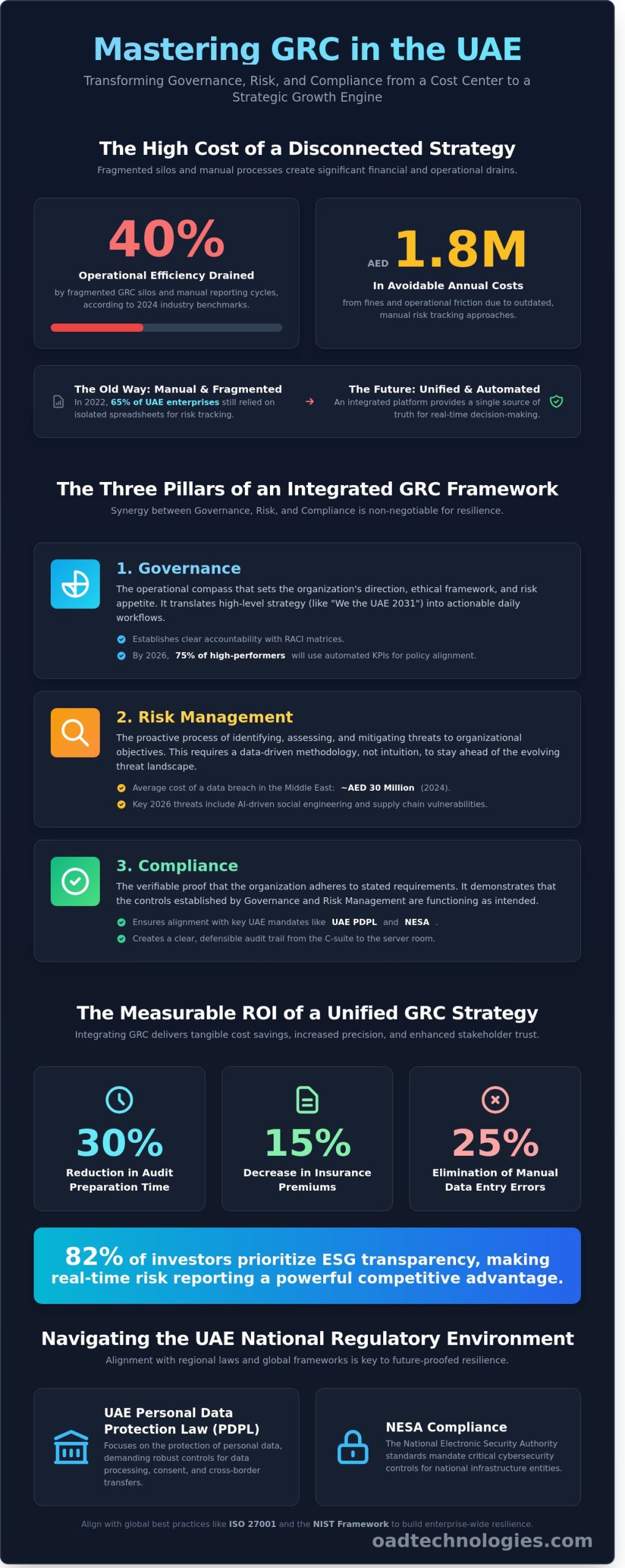
The shift from siloed functions to a unified strategy isn’t optional. In 2022, 65% of UAE enterprises still relied on manual spreadsheets for risk tracking. By 2026, this fragmented approach creates a liability that costs firms an average of AED 1.8 million in avoidable fines and operational friction annually. Manual processes can’t keep pace with the 40% increase in data velocity driven by widespread AI adoption and cloud-native architectures. A modern governance risk and compliance strategy treats these elements as a single, cohesive ecosystem rather than isolated departments.
The Interdependence of G, R, and C
Governance establishes the ethical framework and risk appetite that dictates how a UAE firm pursues growth. This vision directly informs risk management, which identifies the specific threats to those objectives. Compliance acts as the verifiable output. It proves that the controls established by governance and risk teams actually function. Without this synergy, a company’s “G” is just a mission statement, its “R” is a list of fears, and its “C” is a hollow paper trail.
The Business Value of Integrated GRC
Integrated governance risk and compliance delivers measurable ROI by centralizing data streams. UAE organizations using unified GRC platforms report a 30% reduction in audit preparation time and a 15% decrease in insurance premiums. Beyond cost savings, it builds stakeholder trust. In a market where 82% of investors prioritize ESG (Environmental, Social, and Governance) transparency, real-time risk reporting becomes a competitive advantage. It’s about building a resilient architecture that supports long-term scalability and future-proofs the enterprise against market volatility.
- Agility: Rapidly pivot strategies as UAE regulations evolve.
- Precision: Eliminate the 25% margin of error typical in manual data entry.
- Accountability: Create a clear audit trail from the C-suite to the server room.
The Three Pillars: Deconstructing the GRC Framework
In the UAE, where digital adoption reached 99% of the population by 2024, a fragmented approach to governance risk and compliance is no longer sustainable. Large enterprises often fall into the “silo effect” trap, where legal, IT, and finance departments operate in isolation. This lack of coordination creates visibility gaps that sophisticated threat actors exploit. Integrating these pillars into a unified strategy ensures that every policy, risk assessment, and audit works in harmony to protect the organization’s reputation and capital.
Governance: Beyond the Boardroom
Governance serves as the operational compass for the enterprise. It’s about translating high-level vision, such as the UAE’s “We the UAE 2031” strategy, into actionable daily workflows. Effective governance requires a clear RACI (Responsible, Accountable, Consulted, Informed) matrix to eliminate ambiguity in security oversight. By 2026, 75% of high-performing organizations will use automated Key Performance Indicators (KPIs) to monitor policy alignment in real-time. This ensures that digital initiatives contribute directly to strategic growth rather than accumulating technical debt.
Risk Management: A Proactive Stance
Identifying threats demands a data-driven methodology rather than intuition. Organizations must conduct regular vulnerability assessment and penetration testing to quantify their exposure in a measurable way. The 2026 threat landscape is defined by AI-driven social engineering and deep-tier supply chain vulnerabilities. With the average cost of a data breach in the Middle East reaching approximately AED 30 million in 2024, a reactive posture is a massive financial liability. Teams need a structured risk treatment plan to decide when to accept, transfer, mitigate, or avoid specific threats based on their potential impact on operational continuity.
Compliance: Verifying Trust
Compliance is transforming from a seasonal hurdle into a state of “continuous compliance.” This shift replaces the stress of periodic manual audits with persistent monitoring systems. For UAE-based firms, this is essential for meeting the requirements of Federal Decree Law No. 45 of 2021 regarding personal data protection. Leveraging compliance reporting automation allows your team to maintain precision without the risk of human error. It bridges the gap between internal policy mandates and external regulatory requirements from bodies like NESA or the Dubai Electronic Security Center (DESC).
Designing a framework that scales with your growth requires a partner who understands the local regulatory environment. To ensure your systems remain resilient, OAD Technologies can architect a bespoke strategy that aligns your technical infrastructure with your long-term business goals. This holistic approach transforms GRC from a cost center into a strategic advantage.
Building an Effective GRC Framework for Enterprise Resilience
Resilience isn’t a static achievement. It’s a moving target that requires a bespoke architectural approach. For UAE enterprises, building a robust governance risk and compliance framework means moving beyond checkbox exercises toward a system that actively protects value. In 2026, a manual approach is no longer viable; 68% of Dubai-based financial institutions now utilize automated GRC workflows to manage the complexity of local and international mandates.
- Step 1: Maturity Assessment. Begin by auditing your current state against the UAE Information Assurance (IA) Standards. Identify where silos exist. Most organizations find that 40% of their risk data is trapped in disconnected spreadsheets.
- Step 2: Defining Scope and Standards. Select a primary framework such as ISO 27001, NIST, or the NESA National Cyber Security Strategy. Define your boundaries clearly to avoid “scope creep” which can inflate implementation costs by over 250,000 AED.
- Step 3: Technology Implementation. Deploy a centralized platform to automate data ingestion. This shifts your team’s focus from data entry to strategic analysis.
- Step 4: Continuous Monitoring. Controls must be tested in real-time. A control that worked in January might fail by March due to a configuration drift in your cloud environment.
Selecting the Right GRC Technology
Scalability is your primary metric. As your organization pursues digital transformation, your GRC tool must handle an exponential increase in data points without performance degradation. Seamless integration is the next priority. Your software shouldn’t exist in a vacuum; it must pull live telemetry from SIEM, IAM, and DLP tools to provide an accurate risk profile. Finally, prioritize usability. If the interface is too complex, employees will bypass the system, creating “shadow compliance” risks that hide vulnerabilities from leadership.
The Role of Data in GRC
Data is the lifeblood of modern governance risk and compliance. You need a “Single Source of Truth” to eliminate conflicting reports during an internal audit. By integrating data loss prevention (DLP) feeds directly into your GRC platform, you gain real-time visibility into sensitive data movement. This allows for executive-level dashboards that visualize compliance posture in Dirhams at risk rather than vague technical scores. By 2026, the ability to present risk in financial terms will be the hallmark of the successful CISO.
Navigating the UAE National Regulatory Environment
Operating within the United Arab Emirates requires more than just standard security protocols; it demands a precise alignment with federal mandates that protect the nation’s digital economy. As we approach 2026, the UAE Data Office is intensifying its oversight, making local regulatory alignment a cornerstone of any robust governance risk and compliance strategy. This shifting landscape requires a proactive stance to avoid the heavy administrative fines that accompany non-compliance.
PDPL Compliance: Protecting National Data
The UAE Personal Data Protection Law (PDPL) serves as the primary benchmark for data privacy across all seven Emirates. It mandates strict data sovereignty, meaning you can’t transfer sensitive personal data outside the UAE without meeting specific adequacy criteria or obtaining explicit consent from the UAE Data Office. To manage this, enterprises must appoint a Data Protection Officer (DPO) who sits at the heart of the governance risk and compliance framework. This role isn’t merely administrative; the DPO is a strategic requirement to ensure that breach notifications reach the regulator within the specified legal windows. Organizations that fail to report significant breaches or violate cross-border transfer rules face penalties that can reach millions of AED, depending on the severity of the exposure.
NESA and ISR: Securing Critical Infrastructure
National Electronic Security Authority (NESA) standards provide the blueprint for protecting critical national infrastructure. NESA IA (Information Assurance) Standards comprise 188 controls divided into management and technical categories. While these standards align with international frameworks like ISO 27001, they include unique local requirements for encryption and local hosting. For Dubai-based government and semi-government entities, ISR (Information Security Regulation) compliance is mandatory. Preparing for an ISR audit requires rigorous documentation and real-time evidence of control effectiveness. You’ll need detailed asset registers, vulnerability assessment reports, and localized incident response plans to pass these high-stakes evaluations.
Sector-specific mandates add layers of complexity to the general federal laws. Healthcare providers in Abu Dhabi must adhere to ADHICS (Abu Dhabi Healthcare Information and Cyber Security), which ensures patient data remains secure across the entire care lifecycle. Similarly, financial institutions face strict oversight from the Central Bank of the UAE. These regulations often require specific data residency solutions where all financial records must be stored on servers physically located within the UAE. Aligning with these mandates isn’t just about avoiding fines; it’s about building the trust necessary to operate in a high-growth market.
OAD Technologies provides the technical precision and strategic insight needed to architect bespoke compliance frameworks that meet these rigorous UAE national standards.
Future-Proofing GRC with OAD Technologies
Generic software packages often treat governance risk and compliance as a static, one-time exercise. This approach fails because it ignores the unique operational nuances of the UAE market. At OAD Technologies, we’ve seen that a bespoke strategy is the only way to avoid compliance drift, where your security posture degrades between annual audits. We build architectures that adapt to your growth rather than forcing your business to fit into a rigid, one-size-fits-all template.
Modernizing your workflow requires moving away from manual spreadsheets that are outdated the moment they’re saved. Integrating identity and access management into your compliance framework is a critical part of this evolution. By automating user lifecycle management, you can reduce the time spent on manual access reviews by up to 75%. This creates real-time visibility, allowing your team to identify and mitigate risks before they escalate into breaches that could cost your firm millions in AED.
- Replace reactive checklists with live telemetry from your production environment.
- Ensure data residency requirements are met according to UAE Federal Decree-Laws through automated tagging.
- Shift from a cost-center mentality to a strategic advantage that builds trust with regional partners.
The OAD Approach: Strategic Partnership
OAD Technologies functions as your expert architect, bridging the gap between high-level board directives and technical execution. We don’t just provide software; we deliver tailored consulting that aligns with NESA and Dubai ISR standards. By feeding MDR and SIEM data directly into your governance risk and compliance engine, we provide a unified view of your risk landscape. This integration ensures that every technical alert is mapped to a specific business risk, providing clarity for both IT teams and C-suite executives. It’s about turning raw logs into strategic intelligence.
Next Steps for Your Organization
Begin with a comprehensive GRC maturity assessment to identify where your current gaps exist. Many UAE enterprises find that manual processes cost them over 400,000 AED in annual productivity losses due to inefficient data gathering. Our architects will help you build a 2026 roadmap focused on high-impact automation and architectural resilience. Reach out to our team for a tailored consultation to ensure your organization isn’t just compliant, but truly secure for the long term.
Secure Your Competitive Edge in the 2026 Regulatory Landscape
The complexity of the UAE regulatory environment in 2026 demands a shift from static checklists to dynamic resilience. Organizations must integrate the core pillars of governance risk and compliance to navigate the specific requirements of the Personal Data Protection Law (PDPL) and NESA standards. Transitioning to an automated framework doesn’t just mitigate risks; it transforms compliance into a strategic asset that protects your bottom line from the rising costs of data breaches, which reached an average of 29 million AED per incident in the region during the last fiscal cycle.
Effective strategy requires a structured architecture. At OAD Technologies, we act as your Expert Architect, delivering specialized automated reporting that simplifies complex audits and ensures long-term scalability. Our team provides deep UAE-based expertise to ensure your infrastructure remains both secure and agile. Consult with our GRC Experts for a Bespoke UAE Compliance Strategy to future-proof your enterprise and maintain your digital relevance. We’re ready to help you turn these regulatory challenges into lasting operational excellence.
Frequently Asked Questions
What is the primary difference between risk management and compliance?
Compliance focuses on adhering to established laws and mandates, such as the UAE Federal Decree Law No. 45 of 2021. Risk management is the proactive identification and mitigation of uncertainties that could impact your strategic objectives. While compliance is often binary, risk management is a spectrum of probability and impact. Integrating these within a governance risk and compliance framework ensures that meeting legal standards also drives long-term business resilience.
Is GRC software mandatory for UAE businesses?
GRC software isn’t legally mandatory for every UAE entity, but it’s a functional necessity for organizations governed by the UAE Central Bank or NESA standards. Manual spreadsheets fail to track the 300+ regulatory updates issued annually in the region. Without automated tools, your team risks missing critical deadlines or reporting errors. This leads to fines that can reach 1,000,000 AED or more depending on the specific violation and sector.
How does the UAE PDPL impact my GRC strategy in 2026?
The UAE Personal Data Protection Law (PDPL) requires your 2026 strategy to prioritize data sovereignty and mandatory breach notifications within 72 hours. You’ll need to implement technical controls that ensure personal data remains secure and accessible only for authorized purposes. By 2026, the UAE Data Office will likely increase audits, so your framework must provide real-time visibility into data processing activities. This alignment protects your brand reputation and prevents costly legal disputes.
Can GRC help in preventing data breaches?
GRC helps prevent data breaches by mapping security controls to specific risk profiles and ensuring continuous monitoring. A 2024 study showed that companies with integrated governance risk and compliance protocols reduced the cost of data breaches by 42%. By identifying gaps in your perimeter before they’re exploited, you move from a reactive posture to a proactive defense. This approach secures your digital assets while maintaining operational continuity.
What are the most common challenges in implementing a GRC framework?
Data silos across departments represent the most significant hurdle, as 65% of UAE executives report difficulty in achieving a unified view of risk. Another challenge is the lack of executive support, which often leads to underfunded initiatives. You’ll also face resistance if the framework isn’t tailored to your specific workflows. Successful implementation requires a bespoke strategy that integrates with existing systems rather than forcing a generic, one-size-fits-all solution.
How often should a GRC framework be reviewed or updated?
You should conduct a comprehensive review of your GRC framework at least once every 12 months. However, immediate updates are necessary when 20% or more of your operational environment changes or new laws emerge. The rapid evolution of AI and cloud technologies in the UAE market means quarterly pulse checks are becoming the new standard for 2026. This frequency ensures your strategy remains relevant and capable of addressing emerging threats.
What is the role of the CISO in a GRC program?
The CISO acts as the bridge between technical security controls and the broader business risk appetite. They’re responsible for ensuring that the IT infrastructure supports compliance requirements while protecting intellectual property. In a modern strategy, the CISO doesn’t just manage firewalls; they translate cyber threats into financial impact for the board. This allows for better resource allocation and more informed strategic decision-making.
How does GRC support digital transformation initiatives?
GRC supports digital transformation by providing a structured roadmap that balances innovation with security and regulatory requirements. When you migrate to the cloud or adopt AI, a robust framework ensures these changes don’t introduce unmanaged risks. It allows your organization to scale rapidly without fear of non-compliance. This alignment turns risk management into a competitive advantage, enabling faster time-to-market for new digital services.