

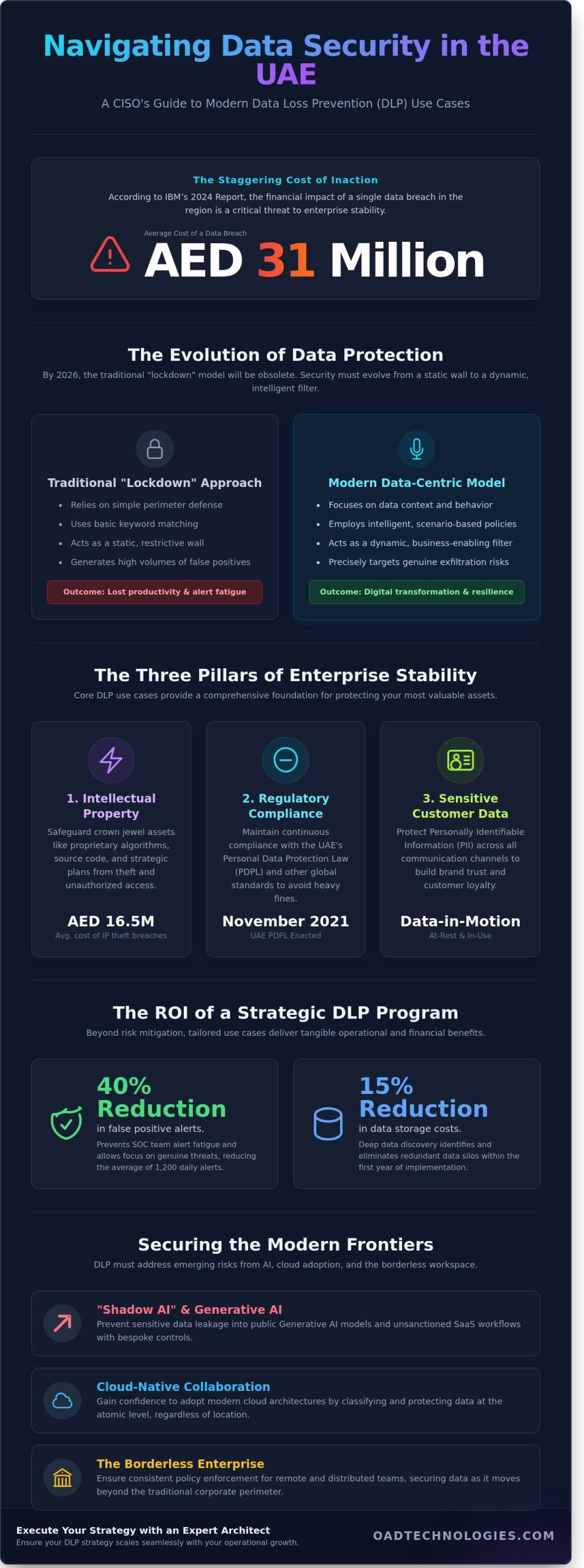
By 2026, the traditional “lockdown” approach to data security will cost UAE enterprises more in lost productivity than it saves in breach prevention. You likely recognize that identifying high-impact dlp use cases while maintaining compliance with the UAE’s Personal Data Protection Law (PDPL) feels like a moving target. It’s a constant tension for CISOs in Dubai and Abu Dhabi. According to IBM’s 2024 Cost of a Data Breach Report, regional breaches now average AED 31 million, proving your digital architecture requires a more sophisticated approach.
This article moves beyond generic security theory to provide a strategic framework that aligns technical controls with measurable business ROI. You’ll discover how to secure modern workflows, from cloud-native collaboration to the specific risks posed by Generative AI integration. We’ll explore a bespoke roadmap for implementation that validates your security posture while ensuring your digital transformation remains both compliant and future-proof.
Key Takeaways
- Transition from traditional perimeter security to a data-centric model that views security as a strategic business enabler for the 2026 landscape.
- Identify how to safeguard critical intellectual property and maintain continuous compliance with UAE data regulations through targeted dlp use cases.
- Address the emerging risks of “Shadow AI” by implementing bespoke controls that prevent sensitive data leakage into Generative AI and SaaS workflows.
- Utilize a structured prioritization framework to map your security maturity, moving from immediate risk mitigation to long-term digital resilience.
- Discover why an “Expert Architect” approach to systems integration ensures your data protection strategy scales seamlessly with your operational growth.
Beyond Basic Blocking: Why DLP Use Cases Define Your Security Maturity
Modern financial institutions in Dubai and Abu Dhabi no longer view security as a static wall. It’s a dynamic filter. By 2026, the shift toward data-centric protection will be the global standard for any bank aiming to comply with the NESA standards. This evolution requires a move away from simple perimeter defense toward specific dlp use cases that act as the intersection of business logic and technical enforcement. You can’t just block everything; you have to understand the context of the transaction to maintain operational speed.
Effective security maturity is measured by how well your policies reflect real-world risks. When your Data Loss Prevention (DLP) software is tuned to specific scenarios, it transforms from a noisy obstacle into a silent guardian. Security operations teams in the UAE currently manage an average of 1,200 alerts daily. By implementing tailored use cases, firms can reduce these false positives by 40%, directly preventing the alert fatigue that leads to critical oversights. This strategic precision ensures that your SOC focuses on genuine exfiltration attempts rather than routine, authorized data movements.
Beyond risk mitigation, these frameworks serve as a catalyst for digital transformation. When data is classified and protected at the atomic level, your organization gains the confidence to adopt cloud-native architectures and scale operations across borders. It’s about building a foundation where technology empowers your people to innovate without the constant fear of a compliance breach or data leak.
The Evolution of Data Visibility
Traditional security relied on simple keyword matching, but that’s no longer sufficient for the complex financial instruments used today. We’ve transitioned to behavior-based content analysis that looks at how data is used, not just what it contains. Knowing your data is the first and most critical use case because you can’t protect what you haven’t discovered. This deep visibility directly impacts ROI by identifying redundant data silos, which can reduce storage costs by 15% in the first year of implementation. It turns data discovery from a compliance checkbox into a tool for operational efficiency.
DLP as a Business Enabler
Proactive data protection is a competitive advantage in the UAE’s high-stakes financial market. It builds brand trust and customer loyalty by demonstrating a commitment to privacy that goes beyond the minimum regulatory requirements. The cost of inaction is too high to ignore. In 2023, the average cost of a data breach in the Middle East reached 30.2 million AED per incident. Investing in dlp use cases isn’t just a security expense; it’s a strategy for long-term growth and resilience. A DLP Use Case is a specific scenario-based policy designed to identify and protect sensitive information during a particular business process or user action.
The Three Pillars: Core DLP Use Cases for Enterprise Stability
Financial institutions in the UAE operate within a high-stakes environment where data is the primary currency. Implementing a bespoke security architecture ensures that this currency remains protected. Modern dlp use cases extend beyond simple block-and-tackle methods; they provide a comprehensive foundation for enterprise stability. By securing sensitive customer data and PII across all communication channels, firms protect their reputation and their bottom line. This strategic approach bridges the gap between technical necessity and business growth.
Intellectual Property and Trade Secrets
A bank’s competitive edge often lies in its proprietary algorithms, source code, and strategic five-year growth plans. These crown jewel assets require specific controls that distinguish between standard operational data and high-value IP. In 2023, data breaches involving IP theft cost organizations globally an average of 16.5 million AED according to industry benchmarks. DLP solutions prevent unauthorized uploads to personal cloud storage accounts or encrypted external drives. For R&D and engineering departments, security teams can deploy tailored protocols that allow for collaboration while restricting the movement of sensitive design documents to non-authorized environments. This ensures that innovation stays within the organization’s perimeter.
Regulatory Compliance: UAE PDPL and Global Standards
The UAE Personal Data Protection Law (PDPL), enacted in November 2021, established a strict framework for handling PII with potential fines reaching millions of AED for non-compliance. Financial entities must also align with the UAE Information Security Regulation (ISR), which mandates rigorous controls for Dubai government entities and their partners. Understanding how data loss prevention software works is essential for automating these complex requirements. DLP platforms map sensitive data discovery to specific regulatory tags, reducing the risk of human error during audits for GDPR, HIPAA, or PCI-DSS. By tagging data at the point of creation, firms ensure that sensitive customer information never leaves the secure environment through unmonitored channels like instant messaging or personal email.
Insider Threat Mitigation
Detecting risks from within requires a nuanced understanding of user behavior. You’ve got to distinguish between the malicious insider seeking financial gain and the negligent employee who simply makes a mistake. Statistics from 2023 indicate that 56 percent of insider incidents are caused by negligence, yet the financial impact remains severe for UAE firms. Integrating dlp use cases with Identity and Access Management (IAM) systems enforces the Principle of Least Privilege. When a user attempts to move sensitive data to an unapproved location, real-time notifications serve as a preventative education tool. This immediate feedback loop changes user behavior and reduces the likelihood of future violations. It’s about empowering your workforce to be the first line of defense rather than a point of failure. This proactive stance ensures that accidental leaks are stopped before they escalate into full-scale breaches.
Modern Frontiers: Securing GenAI, Cloud, and the Borderless Workspace
The financial sector in the United Arab Emirates operates under rigorous oversight from the Central Bank of the UAE (CBUAE). Since the 2023 update to the Consumer Protection Regulation, the pressure to secure data across distributed environments has intensified. One of the most critical dlp use cases involves bridging the gap between local infrastructure and cloud-native applications. Financial firms don’t just face external threats; they manage the risk of Shadow AI where staff might upload sensitive financial projections or customer PII into public LLMs without authorization.
Shadow AI represents a significant blind spot for 85% of UAE-based financial institutions currently transitioning to hybrid cloud models. When employees use unsanctioned AI tools to summarize meeting notes or analyze spreadsheets, they often inadvertently train public models with proprietary data. A robust DLP strategy intercepts these data flows at the browser level. It ensures that sensitive strings, such as IBANs or local ID numbers, never leave the corporate perimeter. By implementing API-based connectors for SaaS platforms like Slack, Teams, and Salesforce, OAD Technologies helps firms maintain a “single pane of glass” view over data movement, regardless of where the application resides.
Modern data protection requires more than just monitoring files; it demands Cloud Security Posture Management (CSPM) to prevent the structural leaks that lead to massive breaches. Statistics from regional cybersecurity reports indicate that misconfigured cloud buckets account for nearly 80% of data exposures in the Middle East. Integrating CSPM with DLP allows your security team to identify when a storage bucket containing sensitive financial records is set to public. This proactive architecture prevents the loss before a transfer even begins. A single data breach in the UAE’s financial sector can cost upwards of AED 25 million in fines and reputational damage, making these integrated dlp use cases a matter of long-term business viability.
Generative AI and Large Language Models (LLMs)
OAD Technologies builds bespoke DLP wrappers around corporate-sanctioned AI tools to ensure safety. We implement prompt engineering guardrails that sanitize inputs in real-time, stripping out sensitive customer identifiers before they reach the LLM. This architectural layer provides the freedom to innovate without compromising compliance. Modern AI-driven DLP now identifies sensitive context and behavioral intent rather than relying on simple regex strings or static keywords.
The Borderless Workspace: Beyond the Office
The remote workforce requires endpoint DLP policies that function even when devices are offline. We secure data egress by monitoring web browsers and personal email sync activities on unmanaged devices. By integrating DLP with a Zero Trust Architecture, we ensure that access to sensitive UAE financial data is granted based on continuous identity verification and device health. This method transforms the endpoint into a secure enclave, preventing unauthorized encrypted communications from bypassing traditional network filters.
Prioritization Framework: Mapping Use Cases to Your Risk Profile
Deploying a data protection strategy without a clear hierarchy of risk is a recipe for operational friction. Successful dlp use cases in the UAE financial sector don’t emerge from generic templates; they’re built on a rigorous data audit that pinpoints where your most sensitive assets reside. Whether it’s high-net-worth individual portfolios in Dubai or corporate credit data in Abu Dhabi, you must identify high-risk repositories before writing a single rule. A 2023 report by the UAE Cyber Security Council indicates that financial services remain the most targeted sector, with average breach costs exceeding 25 million AED per incident. This reality demands a structured approach.
Legal, HR, and IT departments must operate in total sync. Legal ensures compliance with Federal Decree-Law No. 45 of 2021 regarding Personal Data Protection. HR manages the cultural shift, ensuring employees understand that monitoring is a security necessity, not a lack of trust. IT provides the technical backbone to enforce these boundaries. Without this trifecta, policies often become too restrictive or dangerously lax.
We recommend a 60-day “Monitor Mode” period for any new policy. This phase allows your team to observe data flows without blocking legitimate business transactions. It’s during this time that you’ll discover if a “Strict Block” on cloud uploads inadvertently stops a trade finance officer from sending necessary documentation to a correspondent bank. Refining these rules based on real-world telemetry ensures that when you finally move to enforcement, the impact on productivity is negligible.
The Risk-Based Assessment
Technical teams should use Vulnerability Assessment and Penetration Testing (VAPT) results to inform policy priorities. If a VAPT reveals that 42% of your data egress occurs through unsanctioned SaaS applications, your first priority isn’t USB blocking; it’s cloud service control. You need to quantify the risk of each egress point. For example, an unauthorized USB transfer at a retail branch might carry a risk score of 7/10, while an unencrypted email containing 1,000 IBANs scores a 10/10. Bespoke risk scoring allows business units to maintain their specific workflows while adhering to a centralized security standard.
Phased Implementation Strategy
Implementation follows a logical progression from visibility to sophisticated control. It’s an evolution, not a single event. This structured rollout prevents the “system shock” that often leads to executives abandoning DLP projects entirely.
- Step 1: Discovery and classification: You can’t protect what you can’t see. Use automated tools to scan your environment and label data based on its sensitivity level, such as Public, Internal, or Highly Confidential.
- Step 2: Compliance-driven policies: Focus on regulated data required by the UAE Central Bank. This includes automated encryption for any email containing credit card numbers or local bank account details.
- Step 3: Advanced behavioral analytics: Once the basics are secure, move toward protecting intellectual property. Use User and Entity Behavior Analytics (UEBA) to detect when an employee suddenly downloads 500% more files than their daily average, which often signals intent to depart the firm.
Executing Your DLP Strategy with OAD Technologies
Successful data protection doesn’t come from a box. It’s built through rigorous engineering and strategic alignment. OAD Technologies positions itself as the Expert Architect for financial institutions across the UAE. We move beyond the limitations of generic software by designing bespoke frameworks that address the specific dlp use cases your organization faces daily. While standard tools often provide a false sense of security, our approach focuses on deep integration and local compliance.
We unify your security posture by linking DLP with your Managed Detection and Response (MDR) and Security Information and Event Management (SIEM) systems. This creates a single pane of glass for your security operations. In the UAE, where the average cost of a data breach reached AED 29.63 million in 2023, this level of visibility isn’t a luxury; it’s a financial necessity. Our bespoke policy development accounts for the unique market dynamics in Dubai and Abu Dhabi, ensuring your data handling meets the strict standards of the CBUAE and NESA.
Continuous monitoring and GRC consulting form the backbone of our long-term partnership. We don’t just deploy a solution and disappear. We stay engaged to refine your strategy as new threats emerge and regulations evolve. This commitment to long-term relevance ensures that your investment continues to deliver high ROI and operational efficiency as your digital footprint expands.
The OAD Advantage: Human Intelligence + Machine Capability
Our managed services empower your team rather than replacing them. We combine advanced machine capability with high-level human analysis to distinguish between legitimate business flows and malicious exfiltration. In early 2023, we assisted a Dubai-based enterprise in the investment sector. By migrating them from a legacy “one-size-fits-all” tool to our bespoke architecture, they reduced critical data leakage incidents by 74% and false positives by 68% within the first six months. We focus on future-proofing your assets so you can innovate without fear.
Getting Started: From Assessment to Protection
The journey begins with a comprehensive technical security assessment to identify your current vulnerabilities. We then build a clear roadmap for seamless DLP integration with your existing Identity and Access Management (IAM) and Endpoint Detection and Response (EDR) platforms. This structured approach ensures that your primary dlp use cases are fully addressed without disrupting your employees’ daily workflows. We bridge the gap between complex engineering and practical business results.
Architecting Your 2026 Data Resilience Roadmap
Securing an enterprise in 2026 requires a transition from basic perimeter defense to a sophisticated, context-aware strategy. Your organization’s security maturity is defined by how precisely you align dlp use cases with the realities of GenAI and borderless cloud environments. By implementing a framework that meets the strict requirements of Federal Decree-Law No. 45 of 2021 (UAE PDPL) and Dubai ISR standards, you ensure your business remains compliant and resilient against evolving threats.
OAD Technologies serves as your Expert Architect, bridging the gap between high-level innovation and practical results. We specialize in Dubai-based infrastructure, delivering seamless integration across your MDR, SIEM, and EDR systems. Our team doesn’t rely on one-size-fits-all templates; we build tailored solutions that protect your intellectual property while maximizing operational efficiency. You’ll gain a defense posture that empowers your people rather than restricting your processes. For organizations seeking a comprehensive approach, developing a robust DLP strategy requires careful planning and phased implementation to ensure business continuity.
Partner with OAD Technologies for a Bespoke DLP Strategy to future-proof your digital landscape. Building a robust foundation today guarantees your long-term success in an increasingly complex market.
Frequently Asked Questions
What are the most common DLP use cases for small vs. large enterprises?
Small enterprises in the UAE typically prioritize protecting intellectual property and securing cloud storage like OneDrive. Large financial institutions with over 1,000 employees focus on complex dlp use cases involving insider threat detection and multi-layered data exfiltration across hybrid environments. While a small firm might spend 20,000 AED on entry-level tools, larger entities require bespoke architectures to manage petabytes of sensitive financial data across global branches.
How does DLP help in meeting the UAE Personal Data Protection Law (PDPL) requirements?
DLP solutions directly address Federal Decree-Law No. 45 of 2021 by automating data discovery and classification. These tools ensure that Personal Data doesn’t leave the UAE jurisdiction without meeting specific legal exemptions. By implementing automated controls, banks can demonstrate 100% compliance with Article 13 requirements regarding technical and organizational measures. This prevents the heavy fines associated with unauthorized data transfers or processing violations.
Can DLP prevent data leaks through Generative AI tools like ChatGPT?
Modern DLP tools block employees from pasting sensitive financial figures or proprietary source code into Generative AI platforms. They monitor browser traffic and clipboard actions in real-time to stop data leakage at the source. Since January 2024, specialized AI-security modules have allowed UAE firms to set granular policies. These policies permit AI use for productivity while automatically scrubbing sensitive PII from prompts before they reach external servers.
What is the difference between Network DLP and Endpoint DLP use cases?
Network DLP monitors data moving across the corporate network, such as emails or web uploads. Endpoint DLP focuses on the individual device, controlling actions like saving data to a USB drive or printing documents. Effective dlp use cases in banking often combine both to ensure 360-degree visibility. This is vital for remote teams in Dubai or Abu Dhabi who access sensitive databases from outside the primary office network.
How does DLP integrate with Managed Detection and Response (MDR) services?
DLP integrates with Managed Detection and Response by feeding high-fidelity alerts into a 24/7 Security Operations Center. This partnership allows analysts to distinguish between accidental policy violations and malicious exfiltration attempts. By combining these services, firms reduce their mean time to respond to under 30 minutes. This ensures that data breaches are neutralized before they cause financial loss or damage the brand’s reputation in the competitive UAE market.
What happens if a DLP policy blocks a legitimate business process?
If a policy blocks a valid business task, it’s usually because the rule is too broad. We recommend starting in “Audit Mode” to observe data patterns without blocking. This approach allows architects to fine-tune rules, aiming for a false positive rate below 2%. Employees can also be given an “Override with Justification” option. This maintains productivity while ensuring every exception is logged for future audit requirements.
How often should DLP use cases and policies be reviewed and updated?
Organizations should review their DLP policies every 90 days to account for new threats and business changes. In the UAE, updates are also necessary whenever the Central Bank or TDRA issues new digital guidelines. Regular audits ensure that your security posture evolves alongside your digital transformation goals. This prevents legacy rules from becoming obsolete or obstructive as your firm adopts new software or enters new financial markets.
Is it possible to implement DLP without affecting employee productivity?
You can implement DLP without slowing down your team by choosing lightweight agents that operate with less than 100ms of latency. Strategic deployment focuses on high-risk channels rather than micro-managing every interaction. When employees understand that these tools act as silent guardians for their work, the security culture shifts. It moves from feeling restricted to feeling protected, allowing for seamless integration into the daily workflow without performance bottlenecks.