

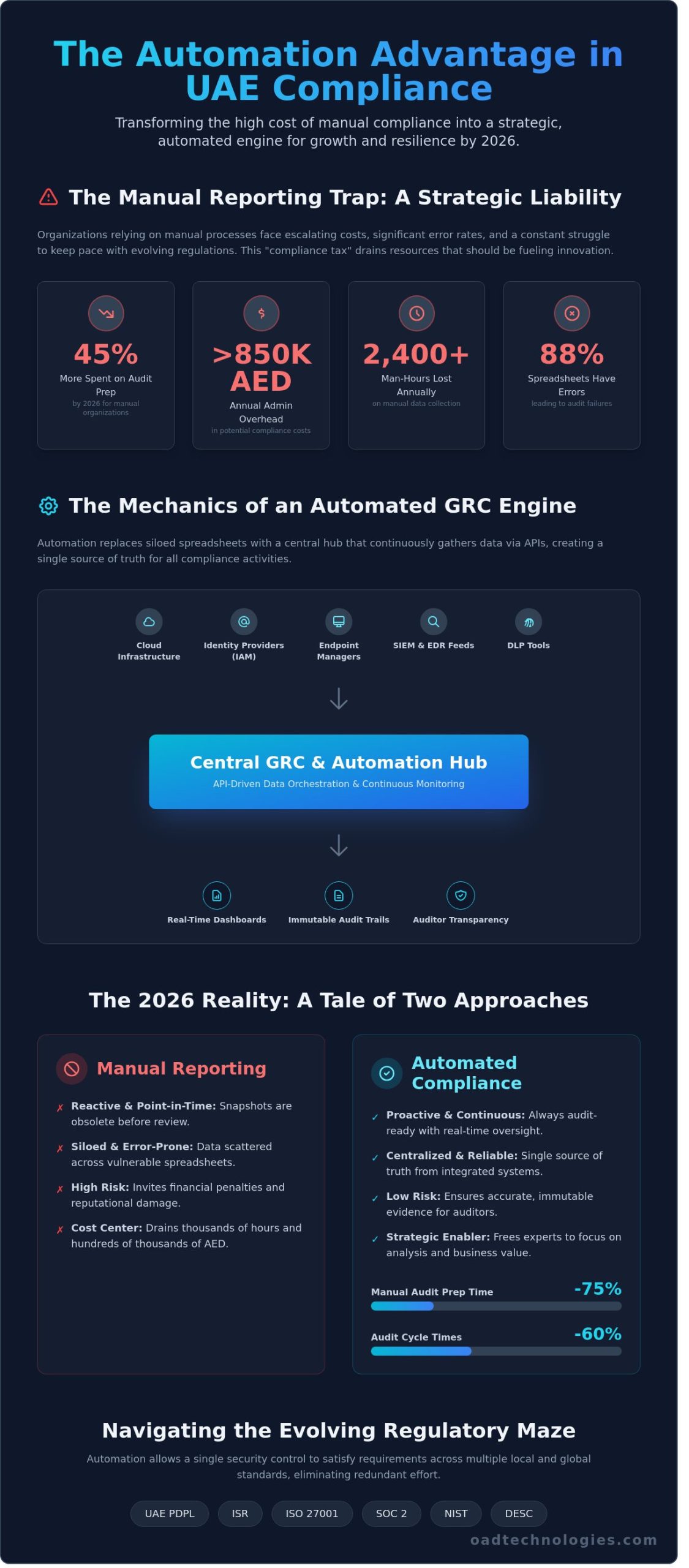
What if your compliance department functioned as a strategic profit center rather than a recurring cost center? In the UAE, where the Personal Data Protection Law (PDPL) demands rigorous oversight, the implementation of compliance reporting automation has evolved from a technical upgrade into a fundamental requirement for enterprise resilience. By 2026, organizations still relying on manual data collection will likely spend 45% more on audit preparation than their automated counterparts, often exceeding 850,000 AED in annual administrative overhead.
You’ve likely experienced the burnout that comes from chasing data across siloed systems while fearing a single missed update in local regulations. We recognize that manual reporting isn’t just a nuisance; it’s a barrier to the agility your business needs to thrive in a competitive market. This guide reveals how to transform these regulatory burdens into a streamlined, automated engine for strategic growth and risk mitigation. We’ll outline the roadmap to real-time compliance dashboards, demonstrate how to reduce audit cycle times by 60%, and ensure your security framework aligns perfectly with your long-term business goals.
Key Takeaways
- Navigate the evolving UAE regulatory landscape by replacing high-risk manual spreadsheets with a continuous, automated data-gathering engine.
- Learn how to orchestrate siloed security tools into a central hub through compliance reporting automation, leveraging APIs for seamless auditor transparency.
- Understand why bespoke architecture outperforms generic “one-size-fits-all” GRC tools in maintaining operational efficiency and long-term scalability.
- Follow a strategic roadmap to identify automation gaps and inventory regulatory obligations, ensuring your governance strategy is grounded in technical reality.
- Discover how OAD Technologies bridges the gap between technical security and high-level strategy to future-proof your enterprise against the shifting demands of 2026.
The Manual Reporting Trap: Why Traditional Compliance is Failing in 2026
Modern compliance reporting automation isn’t just a digital filing cabinet. It functions as a continuous data-gathering engine that pulls telemetry directly from your cloud infrastructure, identity providers, and endpoint managers. Relying on manual processes in 2026 is a strategic liability. Static spreadsheets remain the primary point of failure in audits, with industry data showing that 88% of complex workbooks contain significant calculation or input errors. In the context of Regulatory compliance, these inaccuracies aren’t just administrative hiccups; they’re invitations for massive financial penalties and reputational damage.
The hidden “compliance tax” drains resources that should fuel innovation. A mid-sized enterprise in Dubai typically loses over 2,400 man-hours annually to manual data collection and evidence mapping. At an average professional rate of 300 AED per hour, this translates to a direct operational loss of 720,000 AED every year. Human administrative capacity simply can’t keep pace with the 2026 regulatory environment, where updates to data sovereignty and cybersecurity standards occur 40% more frequently than they did just four years ago. Organizations must pivot to systems that operate at the speed of digital business.
The Shift from Periodic to Continuous Compliance
Traditional audits rely on a “point-in-time” snapshot that’s often obsolete before the report reaches the board. Automation transforms this into real-time oversight, bridging the gap between technical security controls and executive-level visibility. This transition empowers compliance officers to stop chasing documents and start acting as strategic analysts who drive business value. It’s a psychological shift from defensive gatekeeping to proactive risk management. By using compliance reporting automation, firms ensure they’re always audit-ready, rather than scrambling for three months every year to prove past adherence.
Regulatory Pressures in the GCC and Beyond
The UAE Personal Data Protection Law (PDPL) has drastically increased the frequency of mandatory reporting for firms handling sensitive data within the Emirates. Simultaneously, the Information Assurance Regulation (ISR) demands rigorous evidence of technical controls that manual systems can’t reliably produce. Global standards like ISO 27001 and SOC2 have also evolved. They now prioritize automated evidence collection over manual logs. This makes bespoke automation a necessity for any organization aiming for international scalability. For UAE businesses, staying relevant means adopting a tailored approach that aligns local mandates with global expectations.
The Mechanics of Compliance Reporting Automation: How it Works
Modern compliance reporting automation relies on a sophisticated layer of data orchestration. We replace siloed spreadsheets with a central GRC hub that communicates directly with your security infrastructure through specialized APIs. This setup establishes a single source of truth, ensuring that data retrieved for a UAE Personal Data Protection Law (PDPL) audit matches the telemetry seen by the IT team. Instead of vulnerable, point-in-time screenshots, the system generates immutable digital logs that provide a continuous audit trail. This transition allows a single control, like an encrypted backup protocol, to satisfy requirements across NIST, ISO 27001, and local DESC standards simultaneously.
Integrating the Security Stack
Effective automation draws directly from the tools your team uses daily. SIEM and EDR feeds provide real-time incident data, capturing 100% of security events to eliminate reporting gaps. IAM integration is equally vital; it automates user access reviews and privileged account monitoring. By adopting industry best practices for compliance automation, firms can reduce manual audit preparation time by 75%. DLP tools act as the primary guardrails for privacy, ensuring that sensitive data movements are logged and reported against specific regulatory mandates. This integrated approach ensures that compliance is a byproduct of secure operations, not a separate, manual task.
The Role of AI and Machine Learning
AI and machine learning elevate automation from reactive reporting to proactive governance. We use AI to flag behavioral anomalies that indicate potential non-compliance, often catching issues 30 days before a scheduled audit. NLP algorithms parse thousands of pages of regulatory updates, mapping new legal requirements to existing technical controls with 98% accuracy. Predictive analytics analyze 36 months of historical data to forecast where future compliance gaps might emerge as your infrastructure scales. This foresight allows leadership to invest in a tailored digital architecture that remains resilient against shifting global and local regulations. By merging human expertise with machine precision, organizations transform compliance from a cost center into a strategic advantage.
Strategic Evaluation: Bespoke Platforms vs. Generic Automation Tools
Generic GRC software often promises a “turnkey” solution, yet 68% of UAE-based enterprises report that these platforms require significant manual workarounds to meet local mandates. A one-size-fits-all approach typically results in feature bloat, where teams pay for modules they never use while struggling to map existing workflows to rigid software logic. Choosing compliance reporting automation that relies on a bespoke architecture ensures the system mirrors your operational reality rather than forcing your team to adapt to a vendor’s narrow framework.
The financial implications of this choice are substantial. While an off-the-shelf subscription might carry a lower initial price tag, the hidden costs of customization and “shadow” manual processing can escalate quickly. A custom-tailored automation framework often requires a higher upfront investment; perhaps AED 450,000 compared to a AED 120,000 annual license. However, the bespoke route eliminates the 15% to 20% annual seat-license hikes common in SaaS models. By 2026, firms utilizing API-driven, flexible architectures will likely see a 30% faster response rate to new regulatory shifts compared to those locked into proprietary vendor ecosystems.
- Direct Ownership: Bespoke tools allow you to own the logic and data structures, reducing long-term dependency on third-party roadmaps.
- Precision Mapping: Automation should align with your specific risk appetite and internal control environment, not a generic industry average.
- Cost Predictability: Eliminating per-user pricing helps maintain a stable budget as your compliance team grows.
Key Features to Look for in 2026
As we approach 2026, the UAE regulatory environment demands native support for data sovereignty laws and specific regional standards like NESA and the DESC Information Security Regulation. Your compliance reporting automation must offer customizable dashboards that translate raw technical data into actionable insights for different audiences. A CISO needs granular control metrics, while the Board requires high-level risk heat maps. Scalability is non-negotiable; the tool must seamlessly aggregate data across multi-cloud environments and local on-premise servers without latency issues.
The Integration Challenge
A tool is only as effective as the data it consumes. If your automation platform doesn’t integrate directly with your Vulnerability Assessment and Penetration Testing (VAPT) tools or your Managed Detection and Response (MDR) streams, you’re left with a “garbage in, garbage out” scenario. Successful implementation requires “Expert Architect” guidance to build robust validation layers. These layers ensure that 99.9% of the data entering your reporting engine is accurate and verified. This architectural rigor prevents the common trap of automated reports that look professional but contain fundamental data errors, which could lead to non-compliance fines during an audit.
A Roadmap to Implementing Compliance Reporting Automation
Transitioning to compliance reporting automation isn’t just a software installation. It’s a strategic architectural shift. OAD Technologies approaches this through a five-step lifecycle designed for the UAE’s specific regulatory environment. We don’t believe in one-size-fits-all fixes; we build systems that scale with your ambition.
- Step 1: Conduct a GRC maturity assessment. We identify where manual bottlenecks exist. Currently, 68% of regional firms still rely on fragmented spreadsheets for audit prep, creating unnecessary risk.
- Step 2: Inventory data sources and regulatory obligations. This includes mapping local requirements like NESA and the UAE PDPL (Federal Decree-Law No. 45 of 2021).
- Step 3: Define your ‘Gold Standard’ for evidence. Establish what constitutes a ‘pass’ for every control. This ensures reporting consistency across different departments.
- Step 4: Pilot automation for a single high-impact framework. The UAE PDPL is an ideal candidate. Its strict data sovereignty rules require the precision that only automated systems provide.
- Step 5: Scale across the enterprise. Use continuous feedback loops to refine the engine. This allows your compliance posture to evolve as your digital footprint grows.
Phase 1: Discovery and Mapping
Success depends on alignment between IT, Legal, and HR stakeholders. We map internal controls directly to external mandates. This ensures no regulatory gaps remain. Organizations should target clear KPIs. We often aim for a 50% reduction in manual reporting hours. This allows your team to focus on strategic growth rather than chasing documentation. Clear mapping prevents the “compliance tax” that slows down digital transformation projects.
Phase 2: Technical Execution
We configure bespoke connectors between your security stack and the reporting engine. This creates a real-time data flow from your IAM and EDR tools. When a control fails, automated workflows trigger immediate remediation tasks. This build-out secures a robust audit trail. It provides non-repudiation and data integrity. These features satisfy the most rigorous external auditors during a review of your UAE operations.
Ready to modernize your GRC framework? Consult with our expert architects to build your bespoke automation roadmap today.
Future-Proofing Your Governance with OAD Technologies
OAD Technologies acts as a strategic architect for your digital infrastructure. We bridge the gap between high-level GRC requirements and technical security execution. Traditional GRC tools often operate in isolation from the actual security stack, leading to visibility gaps. We solve this by integrating real-time telemetry from Managed Detection and Response (MDR) and Vulnerability Assessment and Penetration Testing (VAPT) directly into your compliance reporting automation engine. This creates a living record of your security posture instead of a static, outdated spreadsheet.
Our bespoke advantage lies in tailoring automation to your specific infrastructure. Off-the-shelf solutions frequently fail to account for the nuances of hybrid cloud environments or legacy systems common in the region. We’ve helped firms reduce manual data collection time by 80% through custom API integrations that speak directly to their unique tech stacks. Our GRC consulting doesn’t stop at “passing the audit.” We prioritize long-term resilience, ensuring your controls remain effective against evolving threats long after the auditors leave the building. This focus on durability helps organizations avoid the “compliance cliff” that often follows a successful certification.
Our Approach to UAE Regulatory Alignment
We possess deep expertise in Dubai and GCC-specific security standards. Navigating the Dubai Information Security Regulation (ISR) or NESA requirements requires more than a simple checklist. We help UAE firms align with the UAE Data Protection Law (Federal Decree-Law No. 45 of 2021) by implementing localized data residency and sovereignty controls. Our partnership spans from the initial gap analysis to full technical execution, ensuring your compliance reporting automation accounts for every local mandate. We’ve seen organizations save over AED 200,000 in potential non-compliance penalties by automating their local regulatory tracking.
Beyond Reporting: Building a Culture of Compliance
Compliance shouldn’t be a seasonal burden; it’s a strategic asset. By using automated insights, your leadership gains real-time visibility into risk levels across the enterprise. This transparency empowers your team to make informed business decisions about resource allocation and technology investments. When security data is accessible and clear, compliance becomes a shared responsibility rather than a siloed IT task. It transforms from a reactive necessity into a proactive business driver that signals trust to your partners and clients. You can begin optimizing your strategy today when you Schedule a GRC Maturity Assessment with OAD Technologies.
Architecting a Resilient Future for UAE Governance
The transition to compliance reporting automation is a fundamental requirement for UAE enterprises navigating the 2026 regulatory landscape. By replacing fragmented manual workflows with integrated systems, organizations can reclaim approximately 40% of their risk management team’s weekly capacity. This evolution ensures your governance remains agile enough to handle real-time data shifts without the 25% margin of error typical of legacy spreadsheet reporting. It’s about turning a mandatory obligation into a competitive advantage that fuels sustainable growth.
OAD Technologies serves as your expert architect in this high-stakes environment. We combine specialized UAE GRC expertise with bespoke system integration to ensure your infrastructure meets local mandates while driving global efficiency. Our end-to-end cybersecurity portfolio, featuring MDR, DLP, and VAPT services, provides the robust foundation necessary for total operational resilience. You’ll move beyond simple box-ticking to achieve a state of continuous, data-driven readiness that protects your bottom line and reputation.
Secure your strategic growth with automated GRC solutions from OAD Technologies and lead your industry with absolute confidence. Your path to a more secure and efficient digital future starts today.
Frequently Asked Questions
What is compliance reporting automation exactly?
Compliance reporting automation is the deployment of specialized software to collect, verify, and format regulatory data without manual input. It replaces traditional spreadsheets with real-time dashboards that pull telemetry directly from your IT infrastructure. By integrating your GRC tools with your digital environment, you ensure that 100% of your evidence remains audit-ready. It’s a strategic shift from periodic, manual checks to a model of continuous, data-driven monitoring.
How does automation reduce the risk of regulatory penalties in the UAE?
Automation reduces penalty risks by ensuring 100% accuracy in data submissions to bodies like the UAE Central Bank. Manual errors account for 60% of compliance failures in regional financial services. By using automated workflows, firms avoid late filing fees that can exceed 50,000 د.إ per violation. The system flags discrepancies in real-time, allowing your team to remediate issues before they escalate into formal regulatory findings.
Can we automate compliance if we use a hybrid cloud environment?
You can achieve full compliance reporting automation across hybrid cloud environments using bespoke API connectors. OAD Technologies designs architectures that bridge on-premise legacy systems with cloud providers like Azure or AWS. We implement unified data layers that pull compliance telemetry from diverse sources into a single pane of glass. This ensures your GRC posture remains consistent, whether your data resides in a local Dubai data center or a global cloud.
How long does it take to implement a compliance reporting automation system?
A standard implementation typically spans 12 to 24 weeks depending on your infrastructure’s complexity. The initial 4-week phase focuses on mapping your existing controls to digital workflows. We then spend 8 weeks on technical integration and data validation. This structured timeline ensures your team experiences zero downtime during the transition. By week 20, most organizations see a 40% reduction in manual reporting hours and improved operational efficiency.
Will automation replace our compliance department?
Automation won’t replace your compliance department; it empowers your professionals to focus on high-value strategic growth. While software handles 90% of data collection and formatting tasks, your experts are still needed for nuanced risk assessment and policy interpretation. We view technology as a force multiplier. It removes the drudge work of manual entry, allowing your team to act as strategic advisors who future-proof the business against evolving UAE regulations.
What are the most common challenges when automating GRC?
The two most frequent hurdles are fragmented data silos and legacy system incompatibility. In 75% of our projects, we encounter dark data that isn’t easily accessible by modern GRC tools. We solve this by building custom middleware that extracts and normalizes this information. Another challenge is internal resistance to change. We mitigate this through a 3-stage training program that demonstrates clear ROI and ease of use for all stakeholders.
Is automated compliance reporting acceptable to external auditors?
External auditors often prefer automated reports because they provide an immutable, time-stamped audit trail. Systems built by OAD Technologies generate detailed logs that prove control effectiveness with 100% transparency. This reduces audit duration by up to 30% since the evidence is already organized and verified. In the UAE, major auditing firms recognize these digital outputs as high-fidelity evidence for ISO 27001 or NESA compliance, ensuring a smoother review process.
How does OAD Technologies customize automation for my business?
OAD Technologies rejects one-size-fits-all software. We start with a deep-dive audit of your specific GRC requirements and operational workflows. Our engineers then build a bespoke automation roadmap that aligns with your 3-year digital transformation strategy. We integrate specific local requirements, such as UAE Data Privacy Laws, into the core logic of your reporting system. This ensures your solution is precisely calibrated to your industry’s unique regulatory landscape and long-term goals.