

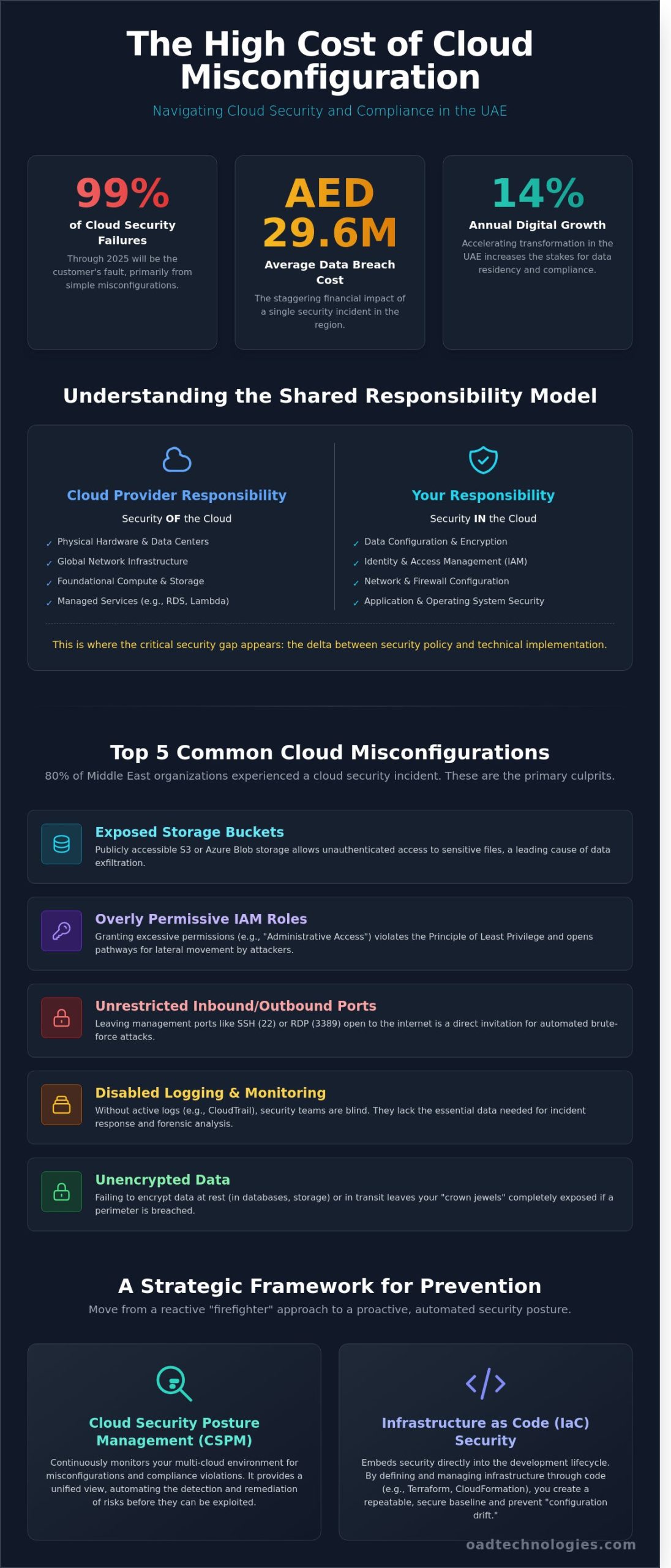
Did you know that 99% of cloud security failures through 2025 will be the customer’s fault, primarily stemming from simple cloud misconfigurations? In the UAE, where digital transformation is accelerating at a 14% annual growth rate, the stakes for your data residency and sovereign cloud compliance are higher than ever. You’ve likely felt the weight of managing thousands of disparate alerts while trying to ensure your multi-cloud environment aligns with NESA standards and the Dubai Information Security Regulation. It’s a relentless cycle that often leaves technical leads feeling more like firefighters than architects.
We’re here to change that narrative by bridging the gap between high-level innovation and practical business results. You’ll learn how to identify the five most critical security gaps that could expose your organization to the average AED 29.6 million cost of a regional data breach. We’ll provide a clear framework for tailored, automated cloud security posture management that doesn’t just flag problems but solves them. This guide outlines exactly how to align your technical settings with global GRC standards, ensuring your infrastructure remains both scalable and secure for the long term.
Key Takeaways
- Master the Shared Responsibility Model to bridge the critical gap between your high-level security policies and actual cloud implementation.
- Identify and remediate the top five common cloud misconfigurations, such as exposed storage buckets and permissive IAM roles, before they compromise your data.
- Balance DevOps agility with rigorous security oversight by addressing the root causes of vulnerabilities within complex multi-cloud environments.
- Deploy a strategic framework utilizing CSPM and Infrastructure as Code (IaC) to architect a resilient, compliant, and automated security posture.
- Learn how bespoke security solutions and MDR integration provide the technical authority needed to future-proof your enterprise against evolving digital threats.
What are Cloud Misconfigurations in Enterprise Environments?
Cloud misconfigurations represent the delta between an organization’s intended security policy and the actual technical implementation of its cloud resources. While cloud providers maintain rigorous standards for the physical and foundational layers of cloud computing security, the Shared Responsibility Model dictates that the enterprise remains accountable for everything inside the cloud. We’ve observed that 99% of cloud security failures through 2025 will be the customer’s fault, primarily due to these preventable gaps in setup and oversight.
It’s vital to distinguish between a simple human error and a systemic architectural flaw. A simple error might involve a developer leaving a single port open during a temporary test. A systemic flaw, however, is a fundamental design weakness, such as an Identity and Access Management (IAM) template that grants “Administrative Access” to all new users by default. These architectural oversights create repeatable vulnerabilities that scale alongside your infrastructure, making cloud misconfigurations the primary catalyst for data breaches globally.
The High Cost of Misconfiguration
In the United Arab Emirates, the stakes for cloud security are exceptionally high due to stringent local regulations like the UAE Data Protection Law and NESA standards. An exposed S3 bucket or an unencrypted database isn’t just a technical glitch; it’s a massive financial liability. Organizations that fail to secure sensitive citizen data face heavy fines and severe reputational damage that can take years to repair. We’ve seen that the average total cost of a cloud-based data breach is projected to reach 18,360,000 AED by 2026.
- Regulatory Penalties: Non-compliance with UAE Federal Decree Law No. 45 can result in significant administrative fines.
- Operational Downtime: Remediation often requires freezing deployments, which halts innovation and impacts ROI.
- Data Exfiltration: Misconfigured storage remains the easiest entry point for ransomware actors targeting enterprise assets.
Native Tools vs. Enterprise Visibility
Default settings provided by AWS, Azure, or GCP are designed for rapid deployment and “out-of-the-box” functionality, not maximum security. These providers prioritize ease of use to reduce friction for developers, which often leaves critical ports open or logging disabled. For a Dubai-based enterprise managing a multi-cloud environment, relying solely on native tools creates a “Visibility Gap.”
Configuration drift occurs when manual changes or automated scripts alter the environment over time, moving it away from the secure baseline. Without a bespoke monitoring strategy, these changes go unnoticed. Managing this drift across different platforms requires a unified architectural approach that bridges the gap between high-level security requirements and the granular reality of complex digital ecosystems.
Top 5 Common Cloud Misconfigurations and Their Impact
In the UAE’s rapidly evolving digital economy, cloud misconfigurations remain the primary catalyst for data breaches. Recent 2023 industry reports indicate that 80% of organizations in the Middle East experienced at least one cloud security incident. These aren’t just technical glitches; they’re strategic liabilities that can cost a Dubai-based enterprise upwards of AED 25 million in remediation and lost trust. Identifying these cloud misconfigurations early is essential for maintaining high-quality craftsmanship in your digital infrastructure.
- Exposed Storage Buckets: Publicly accessible repositories like AWS S3 or Azure Blobs allow anyone with a URL to download sensitive files without authentication.
- Overly Permissive IAM Roles: Granting full administrative rights to developers or service accounts violates the Principle of Least Privilege, providing a direct path for lateral movement.
- Unrestricted Inbound/Outbound Ports: Leaving SSH (22) or RDP (3389) open to the entire internet invites relentless brute-force attacks.
- Disabled Logging and Monitoring: Without active logs, IT teams lose the “black box” data required to reconstruct events during an incident response.
- Unencrypted Data: Failing to encrypt data at rest or in transit leaves the “crown jewels” vulnerable if the perimeter is breached.
Identity as the New Perimeter
Legacy security models relied on physical firewalls, but the cloud shifts the focus to Identity and Access Management (IAM). Attackers exploit misconfigured roles to escalate privileges, often moving from a low-level service account to a full tenant administrator. We frequently see “Orphaned Accounts” left behind by former employees or hardcoded “Secrets” in application code that provide permanent backdoors. By aligning your strategy with the Cloud Security Alliance’s Security Guidance, your team can build a more resilient framework. A bespoke IAM audit ensures that every permission is justified and every identity is verified, future-proofing your infrastructure against evolving threats.
Network and Storage Vulnerabilities
Security Group configurations and VPC peering errors often create unintended bridges between secure and public environments. A common mistake involves “Insecure Backups” where snapshots are stored in unencrypted, public-facing buckets, effectively bypassing primary security controls. In 2022, a major regional entity inadvertently exposed 1.2 million records through a misconfigured API that didn’t require token-based authentication. These gaps aren’t just “IT problems”; they’re risks to your operational efficiency and compliance with the UAE Data Protection Law. Precision in network architecture prevents these leaks before they occur.
The Root Causes: Why Do Misconfigurations Happen?
Identifying why cloud misconfigurations occur is the first step toward building a resilient digital infrastructure. In the UAE’s rapid digital economy, 75% of organizations prioritize speed-to-market over comprehensive security audits. This creates a friction point where DevOps agility outpaces security oversight. When developers push code multiple times a day, the traditional gates of security often become bottlenecks, leading teams to bypass protocols to meet aggressive deadlines.
Complexity adds another layer of risk. The “Paradox of Choice” in multi-cloud environments means managing disparate security protocols across AWS, Azure, and Google Cloud. Each provider uses different IAM logic and storage permissions. Research indicates that managing three or more cloud platforms increases the risk of a breach by 30% compared to single-provider setups. This complexity is often compounded by Shadow IT. Department heads in Dubai and Abu Dhabi frequently procure cloud resources using corporate credit cards to bypass IT queues, creating unauthorized assets that sit outside the protected perimeter.
The global cybersecurity talent gap hit a critical point in 2024, and the UAE is not immune. There’s currently a 25% shortage in specialized cloud security roles locally. Without expert architects to oversee deployment, teams often rely on default settings that aren’t optimized for the specific data residency requirements of the Middle East.
The Human Element in Cloud Security
Manual intervention is the primary driver of system failure. Even the most skilled engineers make mistakes when configuring hundreds of variables across a distributed network. It’s not just about the initial setup; “Configuration Drift” occurs when engineers apply “quick fixes” to production environments without updating the original Infrastructure as Code (IaC) templates. Traditional VAPT (Vulnerability Assessment and Penetration Testing) performed twice a year is no longer sufficient. It provides a static snapshot of a dynamic environment that changes every hour. Understanding common cloud misconfiguration types is essential for teams trying to move away from these manual, error-prone processes.
Architectural Inconsistency
A frequent error involves the “Copy-Paste” mentality. Security policies that work for an S3 bucket don’t translate directly to Azure Blob storage or Google Cloud Buckets. Using a legacy security mindset-treating the cloud like a virtual data center-fails because it ignores the software-defined nature of modern infrastructure. OAD Technologies advocates for “Security by Design” in every bespoke software project. By integrating security into the initial architecture, businesses can avoid the high cost of remediation. A single major leak can cost a UAE firm upwards of AED 500,000 in regulatory fines and lost consumer trust. Proactive architectural planning ensures that security empowers your digital transformation rather than hindering your operational efficiency.
A Strategic Framework for Preventing Cloud Misconfigurations
Preventing cloud misconfigurations requires shifting from reactive firefighting to a proactive, architectural approach. At OAD Technologies, we’ve observed that 80% of security incidents in the UAE originate from preventable configuration errors. Organizations must adopt Cloud Security Posture Management (CSPM) to gain 360-degree visibility into their multi-cloud environments. This oversight ensures every storage bucket and network port aligns with your security baseline in real-time.
Standardization is your strongest defense. By utilizing Infrastructure as Code (IaC) tools like Terraform or Bicep, your team can bake security directly into deployment templates. This eliminates the “human factor” that causes 95% of cloud failures according to 2023 industry research. Coupled with the Principle of Least Privilege (PoLP), you ensure that IAM roles only possess the permissions necessary for their specific function, significantly shrinking your potential attack surface.
The Role of Automation in Posture Management
Manual audits are no longer viable as digital assets scale. AI-driven CSPM solutions identify anomalies by comparing real-time telemetry against historical baselines, flagging unauthorized changes in seconds. Transitioning from manual checks to automated policy enforcement allows your infrastructure to defend itself against drift. By implementing automated remediation, organizations reduce their Mean Time to Repair (MTTR) from several hours to less than 60 seconds.
Building a Culture of Compliance
Security isn’t just a technical hurdle; it’s a core business value. Integrating security into the CI/CD pipeline ensures every code commit undergoes automated vulnerability scanning before it reaches production. In the UAE, alignment with the Dubai Electronic Security Center (DESC) standards or NESA regulations is mandatory for many sectors. Regular GRC (Governance, Risk, and Compliance) assessments help maintain this alignment while protecting sensitive local data.
- Conduct quarterly GRC audits tailored specifically to UAE data residency laws.
- Train technical leads on cloud-native security standards twice per year to stay ahead of evolving threats.
- Deploy “self-healing” scripts to reset unauthorized configuration changes automatically without human intervention.
Securing Your Cloud Future with OAD Technologies
Remediating cloud misconfigurations requires more than a standard checklist; it demands a structural rethink of your digital environment. OAD Technologies delivers bespoke Cloud Security Posture Management (CSPM) solutions designed specifically for your unique enterprise architecture. We don’t believe in generic templates. Instead, we integrate cloud security with Managed Detection and Response (MDR) to provide comprehensive threat detection across every layer of your stack. This dual approach ensures that 100% of your cloud assets are monitored in real-time, closing the loop between identifying a vulnerability and neutralizing a threat.
Aligning your cloud posture with the UAE Personal Data Protection Law (PDPL) is a non-negotiable requirement for regional enterprises. Our frameworks ensure your data residency and processing workflows meet the strict standards set by Federal Decree-Law No. 45 of 2021. This alignment transforms compliance from a burden into a strategic asset. We bridge the gap between technical innovation and strategic ROI, ensuring your security investments protect your high-value revenue streams from preventable downtime and regulatory penalties. By focusing on operational efficiency, we help you scale without increasing your risk profile.
Expert Architecture and Managed Oversight
The OAD approach combines human intelligence with machine capability to eliminate the noise of false positives. Our team acts as an extension of your own, applying rigorous engineering standards to every project. We provide managed Governance, Risk, and Compliance (GRC) services that simplify complex reporting for audits. This future-proofs your digital transformation. We build resilient infrastructure that adapts as your business grows, ensuring your long-term relevance in a competitive market. Our experts focus on precision, ensuring every configuration is optimized for both performance and security.
Next Steps for Enterprise Resilience
Don’t wait for a breach to validate your security strategy. Most organizations discover cloud misconfigurations only after an incident occurs. You can take a proactive stance by requesting a Cloud Security Assessment to identify existing gaps in your environment. Partnering with OAD Technologies offers long-term security posture management that evolves alongside the threat landscape. Our “Expert Architect” methodology ensures your cloud journey is stable, secure, and profitable. Take the first step toward a more resilient digital future today.
Ready to fortify your infrastructure? Protect your enterprise cloud with OAD Technologies and gain the peace of mind that comes with professional, managed oversight.
Mastering Your Cloud Resilience in the UAE
Cloud security isn’t a static goal; it’s a continuous engineering discipline that requires precision. Gartner research indicates that through 2025, 99% of cloud security failures will result from preventable cloud misconfigurations. For UAE enterprises, these errors aren’t just technical glitches. They represent significant risks to operational continuity and compliance with local mandates like the NESA Information Assurance Standards. A strategic defense requires more than basic tools. It demands a sophisticated integration of Cloud Security Posture Management (CSPM) and Governance, Risk, and Compliance (GRC) frameworks tailored to the regional regulatory landscape.
OAD Technologies serves as your expert architect in this journey. We deliver bespoke security solutions that combine advanced SIEM and MDR capabilities with a deep understanding of the Dubai and Abu Dhabi markets. Our team ensures your infrastructure doesn’t just meet current standards but is future-proofed against the next generation of digital threats. By aligning technical excellence with your specific business ROI, we transform security from a cost center into a strategic advantage.
Secure Your Cloud Infrastructure with OAD Technologies
Your path to a more secure and scalable digital future starts with a single, decisive step toward better architecture.
Frequently Asked Questions
What is the most common cloud misconfiguration?
Publicly accessible storage buckets and overly permissive security groups remain the most frequent cloud misconfigurations. These errors occur when default settings prioritize accessibility over security, leaving sensitive data exposed to the public internet. Industry data from 2023 indicates that 43% of initial cloud migrations contain at least one storage bucket with incorrect access controls. This exposure creates an immediate entry point for unauthorized actors to exfiltrate proprietary information without needing to bypass complex firewalls.
How does Cloud Security Posture Management (CSPM) fix misconfigurations?
CSPM tools fix errors by continuously comparing your environment against established security benchmarks like CIS or NIST. They identify deviations in real time and provide step-by-step remediation paths or automated fixes. OAD Technologies implements CSPM to bridge the gap between complex infrastructure and human oversight. This ensures your cloud environment remains compliant with UAE federal standards without requiring constant manual intervention, maintaining a secure baseline even as your architecture scales.
Can cloud misconfigurations be detected by traditional firewalls?
Traditional firewalls cannot detect cloud misconfigurations because they monitor network traffic rather than the underlying resource settings. While a firewall filters packets, a misconfiguration involves the architecture itself, such as an identity policy that grants excessive permissions to a service account. You need specialized tools like Cloud Infrastructure Entitlement Management to see these logical flaws. Relying solely on perimeter defense leaves 90% of your cloud control plane invisible and vulnerable to internal exploitation.
Who is responsible for cloud misconfigurations under the shared responsibility model?
Under the shared responsibility model, the customer is exclusively responsible for the secure configuration of their cloud resources and data. While providers like AWS or Azure secure the physical hardware and global infrastructure, you must manage your own access controls, encryption settings, and network rules. Misunderstanding this boundary causes 95% of cloud security failures through 2025. OAD Technologies helps you navigate this division to ensure your specific operational layer is fully protected and future-proofed.
How do cloud misconfigurations impact UAE PDPL compliance?
Cloud misconfigurations directly jeopardize compliance with the UAE Personal Data Protection Law (PDPL) by failing to implement appropriate technical measures for data safety. A single exposed database can lead to administrative fines that may exceed AED 1,000,000 depending on the severity of the data breach. Maintaining rigorous configuration standards is a legal necessity for any firm processing local resident data. We align your architecture with PDPL Article 13 to ensure total regulatory adherence and strategic growth.
What is the difference between a vulnerability and a misconfiguration?
A vulnerability is a flaw in software code or design, such as an unpatched OS bug, while a misconfiguration is an error in how a system is deployed. For instance, a server might be perfectly patched but remain insecure because you left port 22 open to the entire internet. Misconfigurations are often easier for attackers to exploit because they don’t require custom malware. They simply leverage the existing, legitimate features you’ve accidentally left unlocked during the setup phase.
How often should we audit our cloud configurations?
You should audit your cloud environment continuously using automated tools, supplemented by a deep manual review every 30 days. Static quarterly audits are no longer effective because modern cloud environments change hundreds of times per day. OAD Technologies recommends a real-time monitoring strategy that alerts your team within 60 seconds of a configuration drift. This proactive rhythm prevents minor mistakes from becoming permanent backdoors in your digital infrastructure, ensuring operational efficiency and long-term security.
Is automated remediation safe for production environments?
Automated remediation is safe for production when you implement it through a phased approach with strict guardrails. We recommend starting with a logging-only mode for 14 days to observe how fixes would impact your live applications before enabling active enforcement. Once you’ve validated the logic, you can enable auto-fix for high-risk issues like public storage buckets. This strategy reduces your mean time to remediate from 4 days to under 5 minutes without risking system downtime.