

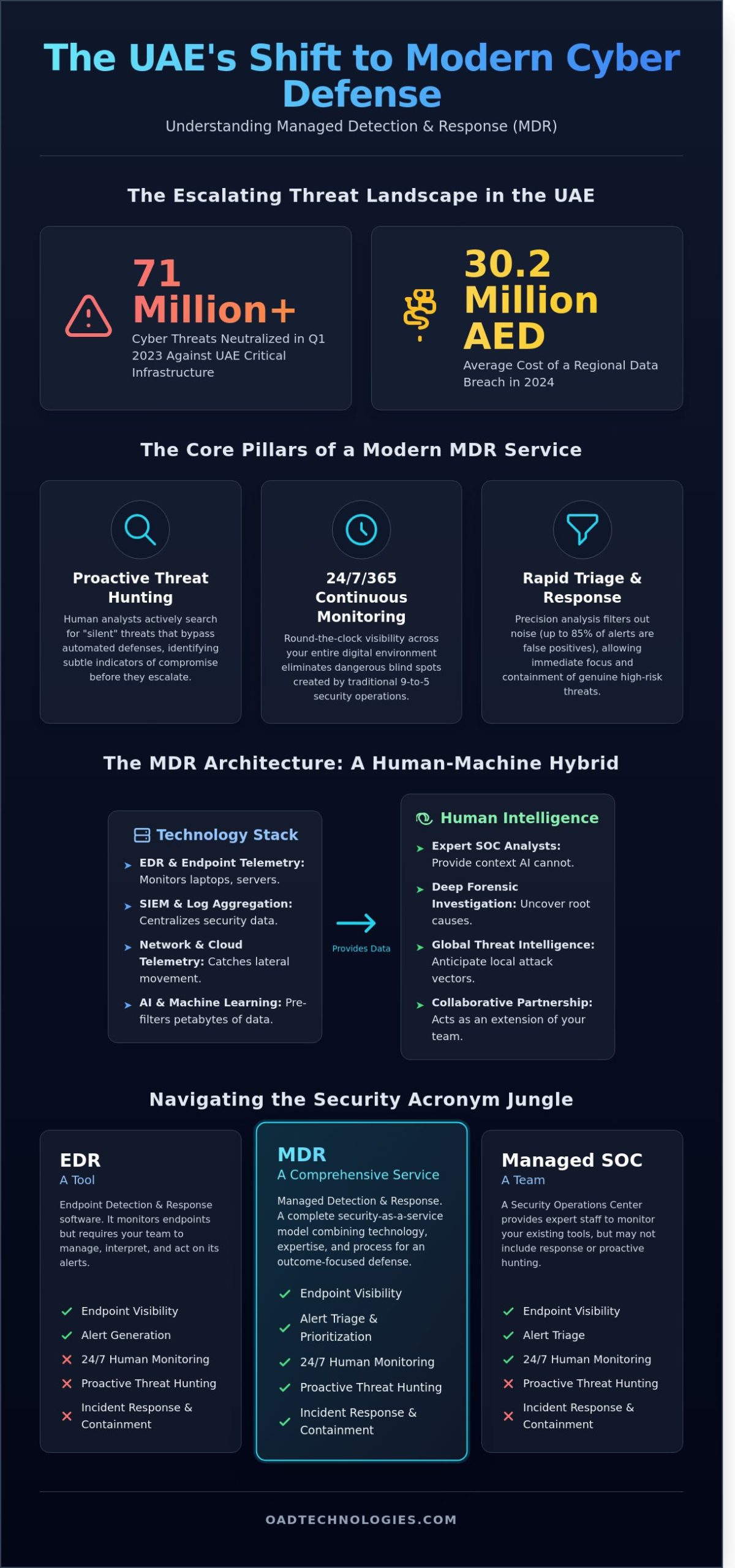
In the first quarter of 2023, the UAE Cyber Security Council neutralized over 71 million cyber threats targeting the nation’s critical infrastructure. You’ve likely found that even the most advanced security stack fails when there isn’t a dedicated expert to validate a midnight alert. With the average cost of a regional data breach climbing to 30.2 million AED in 2024, relying solely on automated software is a risk you can’t afford. This reality is driving the rapid adoption of managed detection and response as a strategic imperative for UAE enterprises seeking true digital resilience.
We recognize the challenge of maintaining 24/7 surveillance while navigating a local shortage of specialized security talent and strict regulatory reporting windows. This article demonstrates how MDR bridges the gap between sophisticated toolsets and human intelligence to safeguard your national digital assets. You’ll learn how to build a resilient security posture that satisfies DESC and NESA requirements while providing the rapid, human-led intervention needed to stop modern ransomware before it compromises your operations.
Key Takeaways
- Understand the critical shift from passive alerting to active, 24/7 response capabilities required to safeguard modern enterprise environments.
- Discover how managed detection and response bridges the gap between sophisticated machine capability and human expertise to create a bespoke security ecosystem.
- Learn to navigate the security acronym jungle by distinguishing between EDR tools, SOC teams, and the comprehensive service model of MDR.
- Align your digital infrastructure with the UAE Personal Data Protection Law (PDPL) and other rigorous national compliance frameworks to ensure governance excellence.
- Transition from a reactive defense posture to a state of continuous security maturity, future-proofing your enterprise against an evolving threat landscape.
Defining Managed Detection and Response (MDR) in the Modern Threat Landscape
Managed detection and response represents a fundamental shift in how UAE enterprises protect their digital infrastructure. It’s a specialized service providing 24/7/365 security monitoring, proactive threat hunting, and immediate incident response. While traditional security models rely on passive alerting, MDR focuses on active containment. This distinction is critical as we move toward 2026. Legacy systems like SIEM often fail to keep pace with polymorphic malware and sophisticated insider threats that bypass static defenses. By integrating human intelligence with advanced analytics, MDR acts as the essential bridge between complex technology sprawl and operational resilience.
The Core Pillars of a Modern MDR Service
- Proactive Threat Hunting: Our analysts don’t wait for a system alert to trigger. They actively search for “silent” threats that have already bypassed automated filters, identifying subtle behavioral patterns that indicate a breach.
- Continuous Monitoring: Cyber threats don’t adhere to business hours in Dubai or Abu Dhabi. MDR provides round-the-clock visibility, eliminating the dangerous blind spots created by traditional 9-to-5 internal monitoring.
- Incident Triage and Analysis: We focus on precision. By filtering out the noise, we ensure that the 85% of alerts typically classified as false positives don’t distract your team from genuine, high-risk signals.
Why Managed Security is No Longer Optional
The cybersecurity talent gap is a pressing reality for regional businesses. In 2024, reports indicated a global shortage of 4 million professionals; the UAE market faces similar pressures as demand for bespoke security expertise grows. Financial stakes are equally high. The average cost of a data breach in the Middle East reached AED 29.6 million in 2023, according to IBM research. Rapid response is the only way to mitigate these losses. Reducing “dwell time” from weeks to minutes prevents lateral movement and data exfiltration. MDR is the strategic outsourcing of technical threat management to achieve superior security maturity.
At OAD Technologies, we view this service as more than a safety net. It’s an architectural necessity that future-proofs your organization against an increasingly volatile threat environment. By combining machine speed with human intuition, we deliver a security posture that’s both scalable and resilient.
The Architecture of MDR: How Human Intelligence and Machine Capability Converge
Managed detection and response isn’t a single software agent or a disconnected call center. It’s a sophisticated ecosystem where human intuition directs machine precision. We act as the Expert Architect for your security, tailoring the stack to fit your specific digital assets rather than deploying a generic template. This approach ensures your defense isn’t just a shield but a customized fortress. By unifying EDR, SIEM, and network telemetry, we create a single pane of glass that provides total visibility across your environment. Machine learning algorithms pre-filter petabytes of data, allowing human analysts to focus on high-priority threats that actually matter.
Technology Stack: Beyond the Endpoint
Effective security requires more than just monitoring laptops. We integrate EDR with network and cloud telemetry to catch lateral movement early. Cloud Security Posture Management (CSPM) is vital here, especially as UAE firms move to hybrid environments to meet NESA or DESC compliance standards. OAD Technologies builds bespoke data strategies into the managed detection and response workflow. This ensures every data point serves a purpose, reducing noise and increasing the speed of containment. You can explore how we design these resilient architectures to protect your specific business goals.
The Human Element: The Real Intelligence Behind the Screen
Technology provides the data. SOC analysts provide the context. Our team performs deep forensic investigations that AI cannot replicate. We use global threat intelligence to anticipate local attack vectors targeting the UAE’s financial and energy sectors. This isn’t simple outsourcing; it’s a collaborative partnership. We act as an extension of your internal IT team, sharing knowledge and improving your long-term security posture. In 2023, UAE organizations using AI and automation in security saved an average of AED 1.2 million in breach costs, proving that the human-machine hybrid is the most efficient path to resilience.
MDR vs. Managed SOC vs. EDR: Navigating the Security Acronym Jungle
Enterprise security often gets buried under a mountain of terminology. To build a resilient architecture, you must distinguish between the tools you buy and the outcomes you achieve. Endpoint Detection and Response (EDR) is the specialized software installed on devices. A Security Operations Center (SOC) represents the human team and infrastructure managing your defense. Managed detection and response is the comprehensive service that fuses both into a single, proactive outcome.
EDR: The Foundation, Not the House
EDR provides the raw visibility into your network’s endpoints. While these tools offer automated blocking, they often generate a volume of telemetry that overwhelms internal teams. In the UAE, where 42% of organizations reported an increase in cyberattacks during 2023, relying solely on automation leaves gaps for sophisticated techniques that mimic legitimate user behavior. While EDR captures the data, MDR interprets and acts upon it to prevent breach escalation. Humans provide the critical context that algorithms miss; they ensure a legitimate administrative task isn’t mistaken for a lateral movement attempt.
MDR vs. Traditional MSSP Models
Traditional Managed Security Service Providers (MSSPs) operate on a notification basis. They monitor logs and send an email when something looks wrong, which doesn’t solve the immediate crisis. This forces your internal IT team to handle the heavy lifting of remediation. Managed detection and response shifts this dynamic by offering active containment. If a threat is detected in your Dubai office at 3:00 AM, the MDR provider isolates the affected machine immediately. It’s a model that allows for strategic growth without a linear increase in security headcount.
A basic 24/7 in-house SOC in the UAE requires at least 8 to 12 analysts to cover shifts effectively. With average Tier 1 analyst salaries in Abu Dhabi starting at AED 18,000 per month, plus licensing and infrastructure, annual costs easily exceed AED 2.5 million. Partnering with an MDR provider typically reduces these operational expenses by 60% while providing access to elite threat hunters. This approach offers several advantages:
- Direct Remediation: MDR providers don’t just tell you there’s a fire; they put it out.
- Root Cause Analysis: You receive detailed reports on how the threat entered, not just that it was stopped.
- Bespoke Tuning: The service adapts to your specific UAE regulatory requirements, such as NESA or Dubai ISR.
Choosing MDR isn’t just about outsourcing; it’s about upgrading your defensive posture. It bridges the gap between having the data and having the expertise to use it. For UAE enterprises, this transition is essential to maintain digital relevance in a market that doesn’t forgive downtime.
Strategic Implementation: Aligning MDR with National Compliance and Risk Frameworks
Managed detection and response serves as a vital catalyst for Governance, Risk, and Compliance (GRC) excellence within the UAE’s evolving regulatory environment. It isn’t just a defensive layer; it’s a reporting engine that satisfies the strict mandates of Federal Decree-Law No. 45 of 2021 regarding Personal Data Protection (PDPL). This law requires organizations to document and report high-risk data breaches within specific timeframes. Our MDR frameworks provide the forensic evidence and timestamped logs necessary to meet these legal obligations without delay.
Adhering to the Information Security Regulation (ISR) Version 2.0 is a mandatory requirement for Dubai government entities and their partners. MDR platforms automate the continuous monitoring required by ISR, replacing manual checklists with real-time visibility. Data sovereignty remains a core priority. Following UAE Cabinet Resolution No. 44 of 2021, OAD Technologies ensures that sensitive telemetry and log data stay within national borders. This localized approach eliminates the legal complexities of cross-border data transfers while maintaining high-speed processing.
Compliance as a Competitive Advantage
Audit cycles often drain internal resources. By utilizing managed detection and response logs, enterprises can reduce their annual Vulnerability Assessment and Penetration Testing (VAPT) preparation time by 40% based on 2023 performance benchmarks. These automated reports demonstrate ‘due diligence’ to regulators like the UAE Securities and Commodities Authority (SCA). It transforms security from a cost center into a strategic asset that supports national digital transformation goals, such as the UAE Strategy for Government Services 2023-2026.
Risk Management and Business Continuity
Technical threats must be translated into business risk metrics to gain C-suite buy-in. We focus on the financial impact. If a breach is intercepted before encryption, the metric isn’t just a blocked IP; it’s the preservation of AED 750,000 in daily operational revenue. MDR minimizes downtime by utilizing bespoke incident response playbooks. These playbooks are specifically tailored to UAE business hours and cultural contexts, ensuring that your 24/7 defense remains effective during local public holidays and the Monday to Friday work week. This precision ensures response times stay under 15 minutes for critical alerts.
Secure your organization’s future with a bespoke MDR strategy designed for UAE compliance.
Future-Proofing Your Enterprise: The OAD Technologies MDR Advantage
Most UAE enterprises operate in a state of perpetual catch-up. Cyber threats in the MENA region increased by 150% in 2023; relying on legacy systems is a liability that costs more than just data. OAD Technologies transforms this dynamic. We move your organization from reactive firefighting to a state of continuous security maturity. Our approach ensures that your defense evolves as quickly as the threat actors targeting the Gulf’s critical infrastructure. We bridge the gap between high-level innovation and practical results, ensuring your security spend translates directly into operational resilience.
Beyond Monitoring: Strategic Partnership
OAD Technologies operates as an Expert Architect. We reject the “one-size-fits-all” approach favored by global volume vendors. These generic models often fail to account for local regulatory requirements like NESA or the UAE Cybersecurity Council standards. Our managed detection and response services are bespoke; we build them to fit your specific risk profile. We integrate MDR with Data Loss Prevention (DLP) and Identity and Access Management (IAM) to create a unified defense. This holistic posture protects the perimeter and the data itself, utilizing intellectual advancement backed by rigorous engineering standards. We don’t just alert you to problems; we architect the solutions.
Getting Started with MDR
Success begins with a comprehensive technical security assessment. You can’t protect what you haven’t mapped. We analyze your environment to identify gaps before any deployment, ensuring your investment delivers a clear ROI. We measure success through hard data. We target a Mean Time to Respond (MTTR) of under 30 minutes for critical incidents. Reducing false positive rates by 45% within the first six months is a standard benchmark for our partners. This precision allows your internal teams to focus on strategic growth rather than alert fatigue. It’s time to move beyond basic visibility and embrace a sophisticated, proactive defense strategy.
Secure your digital future with OAD Technologies’ bespoke MDR services. Our team is ready to help you assess your current posture and implement a managed detection and response framework that meets the unique demands of the UAE market.
Architecting a Resilient Future for Your Enterprise
Cybersecurity in the UAE has evolved beyond simple perimeter defense. Today’s threat landscape requires 24/7 vigilance that aligns with the 2024 UAE Personal Data Protection Law (PDPL) and Information Security Regulation (ISR) standards. By converging human intelligence with machine capability, your organization moves from reactive patching to proactive resilience. You’ve seen how the right managed detection and response strategy doesn’t just block threats; it provides the visibility needed to scale digital operations. With data breach costs in the region averaging over 30 million AED according to 2023 industry reports, the cost of inaction is too high.
OAD Technologies acts as your Expert Architect, ensuring your security posture is built on a foundation of precision. We specialize in seamless integration with your existing SIEM and EDR stacks, so you don’t have to replace current investments to achieve world-class protection. Our team focuses on localized compliance and strategic growth, helping you navigate complex UAE regulatory requirements without sacrificing speed. It’s time to stop worrying about the next breach and start focusing on your core business objectives with total confidence.
Request a Strategic MDR Consultation with OAD Technologies to secure your digital infrastructure. We’re ready to help you master the modern threat landscape.
Frequently Asked Questions
What is the difference between MDR and an in-house SOC?
MDR provides 24/7 specialized expertise and advanced tools at a fraction of the cost of building a full-scale in-house Security Operations Center. Establishing a 24/7 SOC in Dubai typically requires an initial investment exceeding AED 1,500,000 for staffing and infrastructure alone. MDR eliminates these high capital costs while giving you immediate access to Tier 3 analysts who handle complex threats that internal teams might miss.
Can MDR help our company comply with the UAE Personal Data Protection Law (PDPL)?
MDR directly supports compliance with the UAE Federal Decree-Law No. 45 of 2021 by providing the mandatory technical measures required to protect personal data. It ensures your organization meets strict breach notification timelines and maintains the detailed audit logs necessary for regulatory audits. By monitoring data movement 24/7, it helps you avoid the substantial financial penalties associated with non-compliance in the UAE market.
Does MDR replace our existing antivirus or EDR software?
MDR doesn’t replace your Endpoint Detection and Response (EDR) tools; it optimizes them by adding a layer of human-led analysis and strategic response. While your antivirus blocks known malware, a managed detection and response service hunts for sophisticated, fileless attacks that bypass automated filters. It turns your existing software into a proactive defense system by providing the expert eyes needed to interpret complex security telemetry.
How does MDR handle data privacy and sovereignty for national enterprises?
We ensure data sovereignty by utilizing local UAE data centers in Dubai and Abu Dhabi to keep your sensitive telemetry within national borders. Our architecture aligns with the UAE Cyber Security Council standards, ensuring 100% of your metadata remains compliant with local residency requirements. This bespoke approach allows national enterprises to benefit from global threat intelligence without compromising their commitment to local data regulations.
What happens when the MDR team detects a critical threat at 3:00 AM?
The MDR team initiates an immediate containment protocol within 15 minutes of detection to isolate compromised systems and prevent lateral movement. Analysts perform remote triage to kill malicious processes or disable affected user accounts immediately. You’ll receive a verified alert and a clear remediation roadmap by 3:15 AM, ensuring the threat is neutralized long before your office opens for the day.
How long does it typically take to implement an MDR service?
A standard MDR deployment reaches full operational maturity within 30 to 45 days. The first 14 days focus on sensor deployment and log integration across your infrastructure. The remaining period involves tuning the environment to reduce false positives by 90%. This structured timeline ensures the service is perfectly calibrated to your specific network architecture and business logic.
Is MDR suitable for mid-sized enterprises, or is it only for large corporations?
MDR is specifically designed for mid-sized enterprises that lack the AED 500,000 annual budget required to staff just one internal security shift. It provides enterprise-grade resilience for companies with 200 to 1,000 employees by sharing the cost of elite talent and technology across multiple clients. This model allows mid-market firms to access the same sophisticated defense capabilities as global financial institutions.
How do MDR providers perform proactive threat hunting without disrupting business operations?
Analysts perform proactive threat hunting by analyzing metadata and system logs rather than running invasive scans on active production environments. This passive observation method ensures 0% downtime for your critical business applications. By searching for subtle Indicators of Compromise across the telemetry, the managed detection and response service identifies dormant threats and vulnerabilities before they can be exploited by attackers.