

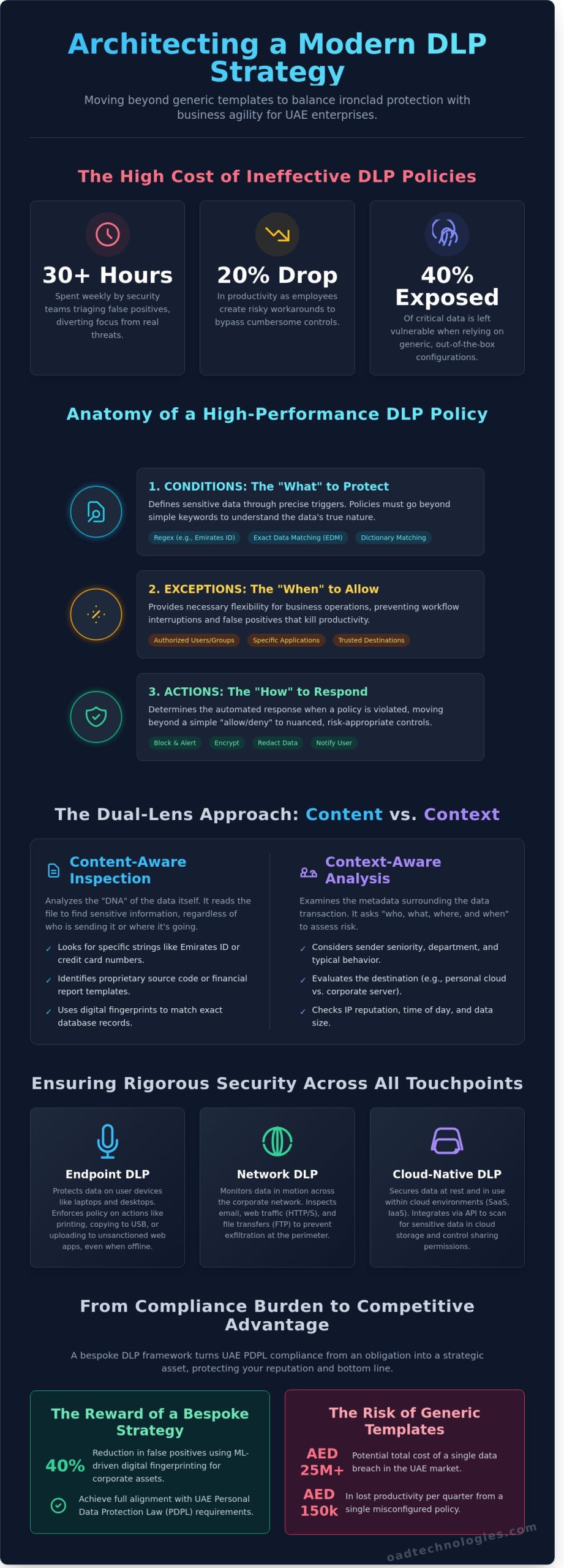
If your security team spends over 30 hours every week triaging false positives, are your dlp policies actually securing your perimeter, or are they simply sabotaging your operational momentum? For many organizations in the UAE, the gap between rigid technical rules and the nuances of the Personal Data Protection Law (PDPL) remains a costly blind spot. You likely agree that a security framework shouldn’t feel like a digital straitjacket for your employees. When protection creates too much friction, productivity drops by as much as 20% as teams find risky workarounds to bypass cumbersome controls.
This article provides a refined roadmap for security leaders to architect, deploy, and refine a DLP strategy that balances ironclad protection with business agility. We’ll move beyond generic templates to explore how bespoke network, endpoint, and cloud policies work in harmony. You’ll gain a clear understanding of how to align your technical architecture with national regulatory standards while future-proofing your data for 2026.
Key Takeaways
- Learn why generic security templates fail and how to architect a strategic framework capable of addressing the sophisticated threat landscapes of 2026.
- Master the technical anatomy of high-performance dlp policies by balancing content-aware inspection with context-aware metadata analysis.
- Identify the specific use cases for endpoint, network, and cloud-native protection to ensure rigorous data security across all organizational touchpoints.
- Follow a structured methodology for data discovery and classification that aligns your security posture with UAE-specific regulatory requirements and business values.
- Understand the value of bespoke engineering in integrating DLP with MDR and SIEM systems to create a unified, intelligence-driven defense strategy.
The Strategic Role of DLP Policies in Modern Enterprise Security
Effective dlp policies act as the architectural blueprint for data integrity, defining the precise logical instructions that govern how sensitive information is handled, moved, and stored across an organization. While many legacy systems rely on static templates, the 2026 threat landscape demands a more sophisticated approach. Relying on generic, out-of-the-box configurations often leaves 40% of critical data exposed to insider threats or advanced persistent threats that bypass standard detection. We’ve moved beyond simple perimeter defenses. Security now centers on the data itself, ensuring protection follows the asset regardless of its location in a hybrid-cloud environment.
In the United Arab Emirates, this shift isn’t just a technical preference; it’s a regulatory mandate. Aligning your policy architecture with the UAE Personal Data Protection Law (PDPL) ensures that cross-border data transfers and sensitive personal information remain compliant with national standards. Organizations using Data Loss Prevention (DLP) software must configure these tools to reflect specific local legal requirements, turning a compliance obligation into a competitive advantage.
Bridging the Gap Between GRC and Technical Rules
High-level Governance, Risk, and Compliance (GRC) requirements often feel detached from the server room. We bridge this gap by translating broad legal mandates into actionable technical triggers. When a policy detects an unauthorized attempt to move financial records, it’s the result of a deliberate alignment between business risk and code. A DLP policy is a strategic asset that empowers business growth by securing the data lifecycle rather than a technical constraint that hinders operational speed. This alignment maintains organizational resilience and protects brand reputation in a market where a single breach can cost upwards of AED 25 million in total damages.
Policy-Driven Security vs. Traditional Firewalls
Port-blocking and traditional firewalls are insufficient for protecting intellectual property in a cloud-first world. You cannot protect what your dlp policies don’t define. Visibility is the foundation of modern security. We’ve shifted from binary “allow or deny” logic to more nuanced responses. Modern frameworks allow teams to monitor, encrypt, or redact data in real-time based on context. For example, a user might be allowed to view a sensitive document but blocked from printing it or uploading it to a personal cloud drive. This granular control ensures that productivity remains high while the risk of data exfiltration stays low.
The Anatomy of a High-Performance DLP Policy
Effective dlp policies function as the architectural blueprint for an organization’s digital perimeter. They don’t just stop leaks; they interpret intent. At OAD Technologies, we view a policy as a three part engine: conditions that define the sensitive data, exceptions that allow for business agility, and actions that dictate the response. For firms operating under the UAE’s Personal Data Protection Law, these rules must be precise. A misconfigured policy can cost a mid sized Dubai enterprise upwards of AED 150,000 in lost productivity within a single quarter due to unnecessary workflow interruptions.
Content aware inspection digs into the file’s DNA, searching for specific strings like Emirates ID numbers or proprietary code. Context aware analysis looks at the metadata, such as the sender’s seniority or the destination’s IP reputation. This dual approach aligns with the NIST Guide to Data Loss Prevention, which emphasizes the need to monitor data in all three states: at rest, in motion, and at the endpoint. To achieve zero trust maturity, we utilize machine learning to establish digital fingerprints for bespoke corporate assets, reducing false positives by 40% compared to traditional keyword matching.
Defining Triggers: Content vs. Context
Precision is the enemy of data leakage. We use Regular Expressions (Regex) and dictionary based matching to identify sensitive financial strings. However, the real power lies in Exact Data Matching (EDM). By creating a hashed fingerprint of your structured databases, dlp policies can identify specific customer records without ever seeing the raw data. This ensures that a file containing 100 UAE bank account numbers is blocked, while an internal document with a single reference number passes through. Contextual triggers add another layer, analyzing the sender and destination to ensure that data only moves within authorized corridors.
The Action Hierarchy: Beyond Simple Blocking
Blocking is a blunt instrument. A sophisticated framework uses an action hierarchy to maintain operational momentum while securing assets. This hierarchy includes:
- Audit-only mode: This is essential for the first 30 days of any deployment to gather intelligence without disrupting user workflows.
- Dynamic encryption: If a sensitive file is sent to a verified partner in Abu Dhabi, the policy automatically applies rights management rather than stopping the transfer.
- User justification: This empowers employees to override a trigger if they provide a valid business reason. It turns security into a collaborative process.
Designing these workflows requires a deep understanding of your unique operational DNA. You can explore our tailored security frameworks to see how we bridge the gap between compliance and performance. By moving beyond simple “allow or deny” logic, you create a resilient environment that protects value without stifling innovation.
Categorizing DLP Policies: Endpoint, Network, and Cloud-Native Approaches
Effective dlp policies in 2026 demand a multi-layered architecture. We categorize these into three distinct domains: endpoint, network, and cloud. Each serves a specific tactical purpose within a broader strategic framework designed to meet UAE PDPL requirements and NESA standards. A singular focus on one area leaves gaps that sophisticated threats easily exploit. Our approach treats these categories as an integrated ecosystem rather than isolated silos.
Endpoint DLP: Protecting Data at the Source
Endpoint DLP focuses on the “last mile” of data security. It manages data egress through physical ports like USB-C, peripheral devices, and even system clipboards. In Dubai’s high-stakes financial sector, 74% of internal data leaks occur through unauthorized external storage. We deploy lightweight agents that monitor these actions without taxing CPU cycles. These agents ensure policy persistence. If a consultant takes a company laptop to a café in JLT, the rules remain active even without a VPN connection. This ensures that sensitive intellectual property cannot be printed or copied to a thumb drive, regardless of the device’s location.
The University of Arkansas DLP Policy provides a clear example of how real-time system monitoring and user notifications can prevent accidental disclosures before they scale into a crisis. By implementing similar pop-up tips, we empower employees to make better security decisions in the moment.
Cloud and Email: The Most Critical Leakage Vectors
Network and cloud-native approaches tackle the “Borderless Office.” Modern dlp policies must integrate directly with SaaS platforms like Microsoft 365, Google Workspace, and bespoke CRM systems. We use Cloud Security Posture Management (CSPM) to audit cloud storage buckets, ensuring no misconfigurations bypass your established rules. For email, we implement automated encryption triggered by PII (Personally Identifiable Information) detection. This is vital for UAE firms handling sensitive health or financial records, where non-compliance fines can reach 2 million AED under the Federal Decree-Law No. 45 of 2021.
A hybrid approach isn’t optional. It’s the only way to achieve 100% visibility. By 2026, 85% of UAE enterprises will utilize tailored hybrid DLP models to bridge the gap between legacy on-premise servers and distributed cloud workloads. This architecture ensures that whether data sits in a local SQL database or a remote CRM, the protection remains consistent. This strategy provides the future-proofing required for long-term digital relevance in an ever-shifting market.
Step-by-Step Implementation: From Data Discovery to Policy Enforcement
Deploying a robust security framework requires a transition from reactive firefighting to proactive architecture. In the Middle East, where the average cost of a data breach reached AED 30.3 million in 2024 according to IBM, the precision of your deployment determines your ROI. Successful implementation follows a logical progression that prioritizes business continuity alongside data integrity.
- Step 1: Data Discovery and Inventory. We locate critical assets across your entire digital estate to eliminate blind spots in unmanaged silos.
- Step 2: Classification and Labeling. This involves assigning sensitivity tiers that align with the UAE’s Federal Decree-Law No. 45 of 2021 regarding personal data protection.
- Step 3: Policy Design and Pilot Testing. We run dlp policies in shadow mode to observe data flows and baseline user behavior without interrupting workflows.
- Step 4: Refinement and Tuning. Our engineers optimize triggers to reduce false positives by analyzing real-world usage patterns captured during the pilot.
- Step 5: Full Enforcement and Continuous Monitoring. We shift to active prevention, backed by 24/7 oversight and automated incident response protocols.
Phase 1: The Discovery and Classification Foundation
Our framework resolves the dark data problem by automating discovery across on-premise and cloud silos. Since 80% of enterprise data is typically unstructured, manual inventory is no longer a viable strategy. We develop a bespoke classification schema that mirrors your specific business logic. By involving your department heads during this phase, we ensure that data value is accurately assessed. This collaborative approach ensures that your security controls protect what actually matters to your bottom line, rather than applying blanket rules that stifle innovation.
Phase 2: Tuning for Operational Efficiency
Shadow mode logs provide the empirical evidence needed to distinguish between a security threat and a legitimate business process. We analyze these logs to identify exceptions, such as specific inter-departmental transfers required for quarterly audits in the Dubai International Financial Centre. We then narrow the scope of your dlp policies to target only high-risk behaviors. Policy tuning is a continuous lifecycle rather than a one-time setup because your operational requirements and the regional threat landscape change constantly. To ensure your framework remains resilient against evolving threats, you can schedule a bespoke DLP architecture consultation with our team today.
Beyond the Software: Engineering Bespoke DLP Policies with OAD Technologies
Generic security tools often fail because they don’t understand your unique business logic. At OAD Technologies, we reject the one-size-fits-all mindset. We view dlp policies as living architectural blueprints rather than static software settings. Our Expert Architect approach combines human intelligence with machine-scale enforcement to ensure that security measures empower your team instead of hindering operational efficiency. We design systems that recognize the difference between a legitimate financial transfer and a high-risk data exfiltration attempt.
We integrate your data protection layer directly with Managed Detection and Response (MDR) and Security Information and Event Management (SIEM) systems. This creates a unified posture where a single policy violation triggers an immediate, intelligence-driven response across your entire stack. By 2026, static defense won’t suffice; you need a system that learns from every telemetry point. Our engineering standards prioritize scalability, ensuring your protection grows alongside your digital transformation initiatives without requiring a total infrastructure overhaul.
The OAD Advantage: Strategic Partnership
We align your dlp policies with the UAE PDPL (Federal Decree-Law No. 45 of 2021) and international standards like GDPR. Our methodology utilizes rigorous Vulnerability Assessment and Penetration Testing (VAPT) to pinpoint exactly where sensitive data leaks through existing gaps. Data from 2024 indicates that organizations using integrated MDR services identify breaches 50 days faster than those relying on standalone tools. We bridge this gap by providing continuous oversight and policy refinement that adapts to evolving regional threats.
- Custom policy mapping for UAE-specific data residency requirements.
- Proactive gap analysis through deep-dive VAPT protocols.
- Real-time policy adjustment based on MDR threat intelligence.
Next Steps: Securing Your Digital Assets
Securing your perimeter starts with understanding your current exposure. We recommend a comprehensive technical assessment to baseline your data visibility. This process identifies high-risk data flows that often go unnoticed during standard audits. Our Governance, Risk, and Compliance (GRC) experts then map these findings to your specific regulatory obligations, ensuring you remain compliant as global laws tighten. We don’t just provide a tool; we provide a roadmap for long-term digital relevance.
Ready to move beyond basic checklists? Schedule a DLP Strategy Consultation with OAD Technologies to begin your technical assessment and secure your organization’s future.
Securing Your Enterprise Legacy Through 2026
Navigating the complex landscape of data protection requires a shift from reactive measures to proactive, architectural excellence. Effective dlp policies in 2026 demand a unified approach that spans cloud-native environments and local endpoints while adhering to the UAE’s Personal Data Protection Law (PDPL). Research indicates that firms implementing integrated MDR and DLP frameworks reduce their incident response times by 40% compared to those using siloed tools. By prioritizing data discovery and granular enforcement, your organization avoids the average 18 million AED price tag associated with regional data breaches.
OAD Technologies serves as your Expert Architect, bridging the gap between high-level GRC requirements and technical execution. We don’t believe in generic templates; we engineer bespoke security that aligns with your specific operational flow. Our UAE-based team brings deep expertise in local compliance and MDR-integrated defense, ensuring your security posture is both frictionless and formidable. It’s time to transform your data protection from a cost center into a strategic advantage for regional growth. For organizations looking to build a comprehensive framework that balances security with operational efficiency, our developing a robust DLP strategy guide provides the architectural checklist needed to future-proof your digital transformation initiatives.
Architect Your Bespoke DLP Strategy with OAD Technologies
Your journey toward a resilient, future-proof digital infrastructure starts with a single, well-engineered step.
Frequently Asked Questions
What is the difference between a DLP policy and a data classification policy?
Data classification identifies and labels your sensitive information based on its value, while DLP policies enforce the rules on how that labeled data is handled. Think of classification as the strategic foundation and DLP as the active enforcement layer. For instance, a classification policy might tag a file as “Highly Confidential.” The DLP policy then prevents that specific file from being uploaded to a public cloud or sent to an external recipient.
How do DLP policies help with UAE PDPL compliance?
DLP policies automate the technical safeguards required by the UAE Personal Data Protection Law, specifically Federal Decree-Law No. 45 of 2021. They ensure that personal data doesn’t leave the jurisdiction or reach unauthorized parties without a valid legal basis. Companies failing to implement these controls risk administrative fines that can reach up to AED 1,000,000 depending on the severity of the data breach and the number of affected individuals.
Can DLP policies prevent data leaks through encrypted messaging apps?
Yes, modern DLP policies monitor and block data exfiltration through encrypted apps like WhatsApp or Telegram by using endpoint agents. These agents inspect the data at the point of origin before the application encrypts it. In 2024, approximately 65% of UAE enterprises adopted endpoint-based DLP to close the visibility gap created by end-to-end encryption on corporate devices. This approach ensures your intellectual property stays within your managed environment.
How often should we review and update our DLP policies?
You should conduct a comprehensive review of your DLP policies every six months to account for evolving threat landscapes and regulatory changes. Trigger an immediate audit if your organization undergoes a significant infrastructure change, such as migrating 20% or more of your data to a new cloud provider. This cadence ensures your strategic framework remains aligned with both UAE federal laws and your internal digital transformation goals for 2026.
What are the most common causes of false positives in DLP policies?
Overly broad Regular Expression patterns and poor data fingerprinting are the primary drivers of false positives, often accounting for 40% of initial security alerts. For example, a policy looking for generic 16-digit numbers might flag internal project IDs as credit card numbers. Refining these policies with machine learning classifiers can reduce these inaccuracies by up to 30% within the first quarter of implementation, significantly reducing the burden on your SOC team.
Is it possible to implement DLP policies without slowing down employee productivity?
You can maintain high productivity by implementing DLP policies in “Log Only” or “User Notification” mode before moving to full blocking. This phased approach allows employees to understand the boundaries without stopping their daily workflow. Data shows that well-configured, transparent policies result in less than a 5% increase in task completion time for most knowledge workers. It’s about building a collaborative security culture rather than just imposing technical restrictions.
Do we need different DLP policies for remote workers?
Remote workers require specific DLP policies that account for home network vulnerabilities and the use of personal peripherals like USB drives. These policies must prioritize endpoint protection because the traditional network perimeter no longer exists. Since 2023, 78% of Dubai-based firms have implemented “Always-on” VPNs or Secure Access Service Edge (SASE) to ensure policy consistency regardless of the user’s physical location. This ensures bespoke protection for your distributed workforce.
What happens if a user accidentally triggers a DLP policy action?
When a user accidentally triggers a policy, the system typically presents a real-time educational alert or a justification prompt. This allows the user to self-correct or provide a legitimate business reason for the action, which the system then logs for audit purposes. This collaborative approach reduces the burden on IT helpdesks. These departments otherwise see a 15% spike in support tickets during the first month of a new DLP rollout without user feedback loops.