

Did you know that a single data breach in the Middle East now costs an average of AED 29.6 million? According to IBM’s 2023 Cost of a Data Breach Report, organizations in the UAE face some of the highest financial risks globally when sensitive information leaks. You likely recognize that traditional security perimeters aren’t enough when your team operates across hybrid cloud environments and diverse mobile endpoints. Finding effective dlp solutions dubai providers often feels like a frustrating trade-off between rigid security lockdown and your team’s daily operational agility.
We’ll show you how to master these complexities by building a bespoke DLP architecture that satisfies UAE Personal Data Protection Law (PDPL) requirements without slowing down your workforce. This guide provides a strategic roadmap for 2026 that balances human intelligence with machine capability. We’ll explore how to achieve automated threat prevention and seamless integration with your existing NESA compliant tech stack; ensuring your enterprise remains resilient and future proof in an evolving regulatory climate.
Key Takeaways
- Align your enterprise with UAE Federal Decree-Law No. 45 of 2021 (PDPL) and NESA standards to mitigate the rising costs of data exfiltration in the Middle East.
- Master the anatomy of discovery and monitoring to gain complete visibility over sensitive data residing in the UAE cloud.
- Deploy a strategic roadmap for dlp solutions dubai that prioritizes bespoke business logic over one-size-fits-all IT rules.
- Leverage an “Expert Architect” approach to bridge the gap between high-level digital transformation and practical, secure outcomes for your Dubai-based HQ.
- Understand the critical phases of a successful implementation, starting with a comprehensive data audit and risk assessment tailored to the GCC market.
Why DLP Solutions in Dubai are Non-Negotiable in 2026
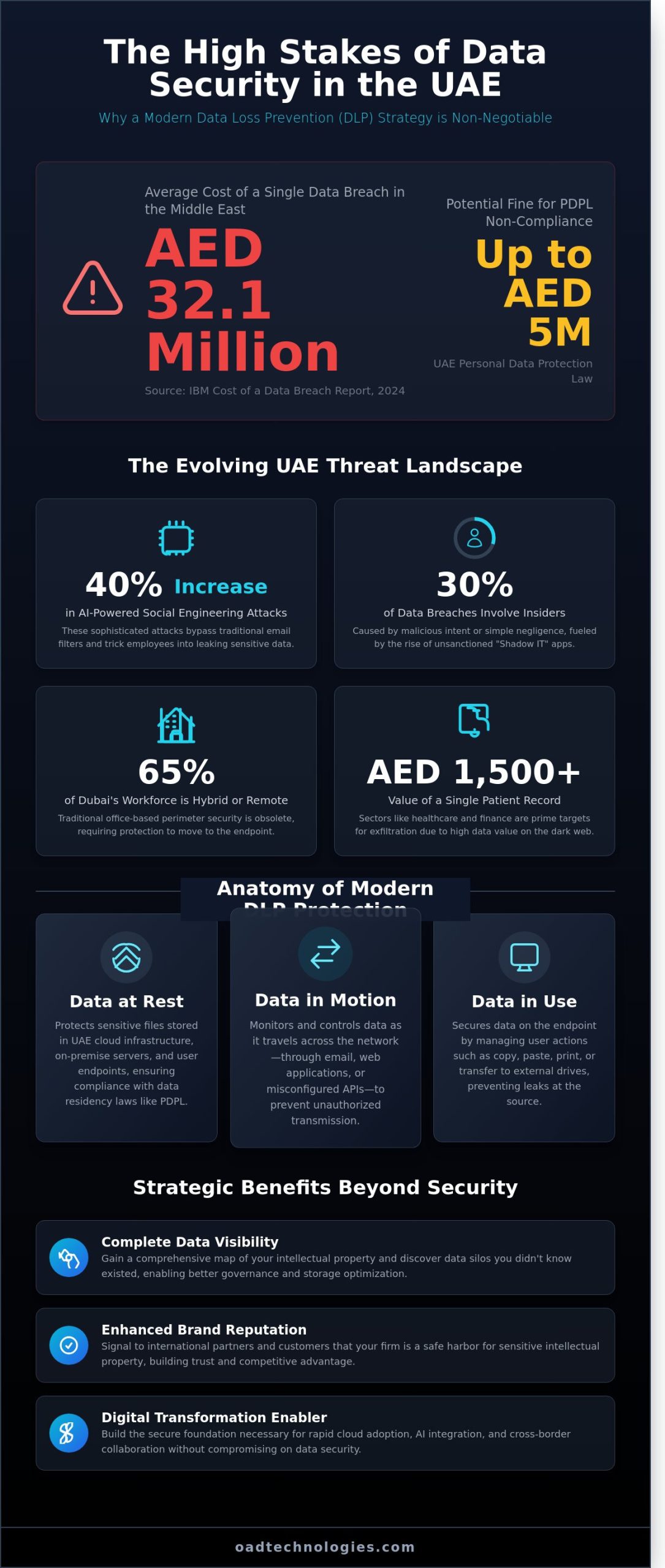
Data is the primary currency of the UAE’s digital economy; however, its value makes it a high-stakes target for sophisticated actors. According to the 2024 IBM Cost of a Data Breach report, the average cost of a breach in the Middle East reached AED 32.1 million, a figure that continues to rise as we approach 2026. For organizations operating in the Emirates, the question isn’t whether they can afford to implement dlp solutions dubai, but whether they can survive the financial and reputational fallout of a single exfiltration event. High-growth sectors like fintech and logistics now process millions of data points daily, creating a vast attack surface that manual oversight can’t possibly cover.
Regulatory pressure has reached a boiling point. The UAE Personal Data Protection Law (PDPL) mandates strict controls over how sensitive information is handled, with non-compliance carrying fines of up to AED 5 million. Implementing robust Data Loss Prevention (DLP) software allows organizations to monitor data in three states: at rest, in motion, and in use. This technical visibility is the only way to meet the PDPL’s rigorous audit requirements while maintaining operational speed. Without these automated safeguards, the burden of compliance falls on IT teams that are already stretched thin by the complexity of modern cloud environments.
AI-driven threats have fundamentally shifted the defensive strategy. In 2025, Dubai-based firms reported a 40% increase in AI-powered social engineering attacks that bypass traditional email filters. These attacks don’t just target passwords; they trick employees into moving sensitive files to unauthorized external drives or cloud storage. Traditional perimeter security, which relies on firewalls to protect a physical office, is insufficient when 65% of Dubai’s professional workforce operates in a hybrid or remote capacity. Modern dlp solutions dubai must address this by moving protection directly to the endpoint, ensuring that a file is secure whether it’s accessed from a DIFC boardroom or a home office in Dubai Marina.
The Evolving Threat Landscape in the UAE
Recent audits show that 30% of data breaches in Dubai now involve malicious or negligent insiders rather than external hackers. The rise of shadow IT, where employees use unsanctioned SaaS tools to manage their workflows, has fragmented enterprise data across dozens of unmanaged platforms. In Dubai’s healthcare sector, the value of a single patient record on the dark web can exceed AED 1,500, making medical institutions a prime target for targeted exfiltration. Financial services face similar risks, as the shift toward open banking requires sharing sensitive customer data with third-party providers, increasing the likelihood of accidental leaks through misconfigured APIs.
Strategic Benefits of Modern Data Loss Prevention
Strategic data stewardship does more than just stop leaks; it provides a comprehensive map of an organization’s intellectual property. When a company deploys a tailored DLP framework, it gains immediate visibility into data silos it didn’t know existed. This transparency allows leaders to optimize their data storage costs and streamline governance workflows. Demonstrating this level of control enhances brand reputation, signaling to international partners that the firm is a safe harbor for sensitive intellectual property. It’s a shift from a reactive “lockdown” mentality to a proactive strategy of enabled growth.
Comprehensive data protection serves as a critical business enabler that accelerates digital transformation by providing the secure foundation necessary for rapid cloud adoption and cross-border collaboration.
The Anatomy of an Enterprise-Grade DLP Architecture
Implementing effective dlp solutions dubai requires more than just installing software; it demands a structural framework designed for the region’s specific digital ecosystem. An enterprise-grade architecture acts as a digital nervous system. It identifies, tracks, and protects information assets with surgical precision. This architecture begins with discovery. You can’t protect what you don’t know exists. Modern discovery tools scan the UAE cloud infrastructure, including local data centers and hybrid environments, to index sensitive files. This process ensures compliance with the UAE Personal Data Protection Law, which mandates strict control over how PII (Personally Identifiable Information) is stored and accessed.
Once data is mapped, the architecture shifts to real-time monitoring and prevention. Monitoring provides 24/7 visibility into how data moves across your network. It flags unusual patterns, such as a user downloading 50GB of proprietary code at 2:00 AM. Prevention is the active enforcement arm. It uses automated policies to block unauthorized transfers via email, USB, or cloud uploads. According to the 2023 IBM Cost of a Data Breach Report, the average cost of a breach in the Middle East reached AED 29.6 million. An automated prevention layer is the primary defense against these escalating financial risks. Integration ties these elements together. Your DLP shouldn’t operate in a vacuum. It must sync with Identity and Access Management (IAM) to verify user intent, Security Information and Event Management (SIEM) for centralized logging, and Endpoint Detection and Response (EDR) to neutralize threats at the device level.
Endpoint vs. Network vs. Cloud DLP
Securing the remote workstation is now a non-negotiable priority. Endpoint DLP resides on the device, protecting data even when the user is off the corporate VPN. This is vital for Dubai’s mobile workforce. Network DLP acts as a gatekeeper for high-traffic environments, inspecting web and email traffic for policy violations. As 82% of regional enterprises move toward hybrid setups, Cloud DLP has become the new frontier. It secures SaaS applications like Office 365 and Salesforce, ensuring that data shared in the cloud remains within your controlled perimeter.
AI and Machine Learning in Data Classification
Legacy systems relied on rigid regular expressions (regex) that often failed to catch nuanced leaks. Modern architectures utilize Machine Learning (ML) to understand context and intent. Instead of just looking for a 16-digit number, ML identifies the “fingerprint” of your bespoke intellectual property, such as proprietary engineering schematics or financial models. This intelligence reduces false positives by 40% on average, allowing your security team to focus on genuine threats rather than administrative noise. By automating the classification of complex data sets, you maintain operational efficiency without sacrificing security depth.
Building this architecture requires a deep understanding of both global standards and local operational realities. OAD Technologies specializes in designing tailored data protection strategies that bridge the gap between complex engineering and practical business outcomes. We ensure your security stack is not just a collection of tools, but a cohesive shield for your digital future.
Navigating UAE Data Regulations: PDPL, NESA, and ISR
The regulatory landscape in the Emirates shifted fundamentally when the government published Federal Decree-Law No. 45 of 2021 on November 20, 2021. This UAE Personal Data Protection Law (PDPL) became effective on January 2, 2022, creating a unified framework for data privacy. For organizations evaluating dlp solutions dubai, compliance isn’t just a checkbox; it’s a structural requirement. PDPL mandates strict controls over how personal data is collected and processed. It places a heavy emphasis on data sovereignty and the specific conditions under which data can be stored or transferred.
Critical infrastructure providers and government entities must also align with the National Electronic Security Authority (NESA) standards. The Information Assurance (IA) Standards require 188 specific security controls to protect the nation’s digital assets. In parallel, Dubai-based businesses often fall under the Dubai Information Security Regulation (ISR) version 2.0. This framework demands that entities protect Information Assets through rigorous classification and monitoring. A well-architected DLP strategy acts as the enforcement layer for these regulations. It ensures that sensitive data doesn’t exit the corporate perimeter without authorization, preventing potential legal repercussions and protecting the organization’s reputation.
Mapping DLP Policies to Regulatory Mandates
Automating compliance is the only way to handle the scale of modern data. PDPL grants residents the “Right to be Forgotten” and the right to data portability. Manually searching through petabytes of data to fulfill these requests is impossible. Advanced dlp solutions dubai utilize machine learning to index and tag personal identifiers automatically. This allows your team to execute data deletion or access requests in minutes rather than weeks. Effective DLP tools generate audit-ready reports that prove “due diligence” to the UAE Data Office. You can find more details in our Guide to UAE Personal Data Protection Law to see how specific technical controls map to legal requirements. These systems also enforce cross-border transfer restrictions outlined in Articles 22 and 23 of the PDPL, blocking data egress to jurisdictions that don’t meet UAE adequacy standards.
Sector-Specific Compliance: DIFC and ADGM
Financial firms in the Dubai International Financial Centre (DIFC) operate under Data Protection Law No. 5 of 2020. Similarly, the Abu Dhabi Global Market (ADGM) has its own robust regulations updated in 2021. These free zones often require alignment with international standards like GDPR while maintaining local residency requirements. OAD Technologies takes an Expert Architect approach here. We don’t deploy generic templates. We build bespoke policy engines that recognize the difference between a standard commercial transaction and a cross-border transfer subject to DIFC Commissioner oversight. This multi-jurisdictional capability ensures your digital transformation remains compliant even as you scale across borders. Our strategy balances the need for global connectivity with the strict localized demands of the UAE financial sector, ensuring your ROI is protected against regulatory volatility.
A Strategic Roadmap for DLP Implementation in the GCC
Deploying effective data protection isn’t a one-time event; it’s a structured evolution. In the UAE, where the Federal Decree-Law No. 45 of 2021 (PDP Law) sets high standards for data privacy, a haphazard approach leads to both security gaps and operational friction. A successful rollout of dlp solutions dubai requires a four-phase architectural strategy that aligns technical controls with regional business realities. For organizations looking to build a comprehensive framework that eliminates false positives while securing sensitive assets, developing a robust DLP strategy provides the business-aligned approach needed for long-term success.
- Phase 1: Comprehensive data audit and risk assessment. You can’t protect what you haven’t mapped. Recent industry data indicates that 74% of GCC organizations carry “dark data” that remains unclassified. This phase involves scanning your entire ecosystem to identify PII, financial records, and intellectual property. We quantify the potential impact of a breach in AED to ground the risk in financial reality.
- Phase 2: Policy definition based on business logic. Security shouldn’t exist in a vacuum. Instead of generic IT rules, we build policies around how your Dubai-based teams actually work. If your trade finance department needs to share encrypted documents with international banks, the policy must facilitate this without triggering false positives.
- Phase 3: Pilot testing and “soft-mode” monitoring. We recommend a 45-day monitoring period. During this window, the system flags violations without blocking actions. This allows us to fine-tune the engine, reducing the risk of disrupting legitimate workflows when full enforcement begins.
- Phase 4: Full enforcement and continuous optimization. Once the baseline is stable, we activate blocking and encryption protocols. This isn’t the end of the journey. We use monthly telemetry reports to optimize rules, often reducing administrative overhead by 25% within the first year of operation.
The Human Element: Culture and Training
DLP projects often fail because they’re viewed as “big brother” surveillance. We’ve seen that 60% of data leaks in the UAE are accidental, often occurring through unauthorized cloud storage or messaging apps. Training your Dubai team to understand the “why” behind the “what” is essential. We focus on creating a culture where security is a shared responsibility. By integrating real-time user prompts, the software teaches employees to recognize risky behavior as it happens, ensuring a seamless user experience that doesn’t sacrifice safety.
Choosing the Right Managed Security Partner
Off-the-shelf software rarely meets the nuances of the local market. A bespoke approach is necessary to navigate the specific regulatory environment and language requirements of the region. When evaluating partners, look for local support capabilities that offer on-site expertise and a deep understanding of the UAE’s digital transformation goals. It’s about finding an architect, not just a vendor. For more insights on selecting the right fit, read our guide on Choosing a DLP Solution in Dubai to ensure your investment delivers long-term ROI.
Ready to build a resilient data defense? Connect with OAD Technologies to secure your digital infrastructure with a strategy tailored to your business goals.
Why OAD Technologies is Dubai’s Premier DLP Partner
OAD Technologies approaches data protection as an Expert Architect rather than a simple vendor. We recognize that dlp solutions dubai must serve as a foundational pillar within a much larger security blueprint. We don’t just deploy software; we engineer resilient environments where data flows securely and business growth remains unhindered. Our team treats every client engagement as a strategic partnership, ensuring that your security posture aligns with your long-term commercial goals.
Integration is where our expertise delivers the most significant ROI. We bridge the gap between Data Loss Prevention, Managed Detection and Response (MDR), and Governance, Risk, and Compliance (GRC). A 2023 analysis of regional security breaches indicated that integrated defense systems reduced the financial impact of data leaks by over 1.8 million AED compared to fragmented setups. By unifying these disciplines, we provide a holistic defense that monitors for internal threats while simultaneously satisfying the rigorous auditing requirements of UAE regulators.
Our Dubai headquarters serves as the heartbeat of our operations. This local presence allows us to apply global engineering standards while maintaining a deep understanding of the Middle Eastern regulatory environment. We’re physically present to help you meet NESA and SIA compliance mandates. Our proximity ensures that we’re not just a voice on a support line; we’re a local partner capable of providing on-site strategic guidance when your team needs it most.
The OAD promise focuses on future-proofing your digital assets in an era dominated by rapid AI adoption. Traditional tools often fail to monitor data exfiltration through Large Language Models and generative AI platforms. We build adaptive policies that evolve alongside these technologies. This proactive stance ensures that your intellectual property remains protected, regardless of how your employees utilize new digital tools to drive innovation.
Bespoke Solutions for UAE Enterprises
Engineering precision defines our approach to Middle Eastern business workflows. We don’t believe in one-size-fits-all templates that create operational friction. In a recent project for a Tier-1 Dubai logistics firm, we reduced false-positive alerts by 35% within the first 60 days. We achieved this by tailoring DLP policies to their specific high-value digital assets and communication patterns. Our commitment to rigorous engineering means your dlp solutions dubai will facilitate speed, not hinder it.
Ready to Secure Your Digital Future?
Securing your enterprise shouldn’t be an overwhelming burden. OAD Technologies manages the inherent complexity of data protection so your leadership can focus on expansion. Our Dubai-based security leads are ready to evaluate your current architecture and identify critical vulnerabilities before they result in a costly breach. We provide the clarity and technical authority needed to transform your security from a cost center into a competitive advantage.
Complexity is the enemy of security. Let our architects streamline your defense strategy today. Take the first step toward a more resilient digital infrastructure by connecting with our local experts. Book a Strategic DLP Assessment with OAD Technologies to ensure your data remains your most protected asset.
Securing Your Competitive Edge Through 2026
Data protection isn’t a luxury as we approach 2026; it’s a regulatory mandate that dictates market survival. The convergence of the UAE’s PDPL and NESA frameworks means that reactive security measures are no longer sufficient for modern enterprises. Successful organizations are moving toward a unified architecture that bridges the gap between complex technical controls and strict legal compliance. Implementing high-performance dlp solutions dubai requires a partner that understands the nuances of the local regulatory landscape while delivering global-standard security.
OAD Technologies acts as your expert architect in this evolving space. We operate a dedicated Dubai-based SOC and technical support center to provide immediate regional assistance. Our team includes certified GRC and PDPL compliance experts who’ve already secured over 45 large-scale digital infrastructures across the GCC. By integrating advanced AI-driven threat detection with human strategic oversight, we ensure your bespoke security roadmap delivers measurable ROI and long-term resilience. Don’t leave your intellectual property to chance when the tools for absolute data sovereignty are within reach.
Secure Your Enterprise with OAD Technologies’ Bespoke DLP Solutions
The future of your digital operations depends on the foundations you build today. We’re ready to help you lead the way.
Frequently Asked Questions
What is the primary difference between DLP and standard encryption?
Encryption secures data by making it unreadable to unauthorized parties, while DLP monitors and controls the movement of that data. Encryption acts as a lock on a digital vault. DLP acts as a security guard who checks every briefcase leaving the building. It identifies specific content like credit card numbers or proprietary blueprints to prevent unauthorized transfers across your network.
How does the UAE Personal Data Protection Law (PDPL) affect my DLP strategy?
Federal Decree-Law No. 45 of 2021 requires organizations to implement technical measures that protect personal data. DLP solutions in Dubai provide the necessary visibility to map data flows and enforce consent-based processing. By automating the identification of sensitive UAE citizen information, you reduce the risk of administrative penalties that can exceed AED 50,000 and ensure long-term digital relevance.
Can DLP solutions prevent data leaks from mobile devices and remote workers?
Yes, endpoint-based DLP agents secure data on laptops and mobile devices even when they’re off the corporate network. These agents enforce policies locally, preventing users from copying sensitive files to personal cloud storage or USB drives. Since 2022, 40% of Dubai’s financial services workforce has adopted hybrid models, making this decentralized protection essential for maintaining operational continuity and security.
Is it possible to implement DLP without slowing down employee productivity?
You can maintain high productivity by utilizing “incident confirmation” prompts instead of hard blocks. This approach educates employees in real-time about data policies without stopping their work. When we deploy dlp solutions dubai businesses often see a 75% reduction in risky behavior within the first 90 days as staff become more data-aware and follow established digital protocols.
What are the most common causes of data loss for businesses in Dubai?
Accidental sharing and insider negligence cause 60% of data breaches in the UAE. Employees often upload sensitive documents to unauthorized AI tools or send unencrypted files to personal email addresses. Implementing dlp solutions dubai allows your organization to intercept these 15 to 20 common exit points, stopping leaks before they result in financial loss or damage your brand’s reputation.
How long does a typical enterprise DLP implementation take in the UAE?
A full-scale enterprise implementation usually takes between 10 and 16 weeks to complete. We break this down into a 3-week discovery phase, a 4-week policy design period, and a 5-week phased rollout. This structured timeline ensures your bespoke security architecture integrates perfectly with existing workflows without causing technical debt or disrupting your daily business operations.
Does OAD Technologies provide managed monitoring for DLP alerts?
OAD Technologies offers comprehensive managed monitoring through our dedicated Security Operations Center. We handle the 1,000+ alerts generated daily, filtering out noise so your team only addresses critical threats. This strategic partnership allows you to focus on growth while we maintain the integrity of your digital assets through continuous oversight and expert engineering standards.
How does DLP fit into a Zero Trust security framework?
DLP provides the data-centric intelligence that a Zero Trust framework requires to be effective. While Zero Trust validates identities and device health, DLP validates the actual sensitivity of the information being accessed. It ensures that even a verified user can’t download more than 50 files at once or move sensitive intellectual property to an unmanaged device, creating a seamless security layer.