

By 2026, a standard firewall license will offer less protection than a single overlooked clause in your NESA compliance audit. You’ve likely realized that the search for cybersecurity companies in uae has shifted from a hunt for software resellers to a demand for strategic architects. It’s no longer enough to deploy tools; you need partners who can translate the UAE Information Security Regulation (ISR) into a functional defense strategy while managing the 3.4 million person global talent gap that affects local internal teams.
We agree that your priority isn’t just a list of vendors, but a resilient infrastructure that respects the UAE PDPL and guarantees long-term operational efficiency. This guide provides a professional framework to differentiate between basic technical execution and high-level consulting expertise. You’ll gain a curated shortlist of partners capable of delivering bespoke security solutions. We’ll outline exactly how to evaluate technical depth against local regulatory knowledge to ensure your digital transformation remains secure and compliant through 2026 and beyond.
Key Takeaways
- Understand the mandatory shift from reactive perimeter security to proactive resilience models within the unique 2026 UAE threat landscape.
- Identify the core technical capabilities required to evaluate top-tier cybersecurity companies in uae, ensuring they balance managed services with rigorous assessments.
- Master a 5-point strategic framework designed to help leadership distinguish genuine technical depth from sophisticated salesmanship.
- Leverage local regulatory expertise and GRC strategies to turn compliance into a competitive advantage while meeting international ISO standards.
- Discover the benefits of a bespoke architectural approach to security that prioritizes long-term digital resilience over generic, one-size-fits-all fixes.
The Evolving Cybersecurity Landscape in the UAE: Why 2026 Demands a New Approach
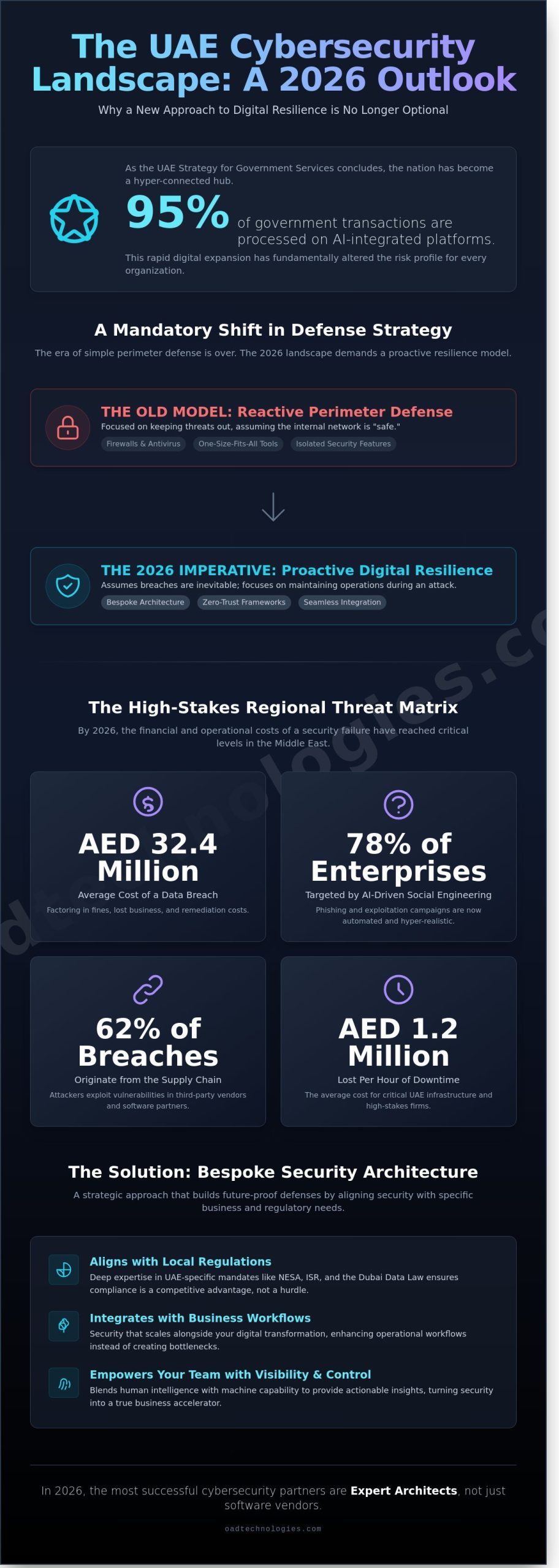
Digital transformation in the Emirates reached a critical velocity by the start of 2026. As the UAE Strategy for Government Services 2023-2025 concludes, the nation has transitioned into a hyper-connected hub where 95% of government transactions are now processed through AI-integrated platforms. This rapid expansion has fundamentally altered the risk profile for every organization in the region. Leading cybersecurity companies in uae are no longer just software vendors; they’ve become strategic partners essential for survival in a volatile digital economy.
The local industry has matured significantly since the era of the DarkMatter Group, moving from centralized, government-centric models to a more diverse ecosystem of private-sector innovators. We’ve moved past the days when a simple firewall was sufficient. In 2026, the focus has shifted from reactive perimeter defense to a model of proactive resilience. This approach assumes that breaches are inevitable and focuses on maintaining operational integrity during an active attack.
Strategic growth in the UAE now depends on how well a business can bridge the gap between innovation and security. With the regional cybersecurity market expected to exceed AED 15 billion by the end of this year, the demand for sophisticated, architecture-led solutions has never been higher. 2026 represents a turning point where legacy systems are finally being phased out in favor of cloud-native, zero-trust frameworks that can handle the sheer volume of data generated by the UAE’s smart city initiatives.
Regional Threats and the 2026 Outlook
State-sponsored actors and sophisticated criminal syndicates have refined their tactics, utilizing generative AI to create phishing campaigns that are nearly indistinguishable from legitimate corporate communications. A 2025 report indicated that 78% of UAE enterprises experienced at least one AI-driven social engineering attempt. The financial and energy sectors remain primary targets because of their central role in the GCC economy. By 2026, the average cost of a data breach in the Middle East has climbed to approximately AED 32.4 million, a figure that accounts for lost business, regulatory fines, and the immense cost of remediation.
- AI-Automated Exploitation: Vulnerabilities are now discovered and exploited by bots within seconds of a patch being released.
- Supply Chain Vulnerability: 62% of regional breaches now originate through third-party vendors or integrated software partners.
- Latency in Response: Every hour of downtime costs high-stakes UAE infrastructure firms an average of AED 1.2 million in lost productivity.
The Move Toward Bespoke Security Architecture
Off-the-shelf security software often fails to account for the unique regulatory requirements of the UAE, such as the NESA standards and the Dubai Data Law. Digital transformation requires integrated security that scales alongside the business. We don’t believe in one-size-fits-all deployments because they create gaps that attackers are quick to exploit. Instead, the market is moving toward bespoke security architecture that aligns with specific operational workflows and data sovereignty needs.
At OAD Technologies, we act as the Expert Architect, blending human intelligence with machine capability to build future-proof defenses. This involves more than just installing tools; it requires a deep understanding of how data moves through an organization. By 2026, the most successful cybersecurity companies in uae are those that prioritize seamless integration over isolated features. We focus on empowering your team with the right visibility and control, ensuring that security becomes an accelerator for business growth rather than a bottleneck. This collaborative approach ensures long-term ROI and protects your strategic relevance in an increasingly complex market.
Core Capabilities to Look for in UAE Cybersecurity Firms
Selecting a partner among cybersecurity companies in UAE requires looking beyond basic firewall management or antivirus subscriptions. By 2026, the sophistication of regional threats has forced a shift toward integrated security architectures. A top-tier firm doesn’t just sell software licenses; they architect a defense posture that aligns with specific local mandates like the Dubai Information Security Regulation (ISR) or NESA standards. This strategic alignment ensures that every dirham invested contributes to a measurable reduction in organizational risk. Effective firms bridge the gap between high-level innovation and practical business results by treating security as a continuous business enabler rather than a one-time technical hurdle.
Strategic security consulting is what separates market leaders from standard vendors. While many can implement a tool, few can design a bespoke security roadmap that accounts for the rapid digital transformation seen across the Emirates. This involves a deep dive into your operational workflows to ensure security measures don’t throttle productivity. According to a recent cybersecurity market analysis, the demand for these high-level managed services is outpacing hardware sales as enterprises seek long-term resilience. A local Security Operations Center (SOC) is a critical component of this resilience, providing onshore data residency and 24/7 monitoring that respects UAE data sovereignty laws.
Managed Detection and Response (MDR) & SIEM
Real-time monitoring is a requirement for survival in Dubai’s high-stakes financial and logistics sectors. Standard Endpoint Detection and Response (EDR) provides the necessary visibility, but MDR adds the human intelligence required to neutralize threats before they escalate. MDR is a continuous lifecycle of threat hunting and response. While a SIEM platform aggregates logs and generates alerts, a managed service ensures that a critical anomaly detected at 2:00 AM is triaged by an expert immediately. This proactive stance reduces the mean time to respond (MTTR), which is vital for maintaining operational uptime in a 24/7 economy.
This principle of proactive detection extends beyond the digital world. In the physical realm, for instance, advanced laser defense systems from specialists like AL Priority USA provide a similar layer of real-time threat awareness for key assets.
Data Loss Prevention (DLP) and Identity Management
The traditional network perimeter has dissolved, making data and identity the new focal points of defense. Modern cybersecurity companies in UAE prioritize Identity and Access Management (IAM) as the cornerstone of a Zero Trust architecture. This model operates on the principle of “never trust, always verify,” which is essential for protecting remote workforces and cloud-native applications. DLP solutions complement this by preventing unauthorized data exfiltration, whether it’s accidental or malicious. By 2026, 85% of UAE enterprises have integrated DLP to protect sensitive intellectual property from being leaked across unencrypted channels or personal cloud storage.
Technical Assessments: VAPT and Red Teaming
Regular Vulnerability Assessment and Penetration Testing (VAPT) is no longer just a best practice; it’s a regulatory requirement for most UAE industries. Automated scans are useful for identifying known patches, but they don’t catch complex logic flaws. Expert-led, manual penetration testing uncovers the vulnerabilities that automated tools miss by thinking like an attacker. Red Teaming takes this a step further by simulating a full-scale, multi-vector assault on your organization. This tests your technology, your internal processes, and your team’s response capabilities under pressure. These rigorous assessments provide the empirical data needed to justify security budgets and prioritize future investments.
Compliance as a Competitive Edge: Navigating UAE Regulations
Compliance isn’t a static checkbox; it’s a strategic pillar for scaling in the Middle East. For firms operating in 2026, Governance, Risk, and Compliance (GRC) serves as the blueprint for digital expansion. Leading cybersecurity companies in uae don’t just help you avoid penalties; they transform regulatory adherence into a badge of reliability that attracts high-value partners. By aligning internal protocols with the UAE’s National Cyber Security Strategy, businesses demonstrate a commitment to the nation’s vision of a secure digital economy.
Expert architects in the security space bridge the gap between local mandates and international standards like ISO 27001. This alignment ensures that a bespoke security framework built in Dubai or Abu Dhabi remains valid for global operations. The business impact of ignoring these laws is severe. Non-compliance with data residency or protection mandates can result in fines exceeding AED 1,000,000, alongside irreparable reputational damage. We view compliance as an engine for operational efficiency. When you streamline data workflows to meet legal standards, you naturally eliminate redundant processes and reduce your overall attack surface.
NESA and Dubai ISR Compliance
The National Electronic Security Authority (NESA) sets the benchmark for critical infrastructure protection through its Information Assurance (IA) Standards. These 188 security controls are mandatory for government entities and their partners. Similarly, the Dubai Information Security Regulation (ISR) dictates how city-level data must be handled. Specialist cybersecurity companies in uae provide tailored checklists that break these complex requirements into actionable technical milestones. This structured approach ensures that every layer of the organization, from the server room to the boardroom, understands its role in maintaining national security standards.
UAE Personal Data Protection Law (PDPL)
Federal Decree-Law No. 45 of 2021, known as the UAE PDPL, changed how data controllers and processors handle sensitive information. It introduces strict requirements for consent, data portability, and the right to be forgotten. A critical component involves cross-border data transfers; firms must ensure that cloud providers maintain local data residency where required or use approved transfer mechanisms. Integrating these requirements into a broader Data Loss Prevention (DLP) strategy is essential. It’s about future-proofing your data architecture so that privacy is baked into the code, not bolted on as an afterthought. This proactive stance ensures that your scalability isn’t hampered by sudden regulatory shifts.
Modern compliance frameworks drive tangible ROI by reducing the cost of audits and accelerating the onboarding of new clients. When a business can prove its maturity through verified NESA or PDPL adherence, it shortens the sales cycle for enterprise contracts. We see this as the intersection of human intelligence and machine capability. Automated compliance monitoring tools now allow firms to maintain a “continuous compliance” posture, alerting teams to drifts in real-time. This methodology replaces the frantic, once-a-year audit prep with a steady, deliberate rhythm of security excellence. It’s a shift from being a reactive entity to becoming a proactive leader in the UAE’s digital landscape.
How to Evaluate Cybersecurity Providers: A 5-Point Framework
Selecting a partner among the many cybersecurity companies in uae requires a methodology that looks beyond glossy brochures. By 2026, the average cost of a data breach in the Middle East is projected to exceed AED 30.2 million. This financial risk demands a structured evaluation process to ensure your chosen firm provides genuine protection rather than just compliance checkboxes. You must move past the sales pitch to examine the engineering reality of their operations.
- Step 1: Assessing Technical Depth vs. Salesmanship. Demand to speak with the lead engineers who will handle your account. If the technical team can’t explain their methodology for lateral movement detection without using marketing slides, they lack the depth required for high-stakes environments.
- Step 2: Verifying Local Regulatory Expertise. Your provider must demonstrate a track record with UAE National Electronic Security Authority (NESA) standards and Dubai Electronic Security Center (DESC) frameworks. Verify their history of successful audits within the UAE’s specific legal landscape.
- Step 3: Analyzing Bespoke Solution Design. Avoid “security-in-a-box” vendors. A 2025 survey found that 82% of successful breaches occurred in environments using generic, non-optimized security configurations. Every architecture should be tailored to your specific data flows.
- Step 4: Evaluating Post-Deployment Support. Security isn’t a one-time installation. Analyze their Managed Detection and Response (MDR) capabilities. A partner should function as an extension of your own team; providing 24/7/365 monitoring from a local or hybrid Security Operations Center (SOC).
- Step 5: Reviewing Technology Partnerships. Check for Tier 1 alliances with global leaders like CrowdStrike, Microsoft, or Palo Alto Networks. These partnerships ensure your provider has early access to threat intelligence and advanced patches.
Vetting the Technical Team
You should scrutinize the certifications of the Vulnerability Assessment and Penetration Testing (VAPT) and MDR teams. Ask if they hold OSCP or CREST certifications; these are the industry benchmarks for technical proficiency. A reliable partner doesn’t just deliver a report; they exhibit a “can-do” attitude backed by rigorous engineering standards. They should proactively suggest architectural improvements that boost your ROI and operational efficiency. Look for firms that prioritize long-term strategic growth over quick, superficial fixes.
Analyzing the Service Level Agreement (SLA)
The SLA must contain concrete metrics rather than vague promises. Focus on Mean Time to Detect (MTTD) and Mean Time to Respond (MTTR). In the current threat climate, a critical incident response time should be capped at 15 minutes. Ensure the agreement mandates transparency in reporting and establishes clear communication cadences. Avoid generic buzzwords; look for industry-standard professional terminology that defines exactly how the firm will mitigate threats. This precision signals a commitment to high-quality craftsmanship and direct accountability.
Building a resilient defense starts with choosing a partner that understands the intersection of human intelligence and machine capability. If you’re ready to move beyond generic security and implement a high-performance strategy, you can consult with our expert architects at OAD Technologies to future-proof your digital assets.
OAD Technologies: Your Expert Architect for Digital Resilience
OAD Technologies doesn’t just deploy security tools; we engineer digital fortresses. We recognize that 82% of UAE enterprises now prioritize cyber resilience over simple perimeter defense. Our approach bridges the gap between high-level innovation and practical business results. We treat cybersecurity as a structural discipline. This “Expert Architect” philosophy ensures that every layer of your infrastructure supports your long-term growth rather than hindering operational speed. As one of the leading cybersecurity companies in uae, we provide the technical authority required to transform security from a cost center into a strategic asset.
We focus on bespoke, future-proofed security solutions because the threat landscape in the Middle East is evolving rapidly. In 2025, local firms faced a 14% increase in targeted ransomware attempts compared to the previous year. Standardized, one-size-fits-all software cannot keep pace with these localized threats. Our core strengths are designed to address these specific challenges through four pillars:
- Data Loss Prevention (DLP): We implement granular controls that protect intellectual property while maintaining the seamless flow of data across remote and hybrid environments.
- Managed Detection and Response (MDR): Our 24/7 monitoring services utilize local intelligence to identify and neutralize threats before they impact your bottom line.
- Vulnerability Assessment and Penetration Testing (VAPT): We conduct rigorous, simulated attacks to identify weaknesses, providing a roadmap for remediation that prioritizes your most critical assets.
- Governance, Risk, and Compliance (GRC): We ensure your business remains fully aligned with UAE regulations, including NESA and the Dubai Information Security Regulation (ISR), saving firms an average of 350,000 AED in potential non-compliance penalties.
Why OAD Technologies is Different
Our methodology centers on the intersection of human intelligence and advanced machine capability. We don’t believe in replacing people with automated scripts. Instead, we empower your team by providing them with high-fidelity data and streamlined workflows. This collaborative approach ensures that your staff becomes your strongest line of defense. By applying our Expert Architect philosophy, we build scalable systems that adapt as your business grows, ensuring you don’t have to overhaul your security stack every 18 months. We provide the precision of an engineering firm with the agility of a tech startup.
Next Steps for Your Security Strategy
Modernizing your defense starts with a clear understanding of your current posture. We recommend initiating a comprehensive technical assessment or a GRC audit to identify immediate gaps in your compliance framework. Our consultants specialize in developing bespoke DLP and Identity and Access Management (IAM) roadmaps that align with your specific industry requirements, whether you operate in finance, healthcare, or logistics. We take direct accountability for the solutions we design, ensuring that your digital transformation remains secure at every milestone. To start your journey toward a more resilient infrastructure, you can Secure your digital future with a bespoke consultation from OAD Technologies and join the ranks of the most secure cybersecurity companies in uae today.
Elevating Your Defense for the 2026 Threat Landscape
The roadmap to 2026 requires a transition from reactive protection to proactive digital resilience. As UAE regulatory frameworks like NESA and SIA standards tighten, your selection of cybersecurity companies in uae becomes a defining factor for your long-term operational continuity. Effective security now demands a dual focus on rigorous VAPT assessments to preemptively close gaps and specialized DLP strategies that lock down sensitive data across every touchpoint.
OAD Technologies delivers this precision from our Dubai-based headquarters, combining deep local regulatory knowledge with an Expert Architect approach to bespoke enterprise security. We don’t offer generic templates; we build tailored infrastructures designed for your specific scale and risk profile. Our team focuses on high-priority VAPT and DLP implementations that turn compliance into a measurable competitive advantage for your business.
Securing your future starts with a strategy that’s as ambitious as your growth targets. Let’s engineer a resilient environment that protects your innovation and your reputation.
Book a Strategic Security Consultation with OAD Technologies
Frequently Asked Questions
How many cybersecurity companies are there in the UAE?
There are approximately 380 registered cybersecurity companies in UAE as of early 2026, according to recent market analysis from the UAE Cybersecurity Council. This count includes specialized local boutique firms and regional headquarters for international tech giants. This growth reflects a 15% increase from 2024 figures, driven by the nation’s rapid digital transformation and the expansion of the Dubai International Financial Centre (DIFC) and Abu Dhabi Global Market (ADGM).
What are the most common cyber threats facing UAE businesses in 2026?
AI-driven social engineering and sophisticated ransomware-as-a-service (RaaS) represent the primary threats to UAE enterprises in 2026. Data from the 2025 Cyber Threat Report indicates that 62% of local businesses experienced at least one targeted phishing attempt using deepfake audio or video. Additionally, supply chain attacks targeting the logistics and energy sectors have surged by 22% since the previous year, necessitating more robust defensive architectures for every organization.
Is it better to hire a local UAE cybersecurity firm or a global provider?
Choosing a local UAE firm is often superior for organizations that require deep alignment with regional regulations like NESA or the Dubai ISR. Local partners provide on-site response capabilities and understand the specific nuances of the GCC threat landscape. While global providers offer broad intelligence, a local “Expert Architect” approach ensures your security framework is bespoke to the UAE legal environment and operational culture, providing better long-term ROI.
What is the difference between VAPT and a simple vulnerability scan?
A simple vulnerability scan is an automated tool that identifies known security flaws, while Vulnerability Assessment and Penetration Testing (VAPT) includes manual exploitation by expert ethical hackers. Think of a scan as a digital checklist and VAPT as a rigorous stress test of your entire perimeter. In 2026, 85% of successful breaches occur through vulnerabilities that automated scans often miss, making manual VAPT essential for maintaining true digital resilience.
How much does a comprehensive cybersecurity assessment cost in Dubai?
A comprehensive cybersecurity assessment in Dubai typically ranges from AED 25,000 for small enterprises to over AED 150,000 for complex, multi-site infrastructures. These costs vary based on the number of endpoints, the complexity of your cloud architecture, and the specific compliance frameworks required. Investing in a tailored assessment provides a clear roadmap for strategic growth and ensures your assets are protected against potential data breach penalties and operational downtime.
What are the mandatory cybersecurity compliance standards for UAE government entities?
UAE government entities must comply with the National Electronic Security Authority (NESA) Information Assurance Standards and the Dubai Information Security Regulation (ISR). Version 2.0 of the ISR remains a critical benchmark for all Dubai-based public sector organizations. These standards mandate rigorous controls across 13 distinct domains; they require annual audits to ensure that the nation’s critical digital infrastructure remains resilient against evolving global threats and sophisticated state-sponsored actors.
How can a cybersecurity company help with UAE PDPL compliance?
Specialized cybersecurity companies in UAE assist with Federal Decree-Law No. 45 of 2021 (PDPL) by implementing automated data discovery and encryption protocols. They bridge the gap between legal requirements and technical execution, ensuring that personal data processing meets the strict standards set by the UAE Data Office. This involves creating bespoke data protection impact assessments (DPIAs) that safeguard citizen privacy while enabling seamless digital operations for your growing business.
What should I look for in a Managed Detection and Response (MDR) provider?
You should prioritize providers that offer a 24/7 Security Operations Center (SOC) based within the UAE to ensure data sovereignty and low-latency response. Effective MDR goes beyond simple monitoring; it requires proactive threat hunting and human-led analysis to identify zero-day exploits. Look for a partner that integrates machine capability with human intelligence, providing a future-proof shield that scales alongside your company’s digital transformation journey and protects your reputation.