

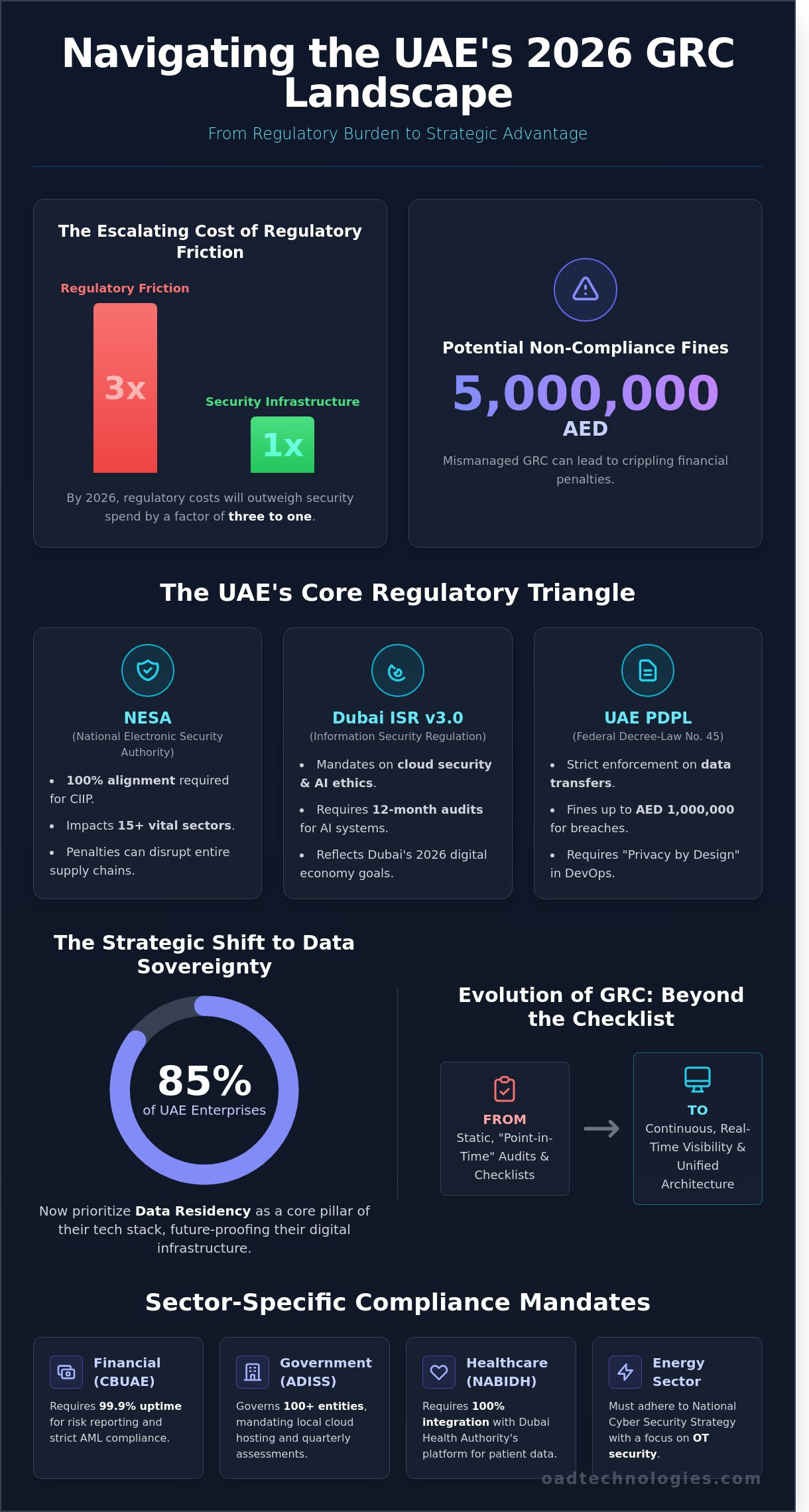
By 2026, the cost of regulatory friction in the Emirates will outweigh the cost of advanced security infrastructure by a factor of three to one. As the UAE PDPL matures, businesses face a fragmented landscape where NESA, ISR, and sectoral mandates often pull in different directions. You’ve likely realized that traditional, siloed approaches to risk management can’t keep pace with these sovereign data requirements. This is why specialized grc consulting services uae have shifted from a luxury to a technical necessity for any firm handling sensitive local data.
It’s exhausting to manage policy documents that don’t reflect your actual technical controls, especially when non-compliance fines can exceed 5,000,000 AED. We’ll show you how to build a unified compliance roadmap that transforms these regulatory burdens into a strategic advantage. You’ll learn how to align your security spend with specific UAE mandates while reducing the risk of data breaches through a bespoke framework designed for the 2026 digital economy.
Key Takeaways
- Discover how modern GRC is evolving into a unified technical architecture designed specifically to meet the UAE’s stringent sovereign data mandates.
- Move beyond the “checklist trap” by learning how to transition from static annual audits to continuous, real-time risk monitoring.
- Master a localized 5-step roadmap for implementing grc consulting services uae that benchmark your operations against NESA and PDPL standards.
- Understand how a bespoke GRC framework serves as a strategic growth enabler, allowing your business to expand globally while remaining resilient locally.
- Learn how OAD Technologies’ “Expert Architect” approach synergizes GRC with managed security to future-proof your digital infrastructure in Dubai and beyond.
The Evolution of GRC Consulting Services in the UAE for 2026
The definition of Governance, risk, and compliance (GRC) has transformed from a fragmented checklist into a unified technical architecture. In the 2026 regulatory climate, UAE enterprises are moving away from generic global frameworks to embrace sovereign data mandates. This shift requires more than just a survival mindset; it demands a strategic “Expert Architect” who can bridge the gap between high-level innovation and practical business results. OAD Technologies views this evolution as a blueprinting process where software scalability meets rigorous local law. We don’t believe in one-size-fits-all approaches; we build bespoke systems that turn compliance into a competitive advantage.
By January 2026, the grace periods for Federal Decree-Law No. 45 of 2021 (PDPL) will have expired for most legacy systems. This makes grc consulting services uae essential for mapping data flows across local borders. The goal is no longer just “being compliant.” It’s about future-proofing your digital infrastructure. 85% of UAE enterprises now prioritize data residency as a core pillar of their tech stack. Our role is to ensure that your governance structures are as ambitious as your growth targets, providing a stable foundation for long-term operational efficiency.
Key UAE Regulations: NESA, ISR, and PDPL
The National Electronic Security Authority (NESA) has tightened its Critical Information Infrastructure Protection (CIIP) policy. For 2026, compliance isn’t optional for the 15+ sectors identified as vital to national security. Organizations must demonstrate a 100% alignment with NESA’s mandatory controls to avoid penalties that can disrupt entire supply chains. Meanwhile, Dubai ISR (Information Security Regulation) v3.0 has introduced specific requirements for cloud security and AI ethics. It’s a move that reflects Dubai’s 2026 digital economy goals, requiring entities to audit their automated decision-making processes every 12 months.
The UAE Federal Decree-Law No. 45 of 2021 (PDPL) has entered a phase of strict enforcement. The UAE Data Office, established in 2022, now actively monitors cross-border data transfers. Organizations failing to implement “Privacy by Design” face administrative fines that can reach AED 1,000,000 for significant breaches. Utilizing professional grc consulting services uae allows firms to integrate these legal requirements directly into their DevOps pipelines, ensuring that every line of code respects UAE data sovereignty.
Industry-Specific Mandates: CBUAE and ADISS
Financial institutions operate under the watchful eye of the Central Bank of UAE (CBUAE). The Consumer Protection Regulation (CPR) mandates that banks maintain a 99.9% uptime for risk reporting systems. It’s a high bar that requires a sophisticated blend of technical authority and strategic partnership. In Abu Dhabi, the Abu Dhabi Information Security Standard (ADISS) governs over 100 government and semi-government entities. By 2026, ADISS requires all covered entities to migrate to secure, locally hosted cloud environments, prioritizing resilience against sophisticated cyber threats.
- CBUAE Compliance: Focuses on anti-money laundering (AML) and the “Stored Value Facilities” regulation.
- ADISS Requirements: Mandates quarterly vulnerability assessments and strict supply chain risk management.
- Healthcare (NABIDH): Requires 100% integration with the Dubai Health Authority’s digital platform for secure patient data exchange.
- Energy Sector: Must adhere to the UAE’s National Cyber Security Strategy 2019-2024 updates, focusing on OT (Operational Technology) security.
Navigating this landscape requires a partner who acts as an extension of your own team. At OAD Technologies, we provide the technical precision needed to solve complex GRC challenges. We don’t just identify pain points; we propose sophisticated technological solutions that empower your people and protect your brand’s long-term digital relevance.
The Pillars of a Modern GRC Framework: Beyond the Checklist
Modern GRC isn’t a static document or a yearly exercise. It’s a dynamic ecosystem where technical controls and business strategy converge to protect digital assets. Effective grc consulting services uae providers shift the focus from manual “point-in-time” audits to continuous, real-time visibility. Strategic governance ensures your security posture supports the UAE’s ambitious digital economy goals; it’s about aligning every technical control with high-level business objectives to drive ROI. When security supports growth rather than hindering it, compliance becomes a competitive advantage.
Compliance orchestration is the engine of this framework. UAE enterprises often face a complex web of overlapping mandates, including NESA, Dubai ISR, and the UAE PDPL. Managing these through spreadsheets is no longer viable. Automation streamlines this by mapping shared controls across different standards, reducing the reporting burden by up to 45%. For instance, financial institutions must align their cybersecurity frameworks with UAE Central Bank regulations to ensure operational resilience and avoid heavy penalties. By 2025, 70% of regional enterprises will likely adopt automated GRC platforms to handle these high-frequency regulatory updates.
The integration of technical controls like Identity and Access Management (IAM) and Data Loss Prevention (DLP) into the GRC lifecycle is mandatory for modern resilience. These tools provide the raw telemetry needed for continuous monitoring. Instead of hoping a policy is followed, you have the data to prove it. This shift from reactive to proactive governance allows businesses to identify gaps before they’re exploited by external threats.
Data-Centric Governance and DLP Integration
Data is the lifeblood of the UAE’s digital market, making its protection a primary governance pillar. Federal Decree-Law No. 45 of 2021 (PDPL) demands strict controls over personal data processing. Automated DLP policies act as the technical enforcer of these legal requirements, preventing unauthorized transfers and ensuring data sovereignty. In multi-cloud environments, Cloud Security Posture Management (CSPM) provides the visibility needed to maintain compliance across local providers like G42 or international platforms. This technical layer ensures that data-centric governance isn’t just a policy on paper but a functional reality that protects your brand’s reputation.
Risk Management as a Technical Discipline
Risk management has evolved into a quantitative science. We’ve moved past vague “high” or “low” risk labels. Instead, we quantify cyber risk in AED to provide the C-suite with actionable financial data. A single data breach in the Middle East cost an average of AED 29.6 million in 2023, according to industry benchmarks. Utilizing Vulnerability Assessment and Penetration Testing (VAPT) allows organizations to validate the effectiveness of their GRC controls. This transition from reactive patching to proactive threat modeling ensures that your bespoke security architecture remains resilient. By measuring risk against actual technical vulnerabilities, you can prioritize investments where they’ll have the most significant impact on your security posture.
Choosing the right grc consulting services uae partner means finding an architect who understands that compliance is the floor, not the ceiling. It requires a commitment to precision and high-quality craftsmanship to build a framework that scales with your business. This structured approach ensures that your organization isn’t just ticking boxes but is actively shaping its digital future with confidence and direct accountability.
Compliance vs. Resilience: Addressing the GRC Misconception
Many organizations in Dubai and Abu Dhabi fall into the checklist trap. They treat audits as a seasonal hurdle, believing that a passed inspection equals a secure perimeter. It’s a dangerous assumption. According to the 2023 IBM Cost of a Data Breach Report, the average cost of a data breach for Middle Eastern companies reached AED 29.6 million, the second highest globally. This figure highlights a critical gap: being compliant doesn’t mean you’re resilient. Our grc consulting services uae move beyond the binary “yes/no” audit mindset to build a defensive posture that actually survives a breach attempt.
We view GRC as a strategic growth engine rather than a regulatory burden. For a UAE firm eyeing expansion into European or North American markets, a robust GRC framework serves as a universal passport. It signals to international partners that your data sovereignty and privacy controls meet global benchmarks like GDPR or SOC2. We help you reduce the “Compliance Tax,” the heavy operational cost of manual evidence gathering, by implementing automated frameworks. This shift allows your team to focus on innovation while the system handles the repetitive validation of controls.
OAD Technologies bridges the gap between high-level policy and technical execution. Most consultants leave you with a stack of PDF policies that sit dormant on a server. We don’t. We translate those policies into technical configurations, ensuring your firewalls, IAM protocols, and cloud environments reflect your written standards. This alignment ensures that when a regulator asks for proof, the data is already there, live and verified.
The ROI of Strategic GRC
Investment in GRC yields measurable financial returns. UAE businesses demonstrating high compliance maturity often see a 15% to 20% reduction in cyber insurance premiums. Beyond insurance, a mature framework accelerates vendor onboarding. In the competitive GCC market, being able to provide a comprehensive security pack can shorten sales cycles from six months to six weeks. You’ll also avoid the hidden costs of delayed incident response. Organizations with integrated GRC workflows identify breaches 50 days faster than those without, saving millions in potential recovery costs and regulatory fines from authorities like DESC or NESA.
The Virtual CISO (vCISO) Advantage
Hiring a full-time CISO in the UAE is a significant investment, with salaries often exceeding AED 70,000 per month for top-tier talent. Our vCISO model provides access to that same level of expertise at a fraction of the cost. We bridge the communication gap between the server room and the boardroom, translating complex technical risks into clear business outcomes for stakeholders. We don’t believe in one-size-fits-all consulting. Your vCISO develops a bespoke strategy tailored to your specific risk profile, whether you’re a fintech startup in the DIFC or a logistics giant in JAFZA. This partnership ensures your security roadmap evolves as fast as the UAE’s regulatory environment, keeping you ahead of the curve without the executive overhead.
- Technical Precision: We map your existing tech stack to regulatory requirements to eliminate redundant controls.
- Scalability: Our frameworks grow with you, ensuring that a 10% increase in data volume doesn’t lead to a 10% increase in compliance workload.
- Future-Proofing: We anticipate upcoming UAE data laws, ensuring your current investments remain relevant for years to come.
Implementing a UAE-Compliant GRC Strategy: A 5-Step Roadmap
Building a resilient governance framework requires more than checking boxes; it demands a structured architectural approach. For organizations seeking grc consulting services uae, the goal is to bridge the gap between rigid regulatory mandates and fluid operational agility. This roadmap ensures your strategy is both defensible and scalable.
Step 1: Gap Analysis. You can’t secure what you haven’t measured. This phase involves benchmarking your current environment against the National Electronic Security Authority (NESA) standards and the 2021 UAE Personal Data Protection Law (PDPL). We identify exactly where your data resides and how it flows across borders. A 2023 assessment of regional firms found that 62% of organizations lacked a formal data inventory, which is the primary cause of PDPL non-compliance.
Step 2: Framework Selection. One size doesn’t fit all in the Emirates. While ISO 27001 provides a global baseline, local entities often require the UAE Information Assurance (IA) Standards. We help you choose a bespoke blend, perhaps integrating NIST for technical depth while maintaining the SIA (Signals Intelligence Agency) requirements for critical infrastructure. This dual-layered approach ensures international credibility and local legality.
Step 3: Technical Control Alignment. Policies are toothless without enforcement. This step involves deploying Identity and Access Management (IAM) to enforce “least privilege” and Endpoint Detection and Response (EDR) to secure the perimeter. We align your SIEM (Security Information and Event Management) to flag specific UAE-centric threats. It’s about ensuring your technical stack actively supports your written policy.
Step 4: Continuous Monitoring. Compliance isn’t a static destination. We establish a Managed Detection and Response (MDR) loop that provides 24/7 oversight. This shift from annual audits to real-time visibility allows you to remediate vulnerabilities before they trigger a regulatory inquiry. In the UAE market, where cyber threats increased by 20% in the last year, passive monitoring is no longer a viable option.
Step 5: Culture and Training. The human element is your strongest asset or your weakest link. We implement brand protection through targeted awareness programs. Employees must understand their role in maintaining the UAE’s digital sovereignty. It’s not just about passing a test; it’s about fostering a culture where compliance is a shared responsibility.
Critical Success Factors for Implementation
Success hinges on securing executive buy-in for long-term investment rather than short-term fixes. You must select a GRC software stack that guarantees UAE data residency, keeping sensitive metadata within the country’s borders. Finally, integrate these GRC workflows directly into your existing ITIL or DevOps pipelines. This ensures that security is “baked in” to every software release rather than bolted on at the end.
Common Pitfalls to Avoid in the UAE Market
Many firms fail by over-relying on international templates that ignore specific SIA or NESA nuances. These generic documents won’t satisfy a local auditor. Another risk is failing to anticipate the evolution of UAE laws. With major updates expected by 2026, a static policy will quickly become obsolete. Don’t treat GRC as a siloed IT project. If the legal and HR departments aren’t involved—and for many, this means consulting with experts like DY Lawyers and Legal Consultants—the strategy will eventually collapse under organizational friction.
OAD Technologies: Bespoke GRC Consulting for the Future of Dubai
OAD Technologies functions as an Expert Architect for your digital infrastructure. We don’t believe in one-size-fits-all templates or generic checklists. Our grc consulting services uae prioritize bespoke frameworks that align with your specific risk profile and operational scale. We bridge the gap between high-level innovation and practical business results, ensuring your compliance posture is as unique as your business model. This architectural approach allows us to build resilience into the core of your organization rather than treating security as an external layer.
GRC consulting shouldn’t exist in a vacuum. We create a powerful synergy by integrating our strategic consulting with active managed security services like Managed Detection and Response (MDR) and SIEM. This integration allows your policy to be informed by real-time telemetry. When our Security Operations Center (SOC) detects a new threat pattern, your GRC framework evolves to mitigate that specific risk. It’s a proactive cycle that replaces static compliance with dynamic, living defense systems.
In October 2023, we partnered with a major UAE financial institution to future-proof their operations for the 2026 regulatory landscape. They faced complex cross-border data requirements and evolving Central Bank of the UAE mandates. We implemented a unified GRC platform that reduced their annual audit preparation costs by AED 350,000. By automating 45% of their control testing, we allowed their internal teams to focus on strategic growth rather than manual documentation and spreadsheet management.
Our commitment to UAE data sovereignty is absolute. We design systems that ensure sensitive information stays within the Emirates, meeting the strict requirements of the UAE Data Protection Law. Regional resilience isn’t just about following rules; it’s about building a digital fortress that protects the nation’s economic interests. We ensure your data architecture supports this vision without sacrificing performance or scalability.
A Comprehensive Security Ecosystem
Our technical solutions, including Data Loss Prevention (DLP) and Identity and Access Management (IAM), automate 60% of compliance reporting tasks. This automation ensures that evidence collection is continuous rather than a panicked year-end scramble. Our Dubai-based SOC provides the localized expertise needed to interpret these reports within the specific context of the Middle Eastern threat landscape. We provide tailored support for Barsha Heights businesses and large-scale enterprises across the country, ensuring every client receives the same level of architectural precision and technical authority.
Partnering for Long-Term Digital Relevance
We move beyond the project-based mindset to a strategic partnership model. Our roadmap for 2026 involves anticipating the next wave of UAE regulations, from AI governance to enhanced cloud security standards. We act as guardians of your long-term digital relevance, ensuring that your technology choices today don’t become compliance liabilities tomorrow. By staying ahead of the regulatory curve, we give you the freedom to innovate and scale your operations without fear of non-compliance or data breaches.
Future-Proofing Your Enterprise for the 2026 Regulatory Landscape
The transition from static compliance to dynamic operational resilience isn’t just a trend; it’s a requirement for the UAE’s 2026 digital economy. Organizations must move beyond basic checklists to integrate technical security layers like DLP and VAPT directly into their governance structures. By adopting a five-step roadmap tailored to NESA and SIA standards, businesses can protect critical infrastructure while driving measurable ROI. Partnering with specialized grc consulting services uae ensures your framework handles the complexities of local data sovereignty and sector-specific mandates.
OAD Technologies provides Dubai-based expertise that bridges the gap between high-level strategy and technical execution. Our bespoke frameworks leverage a full security stack, including MDR and VAPT, to ensure your systems remain future-proof. We don’t believe in one-size-fits-all templates because your risk profile is unique to your operations. Ready to transform your compliance burden into a strategic asset? Book a Strategic GRC Consultation with OAD Technologies to secure your long-term digital relevance. Your path to a resilient, future-ready enterprise starts with a single strategic decision today.
Frequently Asked Questions
What are the primary GRC regulations for businesses operating in Dubai?
Businesses in Dubai must prioritize the Dubai Information Security Regulation (ISR) and Federal Decree Law No. 45 of 2021, which is the UAE Personal Data Protection Law. Financial institutions also face strict oversight from the Central Bank of the UAE through the Consumer Protection Regulation. These frameworks ensure that 100% of critical digital assets meet national security standards while protecting consumer rights across the emirate.
How does the UAE Personal Data Protection Law (PDPL) affect GRC strategy in 2026?
By 2026, the UAE PDPL will require all entities to have fully operational Data Protection Officers and automated breach notification systems that trigger within 72 hours. Our grc consulting services uae help firms transition from manual tracking to integrated risk management. Companies failing to demonstrate Privacy by Design face increased scrutiny as the UAE Data Office scales its audit frequency to biannual reviews for high-risk sectors.
Can GRC consulting services help reduce my cybersecurity insurance premiums in the UAE?
Implementing a robust GRC framework can reduce cybersecurity insurance premiums by 15% to 25% annually. Insurers in the UAE market now require proof of continuous monitoring and documented incident response plans before they’ll issue a policy. By using OAD Technologies to validate your controls, you provide the technical evidence that underwriters need to lower your risk profile and offer more competitive AED rates.
What is the difference between a standard IT audit and a GRC assessment?
A standard IT audit verifies if specific controls are active at a single point in time, while a GRC assessment aligns technical security with your broader business strategy. OAD Technologies views GRC as a continuous lifecycle rather than a simple checklist. We analyze how your 50 or more security controls impact your ROI and long-term scalability, ensuring your infrastructure supports your specific growth targets.
How often should a UAE-based company update its GRC framework?
UAE-based companies should conduct a comprehensive GRC framework review every 12 months or immediately following a 20% change in their technical infrastructure. The rapid pace of digital transformation in Dubai means static policies become obsolete quickly. Regular updates ensure your security posture remains resilient against the 30% increase in regional cyber threats reported by industry analysts over the last two years.
Is NESA compliance mandatory for private sector companies in Abu Dhabi?
NESA compliance is mandatory for all government entities and private companies identified as Critical Information Infrastructure by the UAE Signal Intelligence Agency. Even if your Abu Dhabi firm isn’t classified as such, following the NESA IAS standard is a strategic advantage. It provides a blueprint for protecting 100% of your data assets and often serves as a prerequisite for securing high-value government contracts.
How does OAD Technologies integrate technical tools like DLP into GRC consulting?
OAD Technologies integrates Data Loss Prevention tools directly into your GRC strategy to automate the detection of unauthorized data transfers. We map these technical alerts to specific regulatory requirements like the UAE PDPL. This bespoke approach transforms raw technical data into actionable executive reports. Our grc consulting services uae ensure that your DLP policies protect your intellectual property without hindering your team’s daily productivity.
What are the penalties for non-compliance with Dubai ISR v3.0?
Non-compliance with Dubai ISR v3.0 can lead to administrative fines that scale based on the severity of the violation and the size of the entity. In extreme cases, the Dubai Electronic Security Center may recommend the suspension of business licenses or restrict access to government digital services. Organizations that fail to remediate identified gaps within 30 days face escalating penalties that directly impact their bottom line and market reputation.