

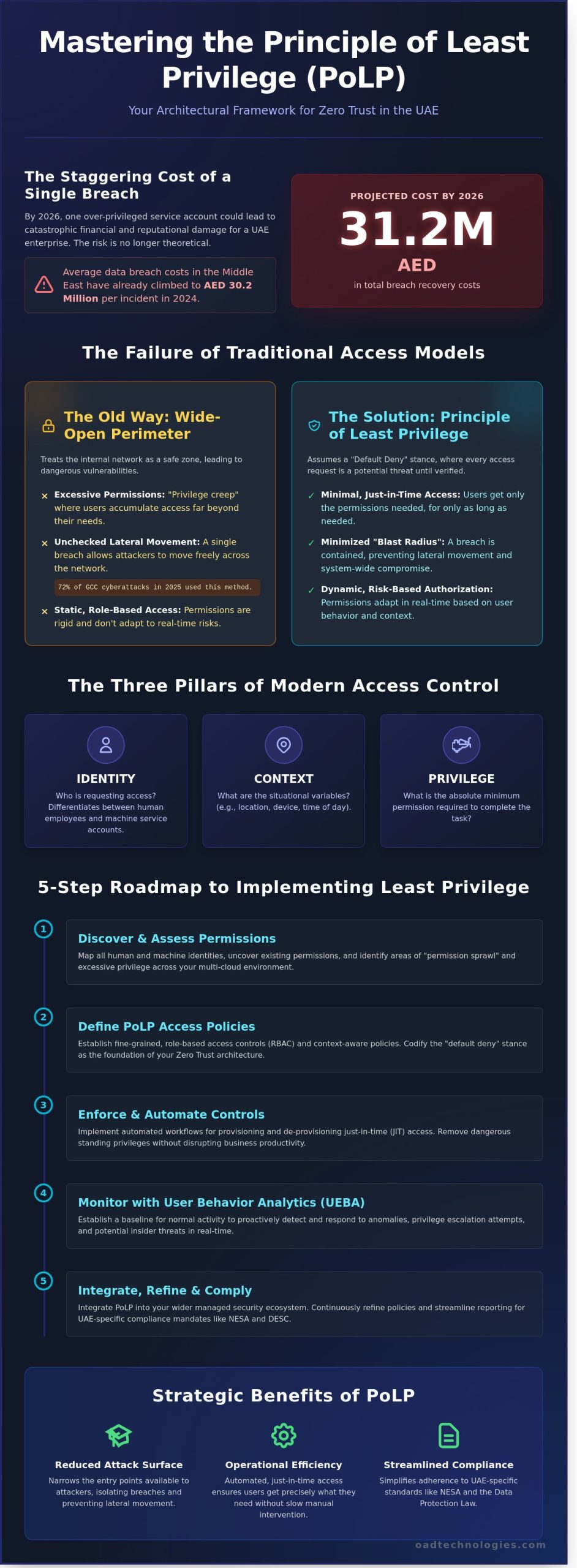
By 2026, a single over-privileged service account could cost your UAE enterprise more than AED 31.2 million in total breach-related recovery costs. This staggering figure reflects a growing reality where the principle of least privilege is no longer just a best practice but a core requirement for survival in the Middle East’s digital economy. You’ve likely felt the friction between security and speed, where the fear of breaking a critical legacy application leads to excessive administrative rights that linger for years. It’s a delicate balance that many IT leaders struggle to maintain while facing strict NESA compliance audits and the complexities of multi-cloud permission sprawl.
We’re here to change that narrative by transforming access control from a bottleneck into a strategic advantage. This guide helps you master the architectural framework of Least Privilege to eliminate lateral movement and simplify your path to Zero Trust. We’ll provide a clear roadmap for IAM modernization that ensures your security posture is both bespoke and future-proof. You’ll discover how to automate the removal of permission sprawl while maintaining the operational agility your business demands for long-term growth.
Key Takeaways
- Learn how to minimize your cyber ‘blast radius’ by isolating potential breaches and preventing lateral movement within your corporate network.
- Master the principle of least privilege to eliminate dangerous ‘permission sprawl’ where identities often hold far more access than their roles require.
- Discover a strategic 5-step roadmap to transition from legacy perimeter security to a modern, identity-centric Zero Trust architecture.
- Understand how to leverage User and Entity Behavior Analytics (UEBA) to establish a baseline for normal activity and proactively hunt for threats.
- Explore how to integrate tailored access controls into your managed security ecosystem to ensure long-term resilience and compliance across the UAE market.
What is the Principle of Least Privilege (PoLP)?
The Principle of Least Privilege (PoLP) represents a fundamental shift in how UAE enterprises secure their digital assets. It’s the practice of granting users, applications, and systems only the minimum level of access required to complete a specific task for the shortest possible time. By 2026, the security perimeter has effectively vanished. Organizations in Dubai and Abu Dhabi have moved toward identity-centric security models where the user identity, not their physical or network location, defines the boundary of trust.
Successful PoLP execution relies on a “Default Deny” stance. This philosophy assumes every access request is a potential threat until proven otherwise. It serves as the most critical pillar of a Zero Trust Architecture (ZTA). In 2024, data breach costs in the Middle East climbed to an average of AED 30.2 million per incident. Reducing the “blast radius” through the principle of least privilege is no longer optional for businesses aiming for NESA or Dubai Electronic Security Center (DESC) compliance. It’s a strategic necessity that limits the damage a single compromised account can inflict on the entire ecosystem.
OAD Technologies views this principle as an architectural blueprint rather than a simple checklist. When we design bespoke systems, we ensure that permissions are ephemeral. Access shouldn’t persist indefinitely. If a financial analyst in a Dubai-based firm needs to run a quarterly report, they receive access for those specific hours, not a permanent administrative token. This precision prevents the “privilege creep” that often leads to catastrophic data leaks.
The Three Pillars of Modern Access Control
Effective access control in 2026 rests on three distinct pillars. Identity focuses on who is requesting access, distinguishing between human employees and machine-to-machine service accounts. Context evaluates the situational variables of the request. Is the employee connecting from a known office in Abu Dhabi or an unrecognized IP? Finally, Privilege determines the absolute minimum permission required. If a user only needs to view a file, they shouldn’t have the “edit” or “delete” rights that could be exploited by malware.
PoLP vs. Traditional Access Models
The “Trust-but-Verify” model of the past decade has failed in the face of sophisticated hybrid cloud environments. Traditional models often treat internal networks as safe zones, allowing users to move laterally across the infrastructure once they’re inside. This “wide-open” approach is a goldmine for modern ransomware. Statistics from 2025 indicate that 72% of successful cyberattacks in the GCC utilized lateral movement to escalate privileges after an initial entry point was established.
Dynamic, risk-based authorization has replaced static permissions. Unlike old systems that granted access based on a job title, modern principle of least privilege implementations use real-time data to adjust permissions. This evolution ensures that your security posture remains resilient against evolving threats. It transforms security from a reactive barrier into a proactive, intelligent layer that empowers your workforce while shielding your most sensitive data assets from unauthorized exposure.
- Reduced Attack Surface: Limiting entry points and permissions narrows the paths available to attackers.
- Operational Efficiency: Automated provisioning ensures users get exactly what they need without manual intervention.
- Regulatory Compliance: Meeting UAE-specific standards like the Data Protection Law becomes a streamlined process.
The Architecture of Restriction: How PoLP Minimizes the Cyber ‘Blast Radius’
Cybersecurity isn’t just about building higher walls; it’s about designing an infrastructure where every room has its own unique lock. This design philosophy defines the “blast radius.” If a threat actor gains access to a single entry point, the extent of the damage depends entirely on how far they can move horizontally through your network. By implementing the principle of least privilege, you effectively compartmentalize your digital environment. This ensures that a breach in a low-level account doesn’t escalate into a total system compromise.
Lateral movement is the primary tactic used in 90% of sophisticated ransomware attacks. Attackers exploit “privilege creep,” where users accumulate access rights they no longer need for their current roles. PoLP shuts down these pathways. When you combine PoLP with micro-segmentation, you create granular security zones. This technical pairing restricts traffic between workloads based on specific business needs rather than broad network permissions. For UAE enterprises operating under the Dubai Cyber Security Strategy, this level of control is a baseline requirement for operational resilience. It reduces the attack surface by eliminating standing privileges and purging unused accounts that act as dormant backdoors.
Mitigating Insider Threats and Credential Theft
The 2023 Verizon Data Breach Investigations Report confirms that 74% of all data breaches involve the human element, including social engineering and simple human error. PoLP acts as a critical safety net here. It limits the impact of accidental data exposure by ensuring employees only see the data essential to their specific tasks. This strategy neutralizes the “God Mode” risk associated with overprivileged administrator accounts. In the Middle East, where the average cost of a data breach reached 29.6 million AED in 2023, reducing the potential for internal leaks is a financial necessity. You can explore how to tailor your access controls to match your specific risk profile and regulatory obligations.
The Technical Mechanics of Privilege Reduction
Effective restriction requires three core technical pillars. First, Separation of Duties (SoD) ensures no single individual has total control over a critical process, such as authorizing and executing a high-value financial transfer. Second, Just-in-Time (JIT) access provides elevated rights only when they’re strictly necessary and for a predetermined duration. This eliminates the risk of “always-on” admin credentials. Finally, Just-Enough-Administration (JEA) limits the scope of what an admin can do. Instead of granting full shell access, JEA provides a restricted toolkit of specific commands. This layered approach transforms your security from a brittle shell into a resilient, multi-layered vault.
Implementing these restrictions doesn’t have to hinder productivity. When executed with a bespoke strategy, PoLP actually clarifies workflows by removing the clutter of unnecessary applications and data from a user’s view. It’s a move toward a more disciplined, scalable architecture. This technical rigor ensures that your organization’s growth isn’t undermined by avoidable security gaps. By focusing on the principle of least privilege, you aren’t just checking a compliance box; you’re future-proofing your entire digital ecosystem against an increasingly aggressive threat environment.
Beyond Basic Permissions: Why Legacy IAM Fails Without Least Privilege
Legacy Identity and Access Management (IAM) systems often operate on a “set it and forget it” mentality that creates massive security gaps. Research from security analysts indicates that 90% of cloud identities use less than 5% of their granted permissions. This creates a phenomenon known as Permission Sprawl. It effectively hands attackers a skeleton key to your digital infrastructure because most accounts hold rights they never actually exercise. While Role-Based Access Control (RBAC) provided a solid foundation for decades, it’s no longer sufficient for enterprise-scale security. RBAC groups users into broad buckets, often granting excessive rights simply because a specific sub-task requires them. It lacks the nuance needed for today’s fragmented perimeter.
To achieve a true principle of least privilege, OAD Technologies advocates for a shift toward Attribute-Based Access Control (ABAC). Unlike its predecessor, ABAC evaluates real-time context. It looks at the user’s location, the time of day, and the security posture of the connecting device. If a developer attempts to access a production database from an unsecured public Wi-Fi in a Dubai cafe at 3:00 AM, ABAC can automatically deny that request. This happens even if their “Role” technically permits the action. This granular, context-aware approach ensures that access isn’t just about who you are, but the conditions under which you’re working.
The Failure of Static Roles in a Cloud Era
Static roles often lead IT teams into the Over-Provisioning trap. Administrators grant broad permissions to avoid the constant friction of “Access Denied” tickets that stall development cycles. This convenience comes at a high price. Gartner reports that through 2025, 99% of cloud security failures will be the customer’s fault, primarily due to identity misconfigurations. Shadow Admin accounts represent a hidden danger in AWS, Azure, and Google Cloud environments. These are users or service accounts with seemingly minor permissions that can be exploited to escalate their own privileges. These hidden paths allow attackers to move laterally across your cloud tenancies without triggering traditional security alarms.
Aligning PoLP with UAE and Global Compliance
For organizations operating within the Emirates, the principle of least privilege is a core regulatory mandate rather than an optional safeguard. The UAE Personal Data Protection Law (PDPL) and the UAE Information Assurance Regulation (ISR) require strict technical controls to protect sensitive citizen data. NESA standards also emphasize the necessity of restricted access to critical information infrastructure. Implementing PoLP ensures that only authorized personnel interact with sensitive data silos, creating a clean, immutable audit trail for GRC reporting.
- UAE PDPL: Requires data minimization and strict access controls for personal data processing.
- NESA & ISR: Mandates the restriction of administrative privileges to the minimum necessary for business functions.
- ISO 27001: Demands regular review of access rights to ensure they remain aligned with job requirements.
Implementing a robust PoLP framework reduces the total cost of annual compliance audits by 30% by eliminating the manual labor required to reconcile over-provisioned accounts and simplify evidence collection. This proactive stance transforms security from a reactive cost center into a strategic business advantage. It aligns your digital architecture with the UAE’s vision for a secure, data-driven economy while protecting your bottom line from the rising costs of data breaches, which can exceed 25 million AED for major regional incidents.
A 5-Step Roadmap for Implementing Least Privilege Without Disrupting Productivity
Adopting the principle of least privilege requires a methodical transition rather than a sudden restriction of access. According to the 2023 IBM Cost of a Data Breach Report, the average cost of a breach in the United Arab Emirates reached AED 29.6 million. To mitigate this risk without stalling operations, organizations must follow a structured engineering roadmap that balances security with usability.
Step 1: Conduct a Comprehensive Privilege Audit
Begin by categorizing permissions into “Unused” and “Reducible.” A 2023 study by CyberArk found that 74% of organizations allow excessive “standing” privileges. You’ll likely find that 60% of your cloud identities haven’t used their assigned permissions in over 90 days. Identifying these allows for immediate, low-risk revocation.
Step 2: Establish a Baseline for Normal Behavior
Use User and Entity Behavior Analytics (UEBA) to observe how staff interact with data. This phase creates a “normal” profile for every role. If a financial analyst typically accesses the ERP system between 8:00 AM and 6:00 PM from a Dubai-based IP, any deviation triggers an alert rather than a hard lockout.
Step 3: Implement Just-in-Time (JIT) and Just-Enough-Access (JEA)
Move away from permanent access. JIT workflows grant elevated permissions only when a specific task requires them, automatically expiring after a set duration. JEA ensures the user only has the specific commands needed for that task, limiting the “blast radius” of a potential compromise.
Step 4: Automate User Access Reviews
Manual “rubber-stamping” of access logs is a primary cause of privilege creep. By 2025, Gartner predicts that 70% of identity governance will be automated. Use tools that flag outliers and high-risk accounts for human review while auto-approving low-risk, standard roles.
Step 5: Continuously Monitor through MDR or SIEM
The principle of least privilege isn’t a “set and forget” configuration. Integrating your identity data with a Managed Detection and Response (MDR) solution ensures that if a credential is stolen, the attacker’s movements are restricted by the very boundaries you’ve built.
Step 1 & 2: Visibility and Baselining
You cannot secure what you cannot see. We recommend starting with a Vulnerability Assessment and Penetration Testing (VAPT) exercise to uncover “hidden” paths to privilege escalation that standard audits miss. Map your “Crown Jewels,” such as customer databases or proprietary financial algorithms, and document every entry point. This visibility ensures that security controls are bespoke to your specific digital architecture, not a generic template.
Overcoming the ‘Productivity’ Objection
The biggest hurdle to security is often the perception of friction. To solve this, deploy self-service access request portals where approvals take minutes, not days. Instead of blocking access entirely, use “Step-up Authentication.” This requires an extra Multi-Factor Authentication (MFA) prompt only when a user attempts a high-risk action or logs in from an unusual location. Clear communication is vital; when employees understand that these measures protect them from being the source of an AED 29 million disaster, they become partners in your security culture. For ongoing discussions and insights into tech culture and security, resources like the {OOAB} Only One Afi Blog can also be valuable.
Building a resilient identity perimeter requires an architect’s precision and a partner’s perspective. Our team helps you design secure access frameworks that empower your workforce while locking down your most critical assets.
Strategic Resilience: Integrating PoLP into Your Managed Security Ecosystem
Adopting the principle of least privilege isn’t a weekend project or a checklist item you complete then ignore. It’s a continuous evolution of your security posture. Static security models fail because businesses are dynamic. Your team grows, roles shift, and technology stacks evolve every quarter. Viewing PoLP as a one-time project is a mistake that leaves gaps in your defense. It’s a living strategy that requires consistent auditing to ensure access rights match current operational needs.
Pairing PoLP with Managed Detection and Response (MDR) creates a powerful defensive synergy. When you restrict user permissions, you effectively shrink the attack surface. This allows MDR teams to focus on genuine anomalies rather than wading through the noise of excessive administrative actions. If a breach occurs, the limited permissions of the compromised account prevent the lateral movement that leads to catastrophic data loss. According to the 2023 IBM Cost of a Data Breach Report, the average cost of a breach in the Middle East reached AED 29.6 million. Implementing PoLP is a financial imperative to mitigate these risks.
The ultimate maturity goal for any UAE enterprise is Zero Standing Privileges (ZSP). In this model, accounts possess no administrative rights by default. Access is granted just-in-time and revoked immediately after the task is finished. This eliminates the risk of dormant high-level credentials being exploited by external actors or disgruntled insiders. It’s the standard that separates resilient organizations from those merely hoping for the best.
The OAD Technologies Advantage: Bespoke Security Architecture
We bridge the gap between high-level GRC consulting and technical IAM implementation. Many firms provide a roadmap; we build the engine. Our architects design scalable frameworks that grow with your digital transformation, ensuring security never becomes a bottleneck for speed. Dubai’s leading firms rely on OAD for specialized DLP and infrastructure protection because we understand the local regulatory environment, including DESC compliance requirements. We don’t believe in one-size-fits-all software. We build bespoke solutions that integrate with your existing legacy systems and modern cloud environments.
Next Steps: Securing Your Enterprise Future
Start with a professional Vulnerability Assessment and Penetration Testing (VAPT). This identifies exactly where your privilege gaps currently exist. You can’t fix what you haven’t measured. Once the assessment is complete, don’t try to overhaul every department at once. Begin your PoLP journey with a focused pilot program on your top 5% highest-risk accounts. This usually includes cloud administrators, database owners, and third-party vendor connections. This targeted approach provides immediate ROI and builds the momentum needed for a full-scale rollout across the organization.
Ready to harden your perimeter and streamline your access management? Secure your digital assets with a bespoke IAM strategy from OAD Technologies. Our team of expert architects is ready to transform your security from a cost center into a strategic advantage.
Securing the GCC Digital Frontier with Strategic Precision
The transition toward a Zero Trust architecture isn’t a luxury for UAE enterprises; it’s a regulatory and operational mandate for 2026. By implementing the principle of least privilege, organizations can reduce their potential cyber blast radius by over 70% while ensuring strict adherence to UAE ISR and NESA standards. Legacy IAM systems often leave gaps that only a granular, permission-based approach can close. You’ll gain operational efficiency and strategic growth by treating security as a bespoke architecture rather than a generic layer.
Our Dubai-based SOC provides real-time MDR monitoring, ensuring your infrastructure remains resilient against evolving threats. We’ve helped numerous GCC enterprises transform their security posture from reactive to proactive through precise engineering standards. It’s time to move beyond standard permissions and embrace a system where every access point is verified and limited. Partner with OAD Technologies to architect your Zero Trust future and secure your long-term digital relevance in the Middle East market. Your journey toward a more secure, compliant, and scalable future starts today.
Frequently Asked Questions
What is the difference between the Principle of Least Privilege and Zero Trust?
The principle of least privilege serves as a core pillar of the Zero Trust framework. While Zero Trust is a holistic security philosophy that assumes no entity is trustworthy by default; PoLP is the specific mechanism used to restrict access rights. NIST Special Publication 800-207 defines Zero Trust as a strategy that requires continuous verification. By applying PoLP, you ensure that even after verification; an identity only accesses resources essential for its current task.
How does PoLP help in preventing ransomware attacks?
PoLP prevents ransomware from spreading by restricting a user’s ability to execute unauthorized code or access sensitive directories. According to the 2023 Verizon Data Breach Investigations Report; 74% of breaches involve the human element. When you limit a workstation’s administrative rights; you block the lateral movement ransomware requires to encrypt your entire network. This containment strategy ensures a single compromised account doesn’t lead to a total system lockout.
Will implementing least privilege slow down my employees’ work?
Implementing the principle of least privilege won’t slow down your team if you use Just-In-Time (JIT) access tools. Modern workflows allow employees to request elevated permissions that are granted automatically for a specific 60-minute window. This approach eliminates the friction of manual IT tickets. We’ve seen organizations reduce their attack surface by 80% while maintaining high operational velocity through these automated, bespoke permission structures.
What is ‘Privilege Creep’ and how do I prevent it?
Privilege creep occurs when employees retain access rights from previous roles as they move within your company. You can prevent this by conducting mandatory quarterly access reviews and implementing automated offboarding protocols. Analysis shows that 50% of users have more permissions than their current role requires. By utilizing identity lifecycle management tools; your IT team can automatically revoke old permissions whenever a user’s HR status changes.
Is PoLP mandatory for compliance with UAE cybersecurity regulations?
PoLP is a mandatory requirement for compliance with UAE cybersecurity standards like the NESA Information Assurance Standards. Section T1.2.1 of the NESA IAS specifically mandates that organizations limit access to information based on business requirements. Similarly; the Dubai Electronic Security Center (DESC) ISR Version 2.0 requires strict identity management. Failure to comply can lead to regulatory penalties and increased vulnerability during official government audits.
How do I implement least privilege for non-human or machine identities?
You implement least privilege for machine identities by using scoped API keys and dedicated service accounts. Unlike human users; machine identities often require 24/7 access; making them prime targets for exploitation. You should utilize Secrets Management platforms to rotate credentials every 30 days and restrict machine permissions to specific IP addresses or resource groups. This ensures that a compromised service account can’t be used to breach your entire cloud infrastructure.
What are the first three steps a CISO should take to start a PoLP project?
A CISO should first conduct a full identity audit; categorize all “Crown Jewel” assets; and establish a baseline for normal user behavior. Your first 90 days should focus on identifying high-risk accounts with excessive administrative rights. By mapping these 3 critical areas; you create a data-driven roadmap for your PoLP rollout. This structured approach ensures that your security investments align directly with the most significant risks to your digital architecture.
Can PoLP be automated, or does it require manual oversight?
PoLP requires a blend of automated enforcement and periodic manual oversight for high-risk exceptions. You can automate 95% of standard access requests using Identity and Access Management (IAM) software. However; manual reviews remain essential for sensitive “Tier 0” administrative roles that control your core infrastructure. This hybrid model ensures your security posture remains agile while maintaining the rigorous engineering standards required for long-term digital resilience.