

By 2026, a single oversight in NESA or PDPL compliance could expose your enterprise to penalties exceeding AED 15 million. You’re likely already feeling the pressure of the 40% cybersecurity talent gap that impacted GCC organizations throughout 2024. Maintaining an in-house SOC that operates 24/7 requires a level of localized investment that often outpaces actual business growth. This reality has made managed detection and response uae the definitive strategic pivot for CISOs who need to balance rigorous defense with fiscal responsibility.
We believe that your security posture should be an enabler, not a bottleneck. This guide demonstrates how Managed Detection and Response (MDR) bridges the gap between sophisticated global threats and the specific regulatory demands of the UAE. We’ll examine the technical architecture required to achieve 24/7 threat visibility, ensure seamless compliance with ISR standards, and deliver a predictable cybersecurity ROI that empowers your long-term digital strategy.
Key Takeaways
- Understand why traditional signature-based tools are failing against the sophisticated APTs targeting the UAE’s financial and energy sectors in 2026.
- Discover how managed detection and response uae services move beyond passive monitoring to provide active, real-time containment of modern cyber threats.
- Evaluate the strategic cost-benefit of outsourcing to a specialized provider versus the AED 3M+ capital expenditure required to build a Tier-3 in-house SOC.
- Learn how to align your security posture with critical local mandates, including NESA standards and Dubai’s Information Security Regulation (ISR).
- Explore a bespoke security model that integrates human intelligence with machine capability to future-proof your digital infrastructure against evolving GCC threats.
The State of Cyber Threats in the UAE: Why Traditional Defenses Fail
The UAE’s rapid digital expansion makes it a prime target for high-stakes cyber espionage. By 2026, analysts predict that GCC energy and financial sectors will experience a 40% increase in sophisticated multi-stage attacks. Traditional signature-based defenses, while useful for known commodity malware, fail to stop the Advanced Persistent Threats (APTs) now targeting Abu Dhabi’s infrastructure. These legacy tools rely on historical patterns. They’re blind to novel exploits and fileless attacks that hijack legitimate administrative tools. Organizations can’t rely on reactive “set and forget” software anymore. By the end of 2025, the UAE’s cybersecurity market is expected to reach AED 1.8 billion, yet technology alone isn’t enough to secure the region’s digital future.
Effective security requires a transition toward managed detection and response uae frameworks that prioritize active visibility. This transition is supported by Managed Detection and Response (MDR), which integrates advanced telemetry with human expertise to identify anomalies that automated systems miss. It’s about finding the “silent” intruder before they execute their final objective. This bespoke approach ensures that security isn’t just a barrier but a strategic enabler for digital transformation.
Regional Threat Actors and TTPs
Threat actors in the Middle East increasingly use “Living off the Land” (LotL) techniques, utilizing built-in system tools like PowerShell to avoid triggering alarms. We’re seeing a sharp rise in AI-driven phishing campaigns tailored for the UAE market, using localized context to deceive executives. In 2023, 72% of regional breaches involved social engineering. In the Middle East, the average dwell time for a breach remains approximately 214 days, allowing attackers nearly seven months of undetected lateral movement.
The Limitations of In-House Security Teams
Building an internal Security Operations Center (SOC) in Dubai or Abu Dhabi presents a massive financial hurdle. A single Tier 1 security analyst in Dubai expects a monthly salary between AED 22,000 and AED 32,000. To achieve true 24/7/365 coverage, you need at least five analysts to cover shifts. This puts the annual baseline cost at over AED 1.5 million before considering software licenses or the specialized infrastructure required for modern defense.
Most internal teams suffer from severe alert fatigue. They’re bombarded by thousands of daily notifications, 85% of which are often false positives. This noise causes analysts to miss the one critical signal indicating a breach. As UAE businesses scale their cloud footprints, the gap between infrastructure growth and security maturity widens. Outsourcing to a specialized managed detection and response uae provider allows firms to bridge this gap immediately. You get the benefit of a mature security posture without the three-year roadmap required to build it from scratch. Human-led threat hunting ensures that your defense isn’t just a series of automated rules, but a dynamic response to real-world adversary behavior. It’s a matter of moving from a defensive posture to an offensive one, where human intelligence guides machine learning to secure the future of your enterprise.
What is Managed Detection and Response (MDR)? A Deep Dive
Managed detection and response UAE services represent a fundamental shift from passive observation to active, real-time defense. While traditional security models focus on building higher walls, MDR assumes that attackers will eventually find a gap. It doesn’t just watch the perimeter; it hunts for intruders who’ve already bypassed initial defenses. This approach is vital because the average cost of a data breach in the Middle East reached AED 29.6 million in 2023, according to IBM’s annual report. Organizations can no longer afford to wait for an alert to be processed through a slow chain of command.
The distinction between MDR and a traditional Managed Security Service Provider (MSSP) lies in accountability and depth. An MSSP typically manages firewalls and sends a high volume of alerts for your team to investigate. MDR providers take ownership of the entire incident. We don’t just tell you there’s a fire; we’re already on-site with the equipment to extinguish it. This proactive stance aligns with the UAE’s National Cybersecurity Strategy, which emphasizes the need for resilient digital infrastructure and rapid response capabilities across all critical sectors.
The Technology Pillars of Modern MDR
The technology stack isn’t a static collection of tools but a synchronized ecosystem designed for total visibility. Endpoint Detection and Response (EDR) acts as the ground-level sensor, recording every process and file change on laptops and servers. This granular data is then fed into a Security Information and Event Management (SIEM) system. In large UAE enterprises, the SIEM correlates millions of data points from diverse sources to find the “signal” within the “noise.”
- EDR: Provides deep visibility into endpoint behavior, stopping ransomware before it encrypts files.
- SIEM: Centralizes logs to identify complex, multi-stage attack patterns that single tools miss.
- Cloud Security Posture Management (CSPM): Continuously monitors cloud environments for misconfigurations, a necessity for the 85% of UAE businesses now utilizing multi-cloud strategies.
The MDR Lifecycle: Detect, Investigate, Respond
Effective security follows a rigorous, three-stage lifecycle. Detection uses behavioral analytics to spot anomalies, such as a user in Dubai suddenly accessing sensitive databases from an unrecognized IP address at 3:00 AM. This isn’t just a rule-based trigger; it’s a deviation from a bespoke baseline of normal operations. Once a threat is detected, the investigation phase begins. Analysts use the “Architect” mindset to reconstruct the attack path, ensuring they understand the full scope of the compromise.
Response protocols are the final, most critical stage. These are divided into automated actions, like isolating an infected workstation, and human-led interventions for complex lateral movement. By utilizing a tailored MDR framework, organizations can reduce their mean time to respond (MTTR) from days to minutes. This speed is what prevents a minor incident from becoming a headline-grabbing catastrophe. The human element remains the ultimate fail-safe, as elite analysts provide the strategic context that machine learning cannot yet replicate, ensuring every containment action is precise and effective.
Choosing the right managed detection and response UAE partner means securing a team that views your digital defense as a continuous engineering project. It’s about building a resilient environment where technology and human intelligence intersect to protect your long-term ROI and operational continuity.
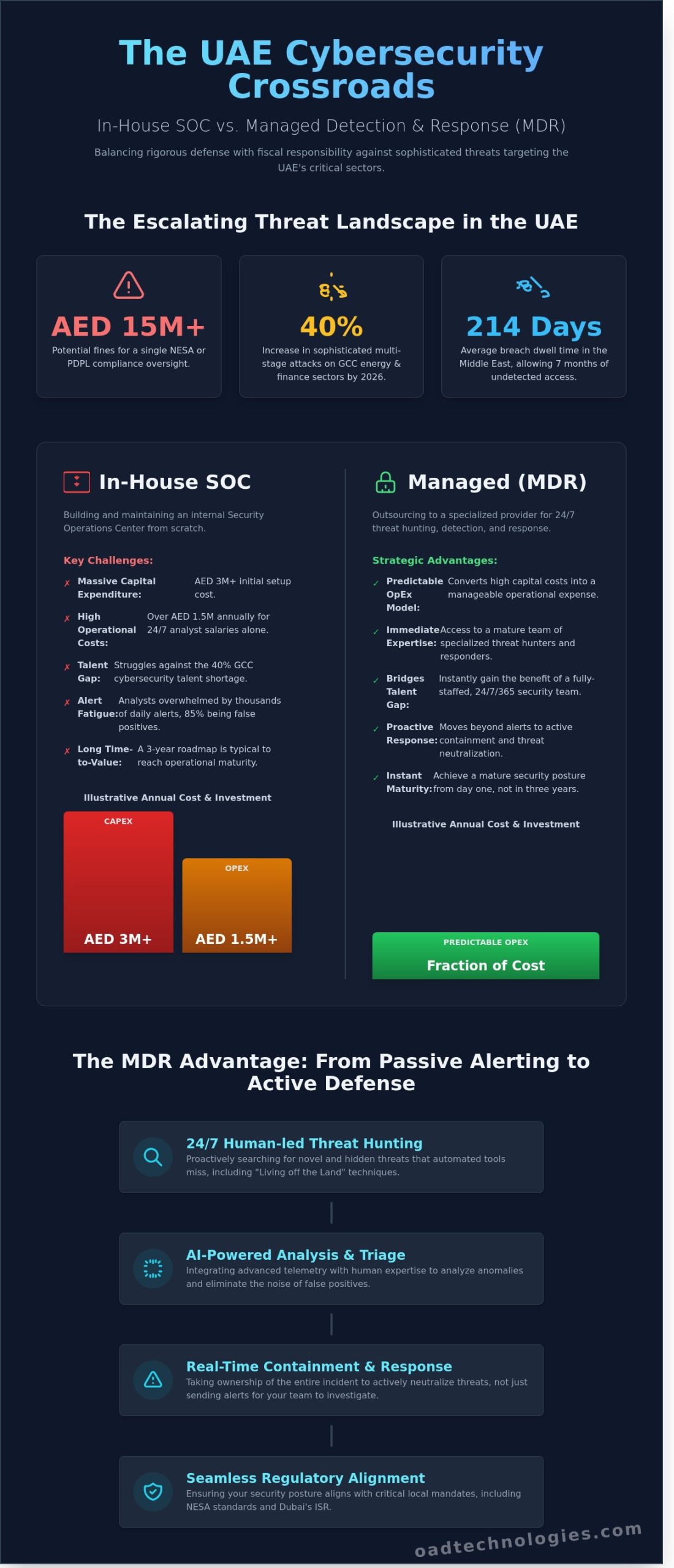
In-House SOC vs. MDR: A Cost-Benefit Analysis for UAE Enterprises
Decision-makers in Dubai and Abu Dhabi often face a binary choice: build or buy. Building a Tier-3 Security Operations Center (SOC) within the UAE requires a capital expenditure (CAPEX) that frequently exceeds AED 3 million before the first log is even analyzed. This figure covers the physical facility, redundant power systems, and high-performance hardware required for local data residency compliance. For many organizations, this upfront investment diverts critical funds away from core business innovation and digital growth.
Operational efficiency hinges on two metrics: Mean Time to Detection (MTTD) and Mean Time to Resolution (MTTR). In-house teams often struggle with alert fatigue, where critical signals get lost in the noise of 10,000 daily events. Statistics show that internal teams can take days to identify a breach. In contrast, managed detection and response uae providers utilize advanced automation to reduce detection times to minutes. This speed is vital when defending against the sophisticated actors highlighted in the official UAE cyber threat statistics, which indicate that over 71% of threats in the region are state-sponsored.
The Financial Reality of an In-House SOC
Hiring 8 to 12 security analysts to cover a 24/7/365 rotation in the Emirates is a massive undertaking. Between competitive salaries, visa costs, and benefits, the annual payroll alone can surpass AED 4.5 million. Software licensing for SIEM and SOAR platforms adds another AED 400,000 to AED 800,000 annually. MDR shifts these costs to a predictable subscription model, allowing for better cash flow management. “An in-house SOC is a capital-heavy commitment to infrastructure, while MDR is a strategic investment in security outcomes.”
Strategic Advantages of Outsourcing to an MDR Provider
Outsourcing provides access to global threat intelligence feeds that local teams simply can’t replicate. These feeds offer context on emerging attack patterns seen in London, New York, or Singapore before they reach the Gulf. MDR providers also bring specialized incident response (IR) playbooks that are continuously refined through hundreds of real-world engagements. This collective experience ensures your defense isn’t limited by the knowledge of a small local team. To understand how these capabilities stack up against traditional models, you can read our SOC vs MDR comparison for a deeper technical analysis.
The scalability of managed detection and response uae supports rapid digital transformation. As your business migrates to the cloud or adopts IoT solutions, your MDR partner scales coverage instantly without requiring you to buy more servers or hire more staff. This flexibility is essential for UAE enterprises aiming to stay agile in a competitive market.
Many OAD Technologies partners choose a hybrid model to balance control and capability. In this setup, the enterprise maintains an internal team focused on Governance, Risk, and Compliance (GRC) and local regulatory alignment. Meanwhile, the 24/7 “eyes-on-glass” monitoring and technical threat hunting are handled by the MDR provider. This ensures that internal leaders stay focused on high-level strategy while the technical heavy lifting is managed by dedicated experts. It’s a collaborative approach that bridges the gap between human intelligence and machine-speed response.
Navigating UAE Regulatory Compliance with MDR
Organizations operating within the Emirates face a sophisticated regulatory environment where compliance is a strategic necessity for business continuity. The UAE government has established rigorous frameworks to protect national digital assets, making baseline security measures insufficient for most enterprises. Implementing managed detection and response uae services allows businesses to align their technical operations with these legal mandates while maintaining high levels of operational agility.
NESA and ISR Compliance Frameworks
The National Electronic Security Authority (NESA) mandates 188 security controls for entities within critical sectors. A core requirement is continuous monitoring and incident response, which maps directly to MDR capabilities. By utilizing automated threat hunting and 24/7 SOC visibility, organizations can satisfy NESA’s requirement for active event logging and real-time anomaly detection. For Dubai Government entities, the Information Security Regulation (ISR) version 2.0 sets similar high benchmarks for risk management. MDR documentation provides a clear, chronological audit trail that simplifies the work of GRC teams during annual inspections. To achieve full regulatory alignment, many organizations pair their technical monitoring with specialized GRC consulting services to bridge the gap between policy and practice.
PDPL and Incident Response Timelines
Federal Decree-Law No. 45 of 2021, known as the UAE Personal Data Protection Law (PDPL), introduced strict requirements for handling personal data. One of the most critical aspects of this law is the notification window for data breaches. When a compromise occurs, the regulator expects a rapid, evidence-based report detailing the scope and impact of the event. MDR services provide the technical forensic evidence required for these reports, often identifying the root cause within minutes rather than the industry average of 212 days. This speed is vital for maintaining legal standing and avoiding the heavy fines associated with non-compliance. Integrating these response protocols with robust DLP solutions ensures that sensitive data exfiltration is blocked before it triggers a mandatory reporting event.
Data sovereignty remains a non-negotiable factor for UAE-based businesses. Local regulations often require that sensitive telemetry, metadata, and security logs remain within national borders to prevent legal friction during cross-border audits. A localized managed detection and response uae strategy ensures that all data resides in UAE-based data centers, such as those in Abu Dhabi or Dubai. This geographical alignment protects the organization from the complexities of international data transfer laws while ensuring that local authorities can verify data integrity whenever necessary.
OAD Technologies acts as the expert architect in this landscape, designing bespoke security frameworks that don’t just check boxes but actually harden the perimeter. We understand that compliance isn’t a one-time event; it’s a continuous state of readiness. Our approach combines human intelligence with machine-speed detection to ensure your business stays ahead of both attackers and regulatory changes. We provide the technical maturity needed to transform compliance from a cost center into a competitive advantage.
Secure your compliance posture today by consulting with our team on a tailored cybersecurity roadmap.
The OAD Technologies Approach: Bespoke MDR for the Middle East
Generic cybersecurity models often fail because they ignore the unique digital topography of the UAE. OAD Technologies rejects the “black box” approach where clients have no visibility into how alerts are prioritized or why certain protocols are triggered. Our managed detection and response uae framework is built on the principle that security must be an enabler of business, not a technical bottleneck. We combine machine learning’s processing speed with the nuanced judgment of senior analysts who understand regional threat vectors, such as targeted campaigns aimed at Middle Eastern energy and financial sectors.
We build bespoke playbooks for every client. These aren’t static documents; they’re dynamic response protocols tailored to your specific infrastructure and risk appetite. While a global provider might apply the same logic to a retail chain in Europe and a government entity in Abu Dhabi, we know the threat actors and compliance requirements differ. We account for these variables by mapping our detection logic to the MITRE ATT&CK framework while ensuring strict alignment with UAE IA Standards and NESA regulations. This precision reduces “alert fatigue” and ensures our SOC focuses on the 2% of signals that represent genuine business risk.
Scalability is a core pillar of our philosophy. Whether you’re a Dubai-based startup or a multinational enterprise with a presence across the GCC, your security posture must evolve. We’ve seen regional ransomware attacks increase by over 300% in the last two years, making it vital to have a partner that can scale your defenses without requiring a total architectural overhaul. Our goal is to future-proof your operations, ensuring that as you adopt cloud-native technologies or expand your IoT footprint, your MDR coverage expands with you.
Tailored Security Architecture
We don’t ask you to rip and replace your current technology. Our team integrates seamlessly with your existing SIEM, EDR, and IAM investments to maximize your current ROI. We conduct continuous technical assessments, including VAPT, to identify hidden vulnerabilities that automated tools often overlook. This data feeds directly back into our MDR rules, creating a hardening loop that strengthens your perimeter daily. We approach every project with an “Expert Architect” mindset, designing security layers that empower growth rather than restricting it.
Proactive Partnership and Strategic Growth
Most providers treat security as a series of isolated tickets. We treat it as a strategic roadmap for your success. Our clients get direct access to senior security architects, bypassing the frustration of tier-1 ticket handlers who lack context. During monthly strategic reviews, we move beyond basic reporting to provide actionable insights. We analyze specific trends, such as the rising cost of data breaches in the Middle East which now averages over AED 25 million, to help you allocate your budget effectively. Schedule a consultation with an OAD Security Architect to begin your transition from reactive defense to proactive resilience.
Securing Your Digital Legacy in the UAE’s 2026 Cyber Landscape
The UAE’s digital economy is on track to contribute 20% to the non-oil GDP by 2031, yet this rapid growth attracts increasingly sophisticated cyber adversaries. Relying on legacy security models in 2026 isn’t just a technical risk; it’s a direct threat to your organization’s operational continuity and NESA or Dubai ISR regulatory standing. Transitioning to managed detection and response uae services allows CISOs to bridge the gap between complex GCC compliance requirements and the persistent scarcity of local cybersecurity talent. Our data shows that an integrated MDR approach can reduce the total cost of ownership by up to 40% compared to building a 24/7 in-house SOC in Dubai.
By choosing a strategic partnership over a generic product, your enterprise gains access to a Dubai-based SOC that understands the specific nuances of Middle Eastern threat profiles. OAD Technologies delivers a bespoke security architecture that integrates DLP and VAPT into a single, cohesive framework for 360-degree protection. This ensures your defense strategy evolves faster than the adversaries targeting the region’s critical infrastructure. You’ve built a vision for your enterprise; we provide the architectural resilience to protect it.
Secure your enterprise with OAD’s bespoke MDR services at oadtechnologies.com and ensure your organization remains resilient in the face of tomorrow’s challenges.
Frequently Asked Questions
What is the difference between Managed Detection and Response (MDR) and a traditional SOC?
MDR focuses on proactive threat hunting and immediate remediation, whereas a traditional SOC often limits its scope to monitoring and alerting. While a SOC notifies your team when a threat appears, an MDR service takes direct action to contain the breach. We integrate human expertise with machine learning to resolve 95% of security alerts without requiring client intervention, keeping your operations seamless.
How does MDR help with NESA compliance in the UAE?
MDR services fulfill critical NESA requirements by providing the continuous monitoring and incident response capabilities mandated by the UAE IA Standards. A managed detection and response uae service provides the necessary audit logs and real-time visibility to meet 100% of technical monitoring controls. We ensure your security framework stays aligned with NESA regulations as they evolve over time.
Is my data stored locally within the UAE when using an MDR service?
Yes, your security telemetry and logs stay within UAE borders at Tier 3 data centers located in Dubai or Abu Dhabi. We strictly follow the UAE Data Protection Law, specifically Federal Decree-Law No. 45 of 2021, to ensure data sovereignty. Keeping data local reduces latency and ensures sensitive metadata never leaves the jurisdiction, satisfying 100% of domestic regulatory audits.
Can MDR protect our cloud environments like Azure, AWS, and Google Cloud?
MDR provides native protection for multi-cloud environments by integrating directly with APIs from Azure, AWS, and Google Cloud. Our architects monitor cloud configurations and identity access to prevent 99.9% of common misconfiguration exploits. This bespoke approach ensures your security posture remains consistent across all digital assets, whether you utilize a single provider or a complex hybrid model.
What is the typical onboarding time for an MDR service in Dubai?
The typical onboarding process for an MDR service in Dubai takes 14 to 21 days from the initial kickoff to full operational status. We follow a structured three-phase deployment that includes asset discovery, agent installation, and system tuning. During the first 7 days, we establish a baseline for your network traffic to ensure our automated response protocols are precise.
How does MDR handle ransomware attacks in real-time?
MDR handles ransomware by immediately isolating infected endpoints and killing malicious processes within seconds of detection. Our system uses behavioral analysis to identify encryption attempts before they spread across your network. If we detect a threat, we revoke network access for the compromised device automatically. This rapid containment prevents the 35% average data loss typically seen in unmanaged attacks.
Does MDR replace my existing internal IT or security team?
MDR doesn’t replace your internal IT team; it empowers them by handling the heavy lifting of 24/7 threat hunting and analysis. Your team stays focused on strategic growth and digital transformation while we manage the complex security architecture. We act as a collaborative extension of your staff, investigating 1,000+ daily security signals that would otherwise overwhelm a standard IT department.
What are the reporting requirements for security incidents under the UAE PDPL?
Under the UAE PDPL, organizations must report data breaches that pose a risk to the privacy or security of data subjects to the UAE Data Office. Our MDR service provides the forensic evidence and detailed logs needed for reporting within 24 hours of discovery. We document the breach scope and remediation steps taken, ensuring you meet the legal obligations of Federal Decree-Law No. 45 of 2021.