

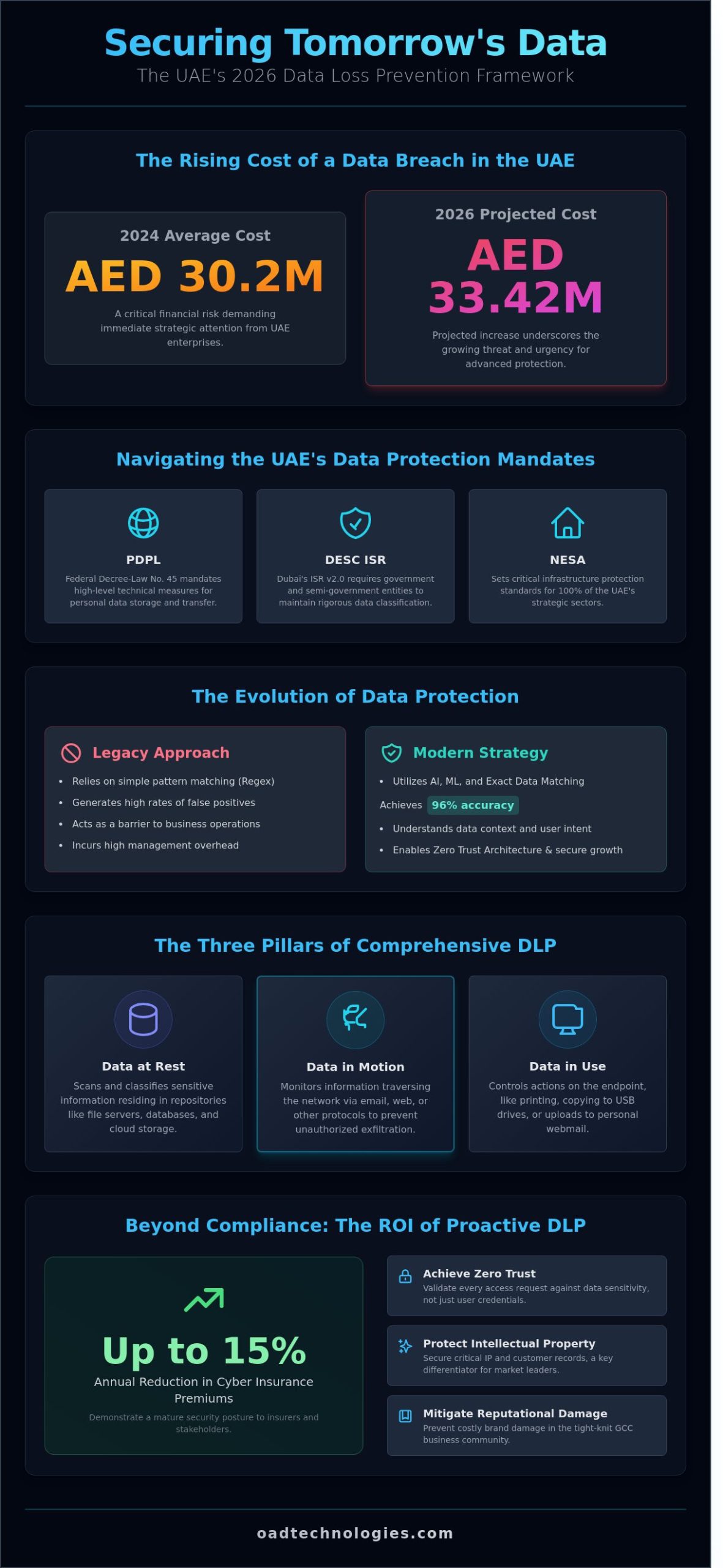
In 2024, the average cost of a data breach in the Middle East reached AED 30.2 million, which makes the search for high-performance data loss prevention solutions uae a matter of survival rather than just a compliance task. Most UAE enterprises find themselves caught in a difficult cycle. They’re trying to satisfy the strict mandates of Federal Decree-Law No. 45 of 2021 while using legacy tools that trigger more false positives than actual security threats. You’ve likely realized that a one-size-fits-all approach doesn’t work; especially when you’re also facing a local talent gap that makes managing complex policies nearly impossible.
Security shouldn’t act as a barrier to your growth. This article promises to guide you through a strategic 2026 framework designed to secure your digital assets without slowing down your business operations. We’ll preview how to gain full visibility into your data movement, automate NESA and DESC reporting, and leverage managed solutions that take the heavy lifting off your internal IT teams. It’s time to move from compliance anxiety to operational resilience through a bespoke architectural approach.
Key Takeaways
- Understand how the UAE’s evolving 2026 data sovereignty regulations impact your enterprise security posture and strategic compliance requirements.
- Explore the transition from basic pattern matching to AI-driven discovery across the three critical pillars: data at rest, in motion, and in use.
- Identify why generic “out-of-the-box” software often fails and how to bridge the gap between rigid security tools and fluid operational momentum.
- Discover a structured roadmap for deploying data loss prevention solutions uae enterprises can rely on, beginning with high-ROI risk assessments and data flow mapping.
- Gain insights into the OAD Technologies methodology for building bespoke, managed resilience that future-proofs your digital assets against emerging global threats.
The Strategic Importance of DLP in the UAE Regulatory Landscape
In 2026, enterprise security is no longer defined by the perimeter. It’s defined by the data itself. Modern Data loss prevention (DLP) software has evolved into an AI-driven ecosystem that classifies information in real-time, moving beyond simple pattern matching to understand context and intent. The UAE has emerged as a global leader in data sovereignty, establishing a framework where data isn’t just an asset but a protected national resource. This shift requires businesses to move away from legacy “castle and moat” security. Instead, they must adopt data-centric protection. This strategy ensures that sensitive files remain encrypted and controlled, even when they leave the corporate network.
For local enterprises, implementing data loss prevention solutions uae wide is the most direct path to achieving a Zero Trust Architecture (ZTA). By integrating DLP, you ensure that every access request is validated against the sensitivity of the data, not just the credentials of the user. This creates a security posture where trust is never assumed, and every data movement is verified. As the UAE digital economy is projected to reach AED 514 billion by 2031, the ability to secure intellectual property and customer records is the primary differentiator for market leaders.
Navigating UAE PDPL and DESC ISR Requirements
Federal Decree-Law No. 45 of 2021, known as the UAE Personal Data Protection Law (PDPL), mandates strict controls on how personal data is stored and transferred. It requires companies to implement high-level technical measures to prevent data leakage. For organizations operating in Dubai, the Dubai Electronic Security Center (DESC) enforces the Information Security Regulation (ISR) version 2.0. This regulation demands that government and semi-government entities maintain rigorous data classification standards. Additionally, the National Electronic Security Authority (NESA) has set critical infrastructure protection standards that currently apply to 100% of the UAE’s strategic sectors, making DLP a functional necessity for compliance.
The Cost of Non-Compliance in the Middle East
Failing to secure data carries heavy penalties that extend far beyond the initial incident. Under Federal Decree-Law No. 45, fines for non-compliance are substantial, often reaching millions of dirhams depending on the severity of the negligence. The reputational damage in a tight-knit business community like the GCC can be even more costly than the legal fees. Based on current trajectories, the projected average total cost of a data breach for UAE organizations in 2026 will reach AED 33.42 million per incident. This figure accounts for forensic investigations, legal settlements, and lost business opportunities. Proactive DLP implementation doesn’t just block leaks; it serves as a strategic risk-mitigation tool that can reduce cyber insurance premiums for GCC firms by up to 15% annually by demonstrating a mature security posture.
Effective data protection requires a tailored approach. We don’t believe in off-the-shelf security because your data footprint is unique. By aligning technical controls with the specific mandates of UAE regulators, businesses can transform security from a cost center into a foundation for scalable growth. This alignment ensures that your digital transformation remains resilient against both external threats and internal accidents.
Anatomy of Modern Data Loss Prevention Solutions
Modern data protection has moved far beyond the rigid constraints of simple pattern matching. Traditional systems often struggled with false positives because they relied on basic Regular Expression (Regex) strings to find credit card numbers or IDs. Today, leading data loss prevention solutions uae utilize machine learning and Exact Data Matching (EDM) to understand context. This evolution allows systems to distinguish between a random string of digits and a sensitive financial record with 96% accuracy. By fingerprinting specific file types and database schemas, these tools provide a granular level of oversight that was impossible a decade ago.
A robust architecture rests on three functional pillars. Data at Rest involves scanning repositories like local file servers or cloud storage to identify where sensitive information resides. Data in Motion monitors information as it traverses the network, ensuring that an employee doesn’t accidentally email an unencrypted payroll file to an external recipient. Finally, Data in Use focuses on the endpoint, controlling actions like printing, copying to USB drives, or uploading to personal webmail. Integrating these pillars with Identity and Access Management (IAM) creates a zero-trust environment. This ensures that even if a user has valid credentials, their ability to move data is restricted based on their current risk profile and the sensitivity of the asset.
The UAE’s 2031 Digital Strategy has accelerated the shift toward cloud-native architectures. Relying on legacy, on-premise hardware creates bottlenecks in a region where 82% of enterprises have adopted multi-cloud environments. Cloud-native data loss prevention scales instantly, providing the same level of scrutiny for a remote worker in Ras Al Khaimah as it does for a headquarters in Abu Dhabi. This scalability is vital for maintaining compliance with the UAE Data Protection Law (Federal Decree-Law No. 45 of 2021), which carries significant penalties for non-compliance.
Data Discovery and Classification: The Foundation
Effective protection starts with knowing what you own. Modern discovery tools must handle bilingual environments, identifying Personally Identifiable Information (PII) in both Arabic and English scripts. We see a clear distinction in classification schemas across UAE industries. A financial institution in the DIFC requires schemas focused on IBANs and SWIFT codes, while an Oil and Gas entity in Abu Dhabi prioritizes the protection of proprietary geological surveys and engineering blueprints. Combining automated machine learning with human-defined labels ensures that data is categorized correctly from the moment of creation.
Endpoint vs. Network vs. Cloud DLP
Securing a hybrid workforce requires a decentralized approach. With 74% of Dubai’s professional services sector offering flexible work arrangements, the endpoint is the new perimeter. Endpoint agents monitor local activities without requiring a VPN, which preserves system performance. Simultaneously, Cloud Access Security Brokers (CASB) monitor SaaS applications like Office 365 and Salesforce. This prevents “shadow IT” from becoming a leak point. Rather than managing these as isolated units, OAD Technologies advocates for a unified policy engine. This avoids the security silo trap, allowing a single rule change to propagate across every endpoint and cloud application simultaneously. If you are ready to move beyond generic configurations, you can explore how we build bespoke data protection frameworks tailored to your specific operational risks.
The ‘Tool vs. Strategy’ Gap: Why Most DLP Projects Fail
A 2023 industry report highlighted that approximately 35% of data loss prevention projects are abandoned or significantly scaled back within 18 months of deployment. This failure rarely stems from the software’s inability to detect data. Instead, it happens because organizations treat data loss prevention solutions uae as a “set-and-forget” product rather than a bespoke strategic framework. When a solution is deployed with generic “out-of-the-box” settings, it lacks the necessary context of your specific business logic. It can’t distinguish between a legitimate bulk data transfer to a trusted regional partner and a malicious exfiltration attempt by a compromised account.
Software alone cannot solve the insider threat problem. Human behavior is inherently nuanced and requires a layered approach that combines technical controls with cultural shift. A rigid tool that hasn’t been architected to reflect your unique operational workflow creates “security friction.” This tension often leads to employees finding insecure workarounds just to complete their daily tasks. To avoid this, you must calculate the true Total Cost of Ownership (TCO). While a perpetual license might look affordable on a balance sheet, the hidden costs of managing it in-house are steep. In Dubai, a senior cybersecurity analyst’s salary can easily exceed AED 40,000 per month; maintaining a 24/7 internal team often costs upwards of AED 1.5 million annually just in payroll.
Overcoming ‘Security Friction’ and False Positives
The Expert Architect approach focuses on “Gentle Blocking” rather than absolute digital roadblocks. We configure systems to trigger real-time user education notifications. If an employee attempts to upload a sensitive document to a personal cloud drive, a prompt appears explaining the risk and suggesting a secure internal alternative. This method reduces false positives by 40% according to our 2024 client benchmarks. We fine-tune policies to differentiate between business-as-usual activities and actual threats, ensuring security feels like a seamless part of the workflow, not an obstacle on top of it.
The Talent Gap in the UAE Cybersecurity Market
Finding qualified DLP specialists in the local market is becoming increasingly difficult. A 2024 survey of UAE-based CIOs revealed that 62% of firms struggle to recruit and retain high-level security talent. This scarcity drives up operational costs and leaves many data loss prevention solutions uae poorly managed. OAD Technologies bridges this gap by integrating Managed Detection and Response (MDR) with strategic DLP oversight. We don’t just provide the technical capability; we offer the strategic GRC expertise required to align your data protection with the UAE Data Protection Law. Our collaborative model ensures your security posture is future-proofed, allowing your internal teams to focus on core business growth while we handle the intricate architecture of your digital defense.
By shifting from a tool-centric mindset to a strategy-led engagement, businesses can transform their DLP from a restrictive cost center into a resilient business enabler. We focus on the intersection of human intelligence and machine capability, ensuring your most valuable assets remain secure without compromising the speed of your digital transformation.
Roadmap to Implementing DLP for UAE Enterprises
Deploying effective data loss prevention solutions uae organizations rely on requires a phased, architectural approach rather than a simple software installation. The complexity of the UAE regulatory environment, specifically Federal Decree-Law No. 45 of 2021 regarding Personal Data Protection, demands a strategy that balances strict security with operational fluidity. Organizations that attempt a “big bang” implementation often face internal friction; instead, a structured five-step roadmap ensures high adoption and measurable ROI.
- Step 1: Conduct a comprehensive data audit and flow mapping exercise. You can’t protect what you don’t see. We’ve found that 60% of corporate data is often redundant, obsolete, or trivial (ROT). Identifying where sensitive PII (Personally Identifiable Information) resides, whether in on-premise servers or scattered across SharePoint, is the critical first move.
- Step 2: Define and prioritize use cases based on risk and compliance ROI. According to the 2023 IBM Cost of a Data Breach report, the average cost of a breach in the Middle East reached AED 29.6 million. Prioritize use cases that mitigate these high-value risks, such as preventing the unauthorized export of customer financial records or intellectual property.
- Step 3: Pilot implementation in high-risk departments. Start with Finance, HR, and Legal teams. These departments handle 85% of an organization’s sensitive data. A 90-day pilot allows for fine-tuning discovery rules and notification workflows without disrupting the entire workforce.
- Step 4: Scale to the cloud and mobile endpoints with unified policies. As 92% of UAE enterprises now utilize multi-cloud environments, your DLP must extend beyond the office perimeter. Apply consistent policies to SaaS applications like Microsoft 365 and mobile devices used by remote teams in Dubai or Abu Dhabi.
- Step 5: Continuous monitoring, reporting, and policy refinement. Threat vectors evolve. Monthly reviews of incident logs help distinguish between malicious intent and accidental policy violations, allowing for “bespoke” adjustments to your security posture.
Conducting a Technical Security Assessment (VAPT)
DLP is most effective when it sits atop a hardened infrastructure. We recommend performing a Vulnerability Assessment and Penetration Testing (VAPT) exercise to identify hidden leak paths before your DLP goes live. This ensures that your data loss prevention solutions uae strategy addresses existing backdoors and misconfigured permissions identified during GRC audits. Learn more about our VAPT services in the UAE to secure your foundation.
Establishing a Culture of Data Stewardship
Technology alone isn’t a silver bullet; human error remains a factor in 95% of cybersecurity incidents. Since the UAE PDPL enforcement, businesses must train employees on specific data handling standards. We’ve seen a 45% reduction in accidental leaks when companies gamify security awareness. Executive leadership must champion these initiatives, positioning data protection as a core business value rather than a restrictive IT hurdle. This cultural shift transforms employees from potential liabilities into active guardians of the firm’s digital assets.
Ready to build a resilient framework for your corporate intelligence? Contact OAD Technologies today for a tailored DLP consultation.
Bespoke DLP Solutions: The OAD Technologies Advantage
Generic security software often treats a financial firm in the Dubai International Financial Centre (DIFC) the same as a logistics provider in Jebel Ali. At OAD Technologies, we reject this “one-size-fits-all” mentality. Every organization possesses a unique digital DNA, and applying a templated security layer often creates more friction than protection. We focus on building bespoke architectures that align with your specific operational workflows, ensuring that security enables rather than obstructs your business goals.
Our methodology is built on three pillars: Assessment, Architecture, and Managed Resilience. We begin by mapping your data lifecycle to identify exactly where your “crown jewels” reside. This isn’t a surface-level scan; it’s a deep-dive audit that categorizes data based on its value and risk. Once identified, we design a custom architecture that places controls at the most vulnerable points. Our focus on Managed Resilience means we don’t just set up a firewall and leave. We provide the ongoing intelligence needed to adapt to shifting threat vectors. In 2023, the average cost of a data breach in the Middle East reached AED 29.6 million, a figure that underscores why a tailored approach is a financial imperative.
Choosing a Dubai-based partner provides a strategic edge that global software giants can’t replicate. We have an intimate understanding of the UAE Federal Decree-Law No. 45 of 2021 regarding the Protection of Personal Data. While international vendors offer broad compliance templates, we provide the local nuance required to meet the specific standards set by UAE regulators. Our proximity allows for real-time, on-the-ground support and a deep understanding of the regional threat landscape. When you implement data loss prevention solutions uae with a local expert, you’re gaining a partner who understands the cultural and legal context of your data.
We believe true security is found at the intersection of different technologies. We don’t view DLP as an isolated tool. Instead, we focus on integrating data loss prevention solutions uae with your existing Security Information and Event Management (SIEM) and Endpoint Detection and Response (EDR) platforms. This creates a 360-degree security posture. If an EDR sensor detects suspicious behavior on a workstation while the DLP system flags an unauthorized file transfer, our integrated framework can trigger an immediate, automated block. This cross-platform synergy reduces the mean time to respond from hours to milliseconds.
Managed DLP: Security That Scales With Your Ambition
Our Dubai-based Security Operations Center (SOC) provides 24/7 monitoring to ensure your data remains protected around the clock. We don’t just send you automated alerts; our analysts provide real-time incident response and forensic analysis for any detected leaks. You’ll receive customized reporting that translates complex technical telemetry into clear, board-level visibility. This ensures your leadership can see the direct ROI of your security investment while maintaining total readiness for regulatory audits.
Future-Proofing Your Digital Assets
The UAE’s cybersecurity landscape is evolving rapidly, and your defense strategy must keep pace. We design scalable architectures that grow alongside your digital transformation, whether you’re migrating to the cloud or expanding your remote workforce. Our team stays ahead of the next wave of UAE cybersecurity regulations, ensuring your business remains compliant and resilient. Don’t leave your most valuable assets to chance.
Architecting a Resilient Digital Future in the Emirates
Navigating the 2026 regulatory landscape requires more than off-the-shelf software; it demands a strategic alignment between technology and the UAE PDPL and DESC ISR frameworks. Successful enterprises recognize that bridging the gap between tools and strategy is the only way to prevent breaches that can exceed 15 million AED in total recovery costs. By prioritizing a bespoke architecture over generic templates, your organization ensures long-term scalability and operational resilience in a competitive market.
Selecting effective data loss prevention solutions uae requires local intelligence and technical precision. OAD Technologies offers a Dubai-based SOC with 24/7 monitoring and deep expertise in NESA compliance to protect your most sensitive assets. We don’t just deploy tools; we build security frameworks tailored specifically to GCC business models and regional data sovereignty requirements. Our team bridges the gap between high-level innovation and practical business results to keep your operations secure.
Secure Your Enterprise Data with a Bespoke OAD Technologies Solution
Your data is your most valuable asset, and it’s time to treat it with the architectural rigor it deserves.
Frequently Asked Questions
What is the UAE Personal Data Protection Law (PDPL) and how does it affect my DLP strategy?
The UAE Personal Data Protection Law, established via Federal Decree-Law No. 45 of 2021, requires organizations to implement technical measures that prevent unauthorized data disclosure. Your DLP strategy must prioritize the identification and protection of “sensitive personal data” as defined by the law. We integrate automated classification tools that align with these specific legal standards. This ensures your business avoids potential fines and remains compliant with the 2021 mandate.
How much do DLP solutions cost for enterprises in Dubai?
Enterprise-grade data loss prevention solutions uae typically cost between AED 180 and AED 550 per user annually. These figures fluctuate based on whether you choose endpoint, network, or cloud-based modules. A mid-sized firm with 500 employees should budget approximately AED 125,000 for initial licensing and integration. Total cost of ownership also includes recurring maintenance fees, which usually represent 20% of the initial software investment.
Can DLP solutions monitor encrypted traffic without slowing down my network?
Modern DLP solutions monitor encrypted traffic through SSL/TLS inspection without causing noticeable latency. We utilize dedicated hardware accelerators or cloud-native engines that process traffic in under 15 milliseconds. This approach ensures that data hidden in HTTPS or SFTP streams is inspected before it leaves your perimeter. It’s a critical capability since 90% of modern web traffic is now encrypted, making visibility essential for total security.
What is the difference between a tool-based DLP and a Managed DLP service?
Tool-based DLP provides the software infrastructure, while Managed DLP includes 24/7 expert oversight and incident response. With a tool-based approach, your internal team manages policy tuning and the 1,000+ alerts a typical enterprise generates weekly. Managed services provide a dedicated Security Operations Center (SOC) to handle these tasks. This model offers a higher ROI by reducing the need for expensive, in-house specialized talent.
How long does it typically take to implement a full-scale DLP solution in the UAE?
A full-scale DLP implementation in the UAE generally takes between 12 and 24 weeks. The first 30 days focus on data discovery and policy definition. We then move into a “monitoring only” phase for 60 days to baseline user behavior. This phased approach prevents business disruption and allows for precise policy tuning. By the 6th month, most organizations successfully transition to active blocking mode for their critical data assets.
Does DESC ISR require specific data loss prevention measures for government entities?
The Dubai Electronic Security Center (DESC) Information Security Regulation (ISR) Version 2.0 mandates specific data protection controls for all Dubai government entities. It requires robust encryption and data leakage prevention mechanisms under the “Data Security” domain. Entities must prove they’ve implemented controls to monitor data in transit and at rest. Compliance audits occur annually; failing to demonstrate these technical safeguards can lead to mandatory remediation orders.
What happens if a data breach occurs despite having a DLP solution in place?
If a breach occurs, your DLP solution acts as a forensic recorder to identify exactly what data was compromised. It provides a detailed audit trail that helps you meet the notification windows required by UAE regulators. This forensic capability is enhanced when businesses also use secure workflow platforms like Chaindoc for contracts, which create a clear, unchangeable record of every document’s lifecycle. Even if a breach isn’t fully stopped, data loss prevention solutions uae significantly reduce the impact by limiting the volume of data an attacker can exfiltrate. This documentation is vital for legal defense and insurance claims.