

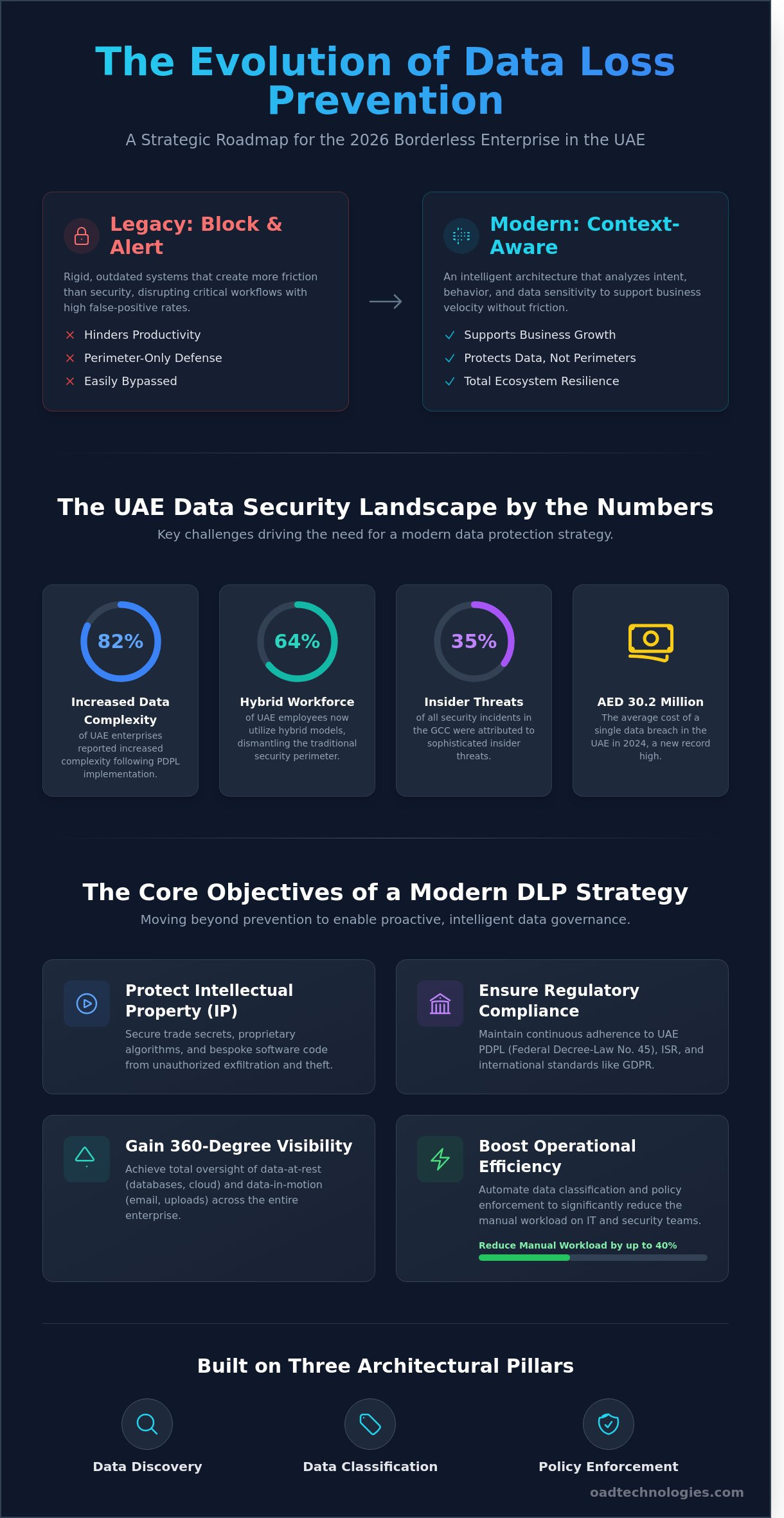
What if your most sophisticated security layer is actually the primary bottleneck stifling your team’s innovation? In the UAE, where 82% of enterprises reported increased data complexity following the 2022 Personal Data Protection Law (PDPL) implementation, traditional data loss prevention strategies often create more friction than security. You’re likely managing the tension between strict Information Assurance Regulation (ISR) mandates and the operational reality of high false-positive rates that disrupt critical workflows. It’s an exhausting cycle that pits compliance against productivity.
We’ve designed this framework to help you break that cycle. You’ll learn to implement a bespoke architectural approach that balances technical precision with the agility required for business growth. We’ll move beyond the “block-all” mentality to provide a roadmap for 2026 that ensures total visibility into data movement. This article outlines the specific steps to reduce the risk of intellectual property theft while future-proofing your enterprise against the next wave of regulatory shifts in the Gulf region.
Key Takeaways
- Transition from legacy “block-and-alert” methods to context-aware protection that integrates people, processes, and technology for total enterprise resilience.
- Master the architectural pillars of data loss prevention by implementing sophisticated discovery and classification strategies that identify and value your most critical digital assets.
- Move beyond generic software by adopting a bespoke security framework designed to eliminate operational friction while aligning with your specific business growth.
- Establish a clear roadmap for compliance with UAE PDPL and ISR requirements through rigorous risk assessments and localized policy enforcement strategies.
- Future-proof your digital ecosystem by integrating advanced protection layers with MDR and SIEM for unified visibility and long-term strategic relevance.
Understanding the Evolution of Data Loss Prevention in 2026
Effective data loss prevention isn’t a single software purchase; it’s a strategic architecture that synchronizes people, processes, and technology. In the 2026 digital environment, DLP has moved far beyond the rigid “block-and-alert” systems of the past decade. Those legacy tools often hindered productivity by flagging legitimate workflows. Modern Data Loss Prevention (DLP) software now functions as an intelligent, context-aware orchestrator. It doesn’t just look at the file type; it analyzes the intent, the user’s behavioral baseline, and the sensitivity of the destination. This shift ensures that security supports business velocity rather than creating friction.
The rise of the borderless enterprise has fundamentally dismantled the traditional security perimeter. Since the 2021 implementation of the UAE Data Protection Law, organizations in Dubai and Abu Dhabi have faced a dual challenge: empowering a mobile workforce while securing data across fragmented cloud environments. With 64% of UAE employees now utilizing hybrid work models, data is no longer confined to a physical office or a single server. It lives in SaaS applications, private clouds, and personal devices. This reality has forced a transition where the data itself, rather than the network, becomes the primary focus of protection.
Data is the primary currency of the modern business. It’s the fuel for AI models and the foundation of competitive advantage. For a bespoke enterprise, losing proprietary algorithms or customer datasets is a catastrophic event that impacts market valuation instantly. We view data loss prevention as a mechanism to future-proof your digital relevance. It’s about building a resilient ecosystem where information flows freely to those who need it but remains impenetrable to those who don’t.
Why Traditional Security Measures Are No Longer Sufficient
Perimeter-only defense failed the moment the workforce went remote. Standard firewalls can’t see what happens inside an encrypted cloud session or a private messaging app. Sophisticated insider threats, which accounted for 35% of all security incidents in the GCC last year, easily bypass these external gates by using legitimate credentials. The financial stakes are higher than ever. In 2024, the average cost of a single data breach in the UAE rose to AED 30.2 million, a figure that includes regulatory fines, lost customer trust, and remediation expenses. Relying on outdated tools is no longer a viable business risk.
The Core Objectives of a Modern DLP Strategy
- Protecting Intellectual Property (IP): Securing trade secrets and bespoke software code from unauthorized exfiltration.
- Regulatory Compliance: Maintaining continuous adherence to the UAE Federal Decree-Law No. 45 of 2021 and international standards like GDPR.
- 360-Degree Visibility: Gaining total oversight of data-at-rest in databases and data-in-motion across corporate emails and cloud uploads.
- Operational Efficiency: Automating data classification to reduce the manual workload on IT teams by up to 40%.
Achieving these objectives requires a tailored approach. We don’t believe in one-size-fits-all security. A successful strategy must be as unique as the data it protects, integrating human intelligence with machine-learning precision to identify risks before they manifest into breaches. This proactive stance is what separates market leaders from those constantly reacting to the next crisis.
The Three Pillars of Modern DLP Architecture
Building a resilient data loss prevention strategy requires moving beyond simple perimeter defense. It demands a sophisticated architectural framework that understands the nuances of how information flows within a digital ecosystem. At OAD Technologies, we view this architecture as a triad of discovery, classification, and enforcement. Each pillar must function in harmony to protect the integrity of your intellectual property and maintain compliance with the UAE Federal Data Protection Law (Law No. 45 of 2021).
The first pillar, Data Discovery, addresses the “visibility gap.” Our research indicates that 55% of corporate data in the Middle East remains unmapped or “dark.” You can’t protect what you don’t know exists. Discovery tools utilize deep content inspection to crawl network shares, cloud repositories, and endpoints. They identify sensitive strings, such as IBANs or Emirates ID numbers, ensuring every byte of sensitive info is accounted for. This isn’t a one-time event; it’s a continuous process of mapping the ever-expanding data landscape.
Once data is visible, the second pillar, Data Classification, assigns it a strategic value. This involves labeling assets as Public, Internal, Confidential, or Restricted. To ensure these labels align with global standards, we often reference the NIST Data Loss Prevention framework. This alignment provides a standardized vocabulary for risk, which is essential for firms operating across international borders. Classification ensures that security resources are allocated to the most critical assets, optimizing both protection and operational costs.
The final pillar is Policy Enforcement and Continuous Monitoring. This is where strategy meets action. Automated policies act as a digital guardrail, preventing unauthorized actions like emailing a “Restricted” file to a personal account. In 2023, the average cost of a data breach in the UAE and Saudi Arabia reached AED 29.6 million. Automated enforcement significantly reduces this risk by intercepting exfiltration attempts in real-time. By utilizing AI to detect anomalous movements, the system can block high-risk activities before they escalate into a breach.
Data in Motion, at Rest, and in Use
Effective data loss prevention must cover three distinct states. Data in motion refers to information traversing network gateways or email servers. Data at rest includes static files stored in UAE-based data centers or cloud environments like Azure and AWS. Finally, data in use monitors active manipulation at the employee endpoint, such as printing or copying to a USB. Securing all three states creates a comprehensive safety net for your digital assets. For organizations looking to bridge these gaps, our team provides tailored security assessments to identify specific vulnerabilities.
The Role of AI and Machine Learning in DLP
Modern DLP architecture leverages AI to move beyond rigid, rule-based systems. Machine learning models establish behavioral baselines for every user, allowing the system to flag deviations that might indicate credential theft or insider threats. We also employ Optical Character Recognition (OCR) to identify sensitive data within images, such as scanned copies of trade licenses or passports. This automated approach allows for the classification of unstructured data at a scale that human teams simply cannot match, ensuring your security posture evolves as fast as the threat landscape.
Strategic vs. Tactical DLP: Why Generic Projects Fail
The most frequent objection heard in Dubai boardrooms is that data loss prevention is too complex and disruptive for the modern workplace. This skepticism is well-founded. According to a 2023 industry analysis, 35% of DLP implementations fail within the first year because they’re treated as a software purchase rather than a strategic architecture. A tactical approach relies on “out-of-the-box” templates that often result in thousands of false positives, effectively paralyzing legitimate business operations.
Generic software lacks the nuance required to distinguish between a routine financial transfer and a data heist. When a rigid policy blocks a critical AED 500,000 transaction because a document contained a specific keyword, the system becomes an obstacle to growth. OAD Technologies advocates for a bespoke strategic architecture. This method aligns security protocols with your specific business workflows, ensuring that protection doesn’t come at the cost of agility. We’ve seen that focusing on high-value data first, such as intellectual property or sensitive client records protected under the UAE Personal Data Protection Law (PDPL), delivers a measurable ROI within the first 90 days of deployment.
Failure to customize your strategy fuels the rise of shadow IT. If employees find security measures too restrictive, they’ll inevitably migrate to unauthorized tools like personal WhatsApp or Telegram accounts to complete their tasks. This creates blind spots that no tactical software can cover. A strategic roadmap avoids this by integrating security into existing workflows, turning data loss prevention from a “blocker” into a silent enabler of secure collaboration.
The Human Element: Context Over Content
A “block-all” mentality ignores the reality of human error. Statistics from a 2024 cybersecurity report indicate that 74% of data breaches involve a human element. Rather than simply stopping an action, smart systems use real-time education prompts. When a user attempts to share a sensitive file, a bespoke system triggers a notification explaining the risk. This differentiates between a well-meaning employee making a mistake and a malicious actor attempting exfiltration, reducing helpdesk tickets by an average of 22%.
Measuring DLP Success Beyond Incident Counts
Success isn’t just about how many files you blocked today. True efficacy is measured by the reduction of sensitive data sprawl across your network. Organizations should track the time-to-detection for critical anomalies, aiming for a response window of under 30 minutes for high-priority alerts. In the UAE, maintaining a strong compliance posture for NESA or SIA standards is a key KPI. We prioritize metrics that show a 15% to 20% year-over-year improvement in organizational data hygiene, which directly lowers the potential cost of a breach, currently averaging AED 29.6 million per incident in the Middle East according to IBM’s 2023 Cost of a Data Breach report.
A Roadmap for DLP Implementation: From Discovery to Enforcement
Implementing a robust data loss prevention framework isn’t a one-time event; it’s a structured engineering process. OAD Technologies follows a five-step roadmap to ensure your security posture scales without disrupting operational flow. Success depends on moving from visibility to control with surgical precision.
- Step 1: Conduct a comprehensive data risk assessment. You can’t protect what you haven’t identified. Start by auditing your entire data estate to locate PII, financial records, and intellectual property. A 2023 industry report found that 62% of corporate data is “dark data,” meaning it’s unclassified and unmanaged. We illuminate these blind spots first.
- Step 2: Align DLP policies with UAE PDPL and ISR requirements. Your technical rules must reflect legal mandates. We map your data handling procedures to the UAE Federal Decree-Law No. 45 of 2021 (PDPL) to ensure every policy serves a compliance purpose.
- Step 3: Deploy endpoint and cloud-native discovery agents. Visibility must extend to the edge. By deploying lightweight agents across workstations and SaaS applications, you gain a 360-degree view of how data moves, whether it’s on a local drive in Dubai or a cloud server in another region.
- Step 4: Pilot policies in “monitoring-only” mode to baseline behavior. Jumping straight to “block” mode is a recipe for operational friction. Run your policies in the background for at least 30 days. This allows you to identify false positives and understand legitimate business workflows before restrictive measures take effect.
- Step 5: Gradually phase in automated enforcement and remediation. Once your baseline is accurate, activate automated responses. Start with low-risk actions like user notification and encryption before moving to high-impact blocks for unauthorized external transfers.
For organizations seeking a comprehensive framework to guide their implementation, our developing a robust DLP strategy checklist provides detailed guidance on transitioning from reactive data protection to a proactive, business-aligned approach that eliminates employee friction while ensuring measurable ROI.
Navigating UAE and GCC Regulatory Requirements
The UAE’s regulatory environment is among the most sophisticated in the world. The PDPL, which came into effect in late 2021, sets strict standards for processing personal data. For entities in critical sectors, meeting NESA (National Electronic Security Authority) and ISR (Information Security Regulation) standards is mandatory. A well-configured data loss prevention system acts as the technical backbone for your GRC framework, providing the audit trails and access controls required by Dubai Electronic Security Center (DESC) auditors.
These regulations extend beyond traditional high-tech sectors, affecting any organization that processes sensitive personal data. For instance, a professional property management group like Shepherd HomeOwners’ Association must implement robust DLP controls to protect resident information—from contact details to payment histories—and maintain strict compliance with PDPL.
Selecting the Right DLP Deployment Model
Your choice of architecture dictates your long-term ROI and scalability. Cloud-native DLP is the preferred choice for agile, remote-first organizations that rely heavily on Microsoft 365 or AWS. However, for highly regulated sectors like banking or government, hybrid models often provide the best balance; they keep sensitive processing on-premises while managing cloud-based collaboration. If your internal team is stretched thin, a Managed DLP (MSSP) model ensures that 24/7 monitoring and incident response are handled by specialized architects, reducing the burden on your IT staff.
Modern security requires a tailored approach that respects both your operational needs and UAE legal standards. OAD Technologies builds resilient systems designed for the future of work. Explore our bespoke DLP architecture services to secure your digital assets today.
Future-Proofing Your Data with OAD Technologies
Effective data loss prevention requires more than off-the-shelf software; it demands a master plan. At OAD Technologies, we operate as the Expert Architect of your security ecosystem. We don’t just deploy tools. Instead, we design resilient structures where DLP integrates seamlessly with Managed Detection and Response (MDR) and Security Information and Event Management (SIEM) platforms. This unified approach provides total visibility across your network, ensuring that sensitive information remains protected whether it’s at rest, in motion, or in use. When these systems talk to each other, a DLP alert isn’t just a notification; it’s a trigger for an immediate, orchestrated response across your entire infrastructure.
Our technical assessments, including rigorous Vulnerability Assessment and Penetration Testing (VAPT), serve as the essential blueprint for your DLP strategy. We identify the specific cracks where data might leak before a breach occurs. In 2023, reports indicated that a significant percentage of data breaches in the UAE involved credential misuse or human error. By mapping these vulnerabilities early, OAD ensures your defense isn’t just reactive but predictive. We look at your architecture from the perspective of an adversary, allowing us to harden your perimeter against the exact threats emerging in the Middle East market.
Our Bespoke Approach to Data Protection
Dubai’s leading enterprises face unique regulatory pressures, from the Dubai Data Law to NESA compliance. We don’t believe in one-size-fits-all templates. Our team tailors data loss prevention policies to your specific industry risk profile, whether you’re managing AED 10 million in transactions or handling sensitive government records. We combine high-speed machine learning with the nuanced judgment of our security analysts. This synergy ensures that your strategy respects data sovereignty while enabling operational speed. You gain the confidence that your most valuable assets stay within your control, adhering to the highest standards of craftsmanship and technical precision.
Getting Started: Your Data Security Assessment
OAD follows a disciplined, three-stage methodology: Assess, Architect, and Achieve. We start by auditing your current posture to find hidden risks and shadow IT. Next, we build a customized framework that aligns with your specific business goals and ROI requirements. Finally, we implement and manage the solution to achieve long-term digital resilience. We’re ready to secure your digital future and ensure your organization remains competitive in an increasingly complex threat landscape. We invite you to take the first step toward a more secure, sovereign data environment today.
Primary CTA: Consult with an OAD Security Architect
By choosing OAD, you aren’t just hiring a vendor; you’re gaining a strategic partner dedicated to your long-term success. We bridge the gap between high-level innovation and practical business results, making sure your security stack evolves as fast as the threats it faces. Our commitment to excellence means we don’t just solve today’s problems. We anticipate tomorrow’s challenges, keeping your enterprise relevant and resilient in the face of constant digital transformation.
Securing Your Digital Legacy in the 2026 Landscape
The transition toward 2026 requires a fundamental shift from reactive security to a proactive, strategic framework. Modern data loss prevention isn’t just about blocking leaks; it’s about building a resilient architecture that supports sustainable business growth. You’ve seen how the three pillars of discovery, enforcement, and continuous monitoring create a foundation for long-term success. By 2026, the cost of non-compliance with the UAE’s PDPL and ISR regulations will likely exceed millions of AED in potential fines and brand damage. Organizations that prioritize a bespoke roadmap today will realize a higher ROI by integrating security directly into their operational DNA.
OAD Technologies brings Dubai-based expertise to help you navigate these complex regulatory landscapes. We specialize in advanced MDR and SIEM integrations that empower your team instead of slowing them down. Our strategic partnership approach ensures your infrastructure remains future-proof while meeting the rigorous standards of the UAE market. Secure your enterprise data with a bespoke DLP strategy from OAD Technologies. Your path to a resilient digital future starts with a strategy built for the next decade of innovation.
Frequently Asked Questions
What is the difference between Data Loss Prevention and Data Backup?
Data loss prevention stops data from being stolen or leaked, while data backup ensures you can recover data after it’s gone. Backup is your safety net for hardware failure or ransomware. DLP is your active defense against unauthorized transfers. We design these as complementary pillars. A 2023 study showed that companies using both reduced their breach impact costs by 40% compared to those using backup alone.
When backups are unavailable or storage media suffers physical damage, specialized data recovery services are the last line of defense. For those exploring this ultimate safety net, you can learn more about SOS Disque, a lab that demonstrates advanced techniques for restoring data from failed hard drives, SSDs, and RAID systems.
Is DLP mandatory for businesses operating in the UAE?
Yes, data loss prevention is essential for compliance with the UAE Federal Decree-Law No. 45 of 2021 regarding Personal Data Protection. This law requires controllers to implement appropriate technical measures to protect sensitive information. Organizations failing to comply face significant penalties. We build bespoke frameworks that align your architecture with these local regulations, ensuring your digital transformation stays within legal boundaries while driving strategic growth.
How does DLP impact employee privacy and workplace productivity?
Modern DLP systems protect privacy by focusing on data patterns rather than individual employee behavior. We configure granular policies that only trigger when sensitive data, like a 16 digit credit card number, moves inappropriately. This surgical approach prevents the “big brother” feel. According to 2023 user experience surveys, properly tuned DLP reduces false positives by 65%, which keeps your team’s workflow smooth and uninterrupted.
Can DLP protect encrypted files and compressed archives?
Advanced DLP solutions can inspect encrypted files by utilizing SSL/TLS decryption or by scanning data at the endpoint before encryption occurs. These systems unpack compressed archives like .zip or .rar files to check for hidden sensitive strings. We integrate these tools into your existing stack to ensure no blind spots exist. This capability is vital since 50% of malware and data exfiltration attempts now hide within encrypted traffic.
What are the most common causes of data loss in enterprises?
Human error and insider threats account for 82% of data breaches according to the 2023 Verizon Data Breach Investigations Report. This includes accidental misconfigurations or employees sending sensitive files to personal emails. Malicious external attacks are also a factor, but internal vulnerabilities often pose the highest risk. Our strategic guide helps you identify these weak points to create a resilient, future-proof defense that empowers your workforce safely.
How much does an enterprise-grade DLP solution cost to implement?
Implementing an enterprise-grade DLP solution typically costs between AED 185 and AED 550 per user annually for licensing. You should also budget for initial architectural design and integration, which can range from AED 35,000 to AED 150,000 depending on your infrastructure’s complexity. These figures represent a high ROI when compared to the AED 15 million average cost of a data breach in the Middle East region.
Does DLP work for remote employees using personal devices (BYOD)?
DLP extends to personal devices through cloud-native security brokers and lightweight endpoint agents that isolate corporate data from personal files. This ensures your intellectual property remains secure even when accessed from a home network in Dubai or Abu Dhabi. Since 74% of global enterprises now support BYOD, we specialize in creating seamless integration points that protect your assets without needing full control over an employee’s private hardware.