
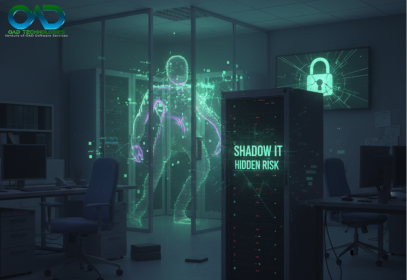
In today’s hyper-connected workplace, innovation moves fast — and employees move even faster. New cloud apps, AI tools, collaboration platforms, and automation services appear daily. If internal systems feel slow, restrictive, or outdated, teams naturally look elsewhere.
And that’s exactly where Shadow IT begins.
On the surface, it looks harmless:
A team signs up for a free project tool…
Someone sends a file through personal Gmail “because it’s quick”…
A department stores documents on an unapproved cloud drive…
Individually these look like small shortcuts.
Collectively, they form one of the biggest hidden cybersecurity threats facing modern organizations.
This article — with insights from OAD Technologies’ cybersecurity practice — explains what Shadow IT really is, why it’s growing, and how enterprises across the UAE, GCC, and beyond can take back control without slowing down business productivity.
What Is Shadow IT?
Shadow IT refers to any technology used inside an organization without approval from IT or security teams.
This includes:
- Personal email accounts used for business communication
- Unapproved cloud storage (Dropbox, Mega, Google Drive, iCloud)
- Free/Trial software installations
- Personal mobile devices accessing corporate systems
- Unknown browser extensions
- Unmonitored note-taking apps
- Unauthorized VPNs running inside the network
- AI tools or chatbots used without reviewing their data policies
If company data is stored, shared, or processed outside the secure corporate environment, it becomes Shadow IT — and a potential threat.
The real issue?
IT cannot protect what it cannot see.
Why Shadow IT Happens (And Why Employees Aren’t the Problem)
Shadow IT isn’t created out of carelessness. It grows because employees are trying to work better, faster, and smarter.
1. Official tools feel slow or outdated
Employees turn to modern, easy-to-use alternatives.
2. Restrictions hinder productivity
Overly rigid systems push users to bypass them.
3. Lack of awareness
Employees simply don’t understand the security impact.
4. Pressure to meet deadlines
Teams choose whatever completes the job quickly.
5. Missing capabilities in existing solutions
If the approved tools can’t do something, employees find tools that can.
6. Explosion of cloud apps and AI tools
“Everyone uses it, so it must be safe” — the most dangerous assumption.
At OAD Technologies, we always emphasize:
Shadow IT is not just a technology issue — it’s a business workflow issue.
The Hidden Dangers of Shadow IT (Bigger Than Most Leaders Realize)
Shadow IT grows silently. By the time companies detect it, it has already introduced risk across the organization.
1. Cybersecurity Vulnerabilities
Unapproved apps are unmonitored, unpatched, and unsecured.
This leads to:
- Weak passwords or no MFA
- Unencrypted files
- Data stored on foreign servers
- Public sharing links
- Unknown API connections
- Malware or data harvesting extensions
- Exposure to ransomware & phishing
Attackers love Shadow IT — it creates blind spots that bypass all corporate defenses.
2. Compliance Violations (UAE & Global Standards)
Industries must adhere to strict frameworks such as:
-
- ISO 27001
- NESA / ADSIC / DESC (UAE)
- GDPR
- HIPAA
- PCI DSS
- SOC 2
Shadow IT breaks:
- Logging
- Monitoring
- Data residency
- Privacy
- Access control
- Reporting
- Audit trails
A single unapproved app can cause:
- Legal penalties
- Contract breach
- Loss of certifications
- Reputational damage
- Loss of client trust
For many organizations, compliance risk is more dangerous than cyber-attacks.
3. Data Loss and No Recovery Options
Shadow IT rarely includes backups or retention.
If an employee:
-
- Leaves the company
- Deletes a file
- Loses a device
- Cancels a subscription
Critical business data can disappear permanently.
4. Wasted Budgets & Tool Duplication
Multiple teams may be paying for:
- Duplicate apps
- Personal licenses
- Overlapping SaaS tools
This leads to uncontrolled spending and operational chaos.
At OAD, we often find companies unknowingly paying for 10–20 redundant tools simply due to lack of visibility.
5. Weak Identity & Access Controls
Most Shadow IT platforms lack:
- MFA
- SSO integration
- Encryption
- Role-based access
This means:
- Ex-employees may still have access
- External parties may view sensitive data
- No logs exist for investigations
This directly conflicts with Zero Trust principles.
How OAD Technologies Helps Organizations Regain Control (Without Killing Productivity)
Shadow IT cannot be fixed by blocking everything.
The OAD approach combines visibility, modernization, user empowerment, and Zero Trust principles.
Step 1: Conduct a Comprehensive Shadow IT Discovery Audit
Using advanced security tools, OAD helps you identify:
- Unapproved cloud services
- Unknown devices
- Risky browser extensions
- External data flows
- Unauthorized SaaS usage
- Suspicious access patterns
Visibility is the first step toward control.
Step 2: Understand Employee Needs & Workflow Gaps
OAD works with your departments to discover:
- Why they use unofficial tools
- What capabilities they lack
- Where productivity bottlenecks occur
Often, teams choose Shadow IT because it solves a real business need.
We identify these gaps and help design safer, approved alternatives.
Step 3: Modernize and Strengthen Approved IT Tools
If tools are outdated, employees will bypass them — always.
OAD helps organizations upgrade to:
- Modern secure cloud platforms
- Integrated collaboration tools
- Faster, more intuitive systems
- AI-assisted workflows
- Feature-rich productivity suites
When tools work well, employees stop going outside the system.
Step 4: Implement Strong Identity & Access Controls
OAD deploys corporate-grade controls such as:
-
- Zero Trust Architecture
- Multi-factor authentication (MFA)
- Device encryption
- Network segmentation
- Role-based access
- Secure BYOD policies
These remove risks even when employees work remotely or across cloud platforms.
Step 5: Real-Time Monitoring & DRP (Digital Risk Protection)
OAD’s DRP and monitoring solutions detect:
- Unauthorized app usage
- Data leakage attempts
- High-risk user behavior
- Compromised devices
- Suspicious cloud traffic
- Credential misuse
This ensures security is continuous, automated, and proactive.
Step 6: Turn Employees Into Cyber Defenders
We provide engaging, practical training that helps teams understand:
- Why some apps are unsafe
- How data leaks happen
- How AI tools handle corporate data
- How to use approved tools securely
- Why personal apps shouldn’t be used for work
A trained employee is not a risk —
they are your strongest security asset.
Step 7: Establish a Clear, Simple Shadow IT Policy
OAD helps organizations build a policy that outlines:
-
- Approved tools
- Prohibited tools
- Data handling rules
- How to request new software
- Employee responsibilities
- Cyber hygiene guidelines
The goal:
Clarity, not complexity.
The Future of Shadow IT: A Hybrid, Cloud-Driven Challenge
As UAE businesses continue to adopt:
- Remote work
- AI-driven productivity tools
- BYOD practices
- Cloud-first strategies
- Contractor-based work models
Shadow IT will continue to evolve.
The answer is not to restrict innovation but to create an environment where security and productivity work together.
This is exactly the vision behind OAD Technologies’ Zero Trust–driven cybersecurity framework.
Final Thoughts: Control Shadow IT Early — Protect Your Digital Future
Shadow IT isn’t a small issue.
It’s an invisible ecosystem that:
- Exposes sensitive data
- Breaks compliance
- Increases cybersecurity risk
- Wastes money
- Weakens operational control
But with the right partners and strategy, organizations can transform this challenge into a predictable, manageable, secure environment.
At OAD Technologies, we help businesses:
 Discover Shadow IT
Modernize official tools
Deploy Zero Trust Architecture
Strengthen access control
Educate employees
Implement DRP and monitoring
Build clear governance frameworks
Shadow IT becomes dangerous only when ignored.
Control it early — and you protect your organization’s data, reputation, trust, and long-term digital strategy.